


Dispensing With Enquiry Without Objective Material Unlawful: Manipur HC
 Copy Link
 Share
 Save
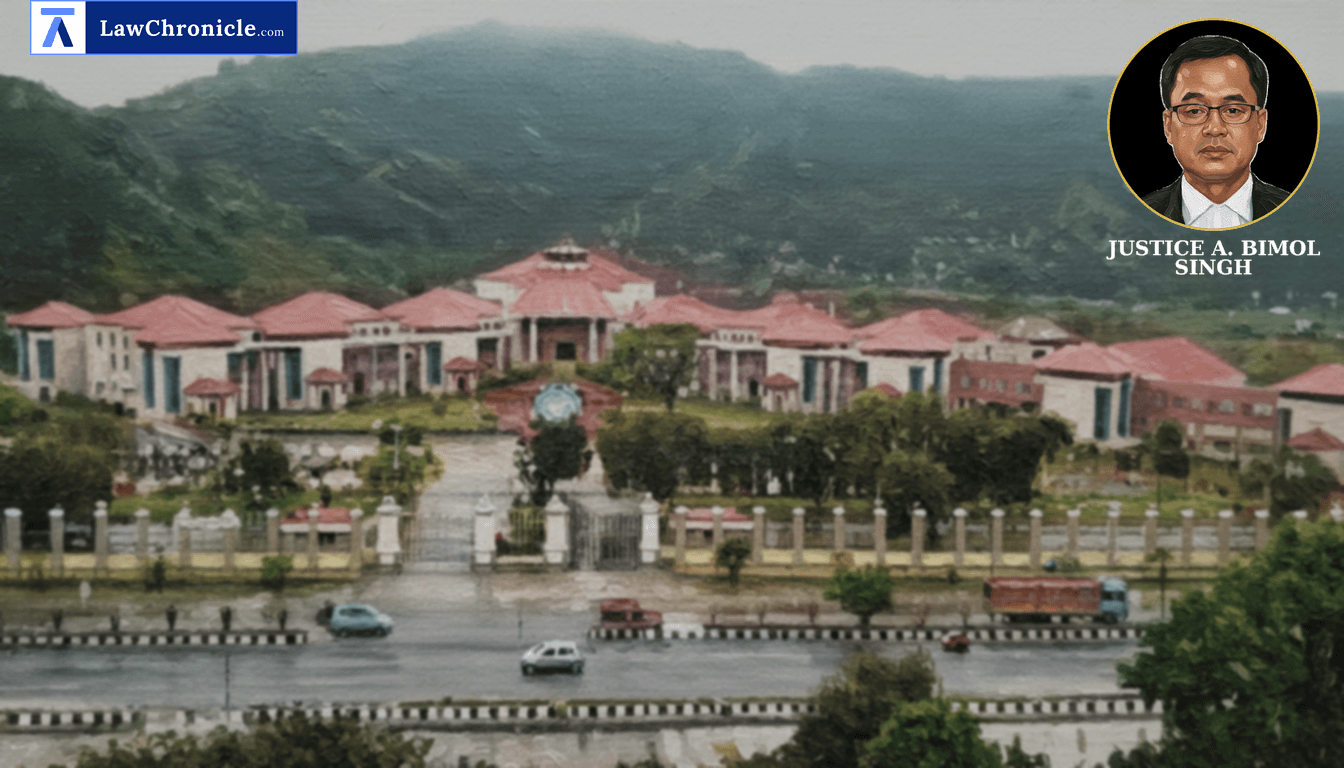
Arbitrary dismissal of force personnel without a departmental enquiry cannot be sustained under the guise of witness intimidation without tangible proof. Rebuking summary terminations based on subjective assumptions, the High Court quashed the dismissal of a CISF constable and ordered his immediate reinstatement with full consequential benefits.
In a recast writ petition, a Single Judge Bench comprising Justice Ahanthem Bimol Singh evaluated the validity of a summary dismissal executed under special statutory provisions without holding a mandatory departmental inquiry.
Key Takeaways
Subjective Fear Cannot Override Enquiry: Authorities cannot dispense with a disciplinary inquiry by merely claiming a sense of fear among witnesses without recording objective, verifiable facts.
Constable Cannot Intimidate Superior Officers: Dispensing with an inquiry on grounds of witness intimidation is legally unsustainable when the primary witnesses are senior officers whom a suspended constable cannot realistically intimidate.
Acquittal in Criminal Trial Impact: Acquittal of the delinquent employee in a parallel criminal prosecution undermines the claim that witnesses were too terrified to depose in departmental proceedings.
Partial Cause of Action Suffices: Communicating rejection orders or appellate decisions to the permanent residential address of the petitioner confers territorial jurisdiction upon the local High Court under Article 226(2).
Invalidation of Summary Dismissal
The High Court scrutinised the invocation of Rule 39(ii) of the CISF Rules, 2001, which permits authorities to dispense with an inquiry if it is not reasonably practicable to hold one. The Court held that subjective satisfaction recorded by the disciplinary authority was contrary to the record and unsupported by independent material.
The Court has following directions:
"For the findings and reasons given hereinabove, the present writ petition is allowed by quashing and setting aside the impugned orders dated 25-09-2009 and 30-12-2009. The respondents are further directed to reinstate the petitioner in service forthwith with all consequential benefits."
The Court, in its reasoning, observed:
"In my considered view, the subjective satisfaction recorded in paragraphs 7 & 8 of the impugned dismissal order is contrary to the materials available on record and the said reasons are not fortified by any independent material to justify the dispensing of the enquiry envisaged under Rule 36 of the CISF Rules and accordingly, I am of the considered view that on this ground alone, the impugned orders cannot be sustained."
Ratio
The power to dispense with a departmental inquiry under statutory service rules or the second proviso to Article 311(2) of the Constitution of India cannot be exercised on the mere ipse dixit or subjective assertion of the disciplinary authority. Such dispensation must be supported by independent, objective facts demonstrating that holding an inquiry is genuinely not reasonably practicable; otherwise, the dismissal order remains arbitrary, legally unsustainable, and subject to judicial invalidation.
Background
The petitioner, a Constable in the Central Industrial Security Force (CISF), was posted in Assam. In September 2007, during a surprise check, he was allegedly found absent from his duty post, under the influence of alcohol, and smoking. When brought to the barracks, he allegedly lost his temper, aimed his rifle at an Assistant Commandant, and fired four rounds during a scuffle, injuring a driver constable.
An FIR was registered, but the petitioner was ultimately acquitted of all criminal charges by the competent court. However, the disciplinary authority dismissed him from service vide order dated 25-09-2009 by resorting to Rule 39(ii) of the CISF Rules, 2001, completely bypassing the departmental inquiry prescribed under Rules 36, 37, and 38. His departmental appeal was rejected on 30-12-2009.
The petitioner challenged his dismissal before the High Court. The respondents raised preliminary objections regarding territorial jurisdiction and the non-exhaustion of the statutory remedy of revision under Section 9(2-A) of the Central Industrial Security Force Act, 1968 read with Rule 54 of the CISF Rules, 2001. The Court rejected both preliminary objections, relying on Nawal Kishore Sharma Vs. Union of India & ors. ( "(2014) 9 SCC 329": 2014 CaseBase(SC) 366) to affirm territorial jurisdiction under Article 226(2) of the Constitution of India because the appellate rejection order was communicated to his Manipur address, and noting that his pending representation to the Director General, CISF served as a valid invocation of revisional powers.
On the merits, the petitioner relied on precedents including Jaswant Singh V. State of Punjab & ors. ( "(1991) 1 SCC 362": 1990 CaseBase(SC) 37) and Chief Security Officer & ors. Vs. Singasan Rabi Das ( "(1991) 1 SCC 729": 1991 CaseBase(SC) 3) to argue that inquiry cannot be dispensed with lightly. Conversely, the respondents cited decisions like Thansingh Nathmal & ors. Vs. The Superintendent of Taxes, Dhubri & ors. ( "AIR 1964 SC 1419": 1964 CaseBase(SC) 405), Roshan Thakuri Vs. Union of India & ors., Manojit Ghosh Vs. Union of India & ors., and Sahadeo Singh & ors. Vs. Union of India & ors. ( "(2003) 9 SCC 75": 2003 CaseBase(SC) 704) to contend that courts should not re-appreciate the adequacy of reasons recorded for dispensing with inquiries. The High Court distinguished the respondents' citations by placing reliance on U.P. State Electricity Board Vs. Pooran Chandra Pandey & ors., which emphasizes that precedents must be understood in the context of their specific facts. Observing that the eyewitnesses were senior officers whom a suspended constable could not reasonably intimidate, and noting that those witnesses had in fact testified during the criminal trial, the High Court quashed the dismissal and appellate orders.
Case Details:
Case No.: WP(C) No. 942 of 2016
Case Title: Tensubam Khomei Singh v. Union of India & Ors.
Appearances:
For the Petitioner(s): Mr. Kh. Tarunkumar, Sr. Advocate asstd. by Mr. W. Jamon, Advocate
For the Respondent(s): Mr. W. Darakeshwor, Sr. Panel counsel
Source: 2026 CaseBase(MAN) 4
Similar Articles
 Breaking News


