


Madras HC: Criminal Acquittal Does Not Bar Motor Accident Compensation
 Copy Link
 Share
 Save
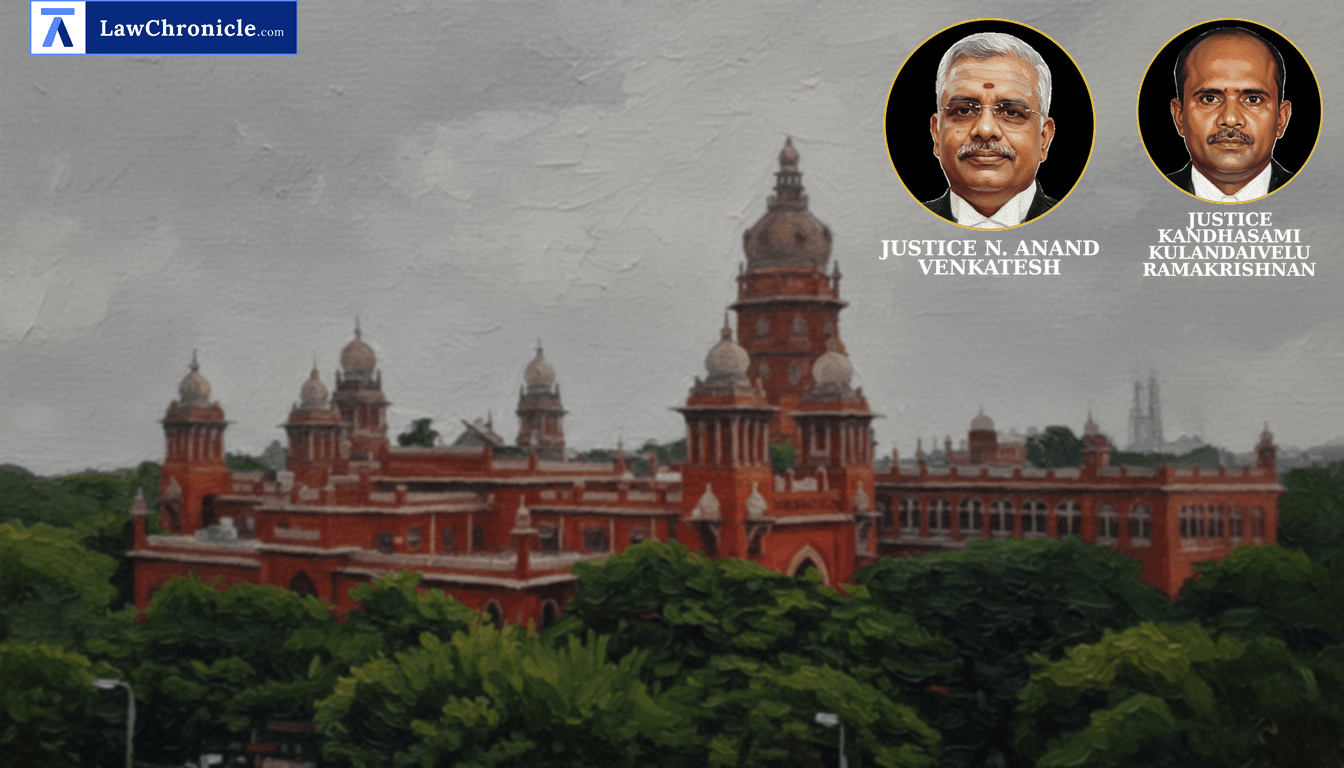
The Madras High Court clarified that the standards of proof in motor accident claims are distinct from criminal trials, emphasizing that an acquittal in a criminal case does not automatically negate civil liability.
A division bench comprising the Hon’ble Justice N. Anand Venkatesh and the Hon’ble Justice K.K. Ramakrishnan heard an appeal filed by an insurance company challenging an award passed by the Motor Accident Claims Tribunal. The appellant contended that the offending vehicle was not involved in the accident, relying on the fact that the driver was acquitted in a connected criminal case and that a key eyewitness was not examined by the police during the initial investigation.
The Court has the following directions:
"The appellant–Insurance Company is directed to deposit the entire award amount, together with accrued interest and costs, after deducting the amount, if any, already deposited, within a period of six weeks from the date of receipt of a copy of this judgment. On such deposit, the claimants are permitted to withdraw their respective shares of the award amount, together with proportionate interest and costs, in terms of the apportionment made by the Tribunal, after due adjustment of any amount already withdrawn."
Standard of Proof in Motor Accident Claims
The Court highlighted that proceedings under Section 166 of the Motor Vehicles Act, 1988 are summary in nature. Unlike criminal trials which require proof beyond a reasonable doubt, motor accident claims are decided on the touchstone of preponderance of probabilities. The bench noted that technicalities should not outweigh the beneficial object of the legislation.
The Court, in its reasoning, observed: "The Hon'ble Supreme Court has consistently held that proceedings under Section 166 of the Motor Vehicles Act are summary in nature and that the claimants are only required to establish their case on the touchstone of preponderance of probabilities. The strict standard of proof applicable to criminal trials, namely proof beyond reasonable doubt, has no application to claim proceedings before the Motor Accident Claims Tribunal."
Reliability of Witnesses Not Examined by Police
Addressing the insurer's argument regarding the non-examination of a witness by the Investigating Officer, the bench noted that such omissions do not render the testimony inadmissible. Relying on Kusum Lata v. Satbir ( "(2011) 3 SCC 646": 2011 CaseBase(SC) 385) and Anita Sharma v. New India Assurance Co. Ltd. ( "(2021) 1 SCC 171": 2020 CaseBase(SC) 1320), the Court stated that the Tribunal must independently assess witness credibility. If the testimony inspires confidence and is otherwise trustworthy, it can be safely relied upon even if the witness was not cited in the criminal case.
Background:
The dispute arose from a 2013 accident where a school teacher died after his two-wheeler was hit by a vehicle allegedly driven in a rash and negligent manner. While the police initially filed a final report against the driver, the criminal court later acquitted him, giving him the benefit of doubt regarding his identity. The Insurance Company relied on Reshma Kumari and Others v. Madan Mohan and Another ( "2013 (1) TN MAC 481 (SC)": 2013 CaseBase(SC) 254) to argue that the claimants failed to establish foundational facts.
However, the High Court observed that the owner's attempt to shift responsibility in the criminal case likely aimed to avoid the statutory consequences of the driver lacking a valid license. The Court referred to Bimla Devi v. Himachal Road Transport Corporation ( "(2009) 13 SCC 530": 2009 CaseBase(SC) 631), Mangla Ram v. Oriental Insurance Co. Ltd., Sunita v. Rajasthan State Road Transport Corporation ( "(2020) 13 SCC 486": 2019 CaseBase(SC) 2094), and Parmeshwari v. Amir Chand ( "(2011) 11 SCC 635": 2011 CaseBase(SC) 909) to reiterate that claimants only need to establish a probable case. It also cited Janabai v. ICICI Lambord Insurance Co. Ltd., Laxmi Gontiya and another v. Nand Lal Tahalramani and others, and Raju v. Sardar Singh and another, where it was held that the absence of a registration number in an FIR is not fatal to a claim if the involvement is otherwise established.
Citing Ramasamy v. National Insurance Co. Ltd. and New India Assurance Co. Ltd. v. Kiran Singh & others, the Court emphasized that insurance companies act as trustees of the public and should not routinely contest genuine claims. Ultimately, the High Court dismissed the appeal, confirming the Tribunal's award of Rs. 48.94 Lakhs and the "pay and recover" liberty.
Case Details:
Case No.: C.M.A.(MD).No.54 of 2023
NeutralCitation: 2026:MHC:2292
Case Title: M/s. Shree Ram General Insurance Co., Ltd. v. Daniel and Others
Appearances:
For the Petitioner(s): Mr. D. Sivaraman
For the Respondent(s): Mr. A. John Vincent (R1 & R2), Mr. R. Arun Raj (R3)
Source: 2026 CaseBase(MAD) 300
Similar Articles
 Breaking News


