


Madras HC: Dignity Not Privilege, Residence Most Intimate Right
 Copy Link
 Share
 Save
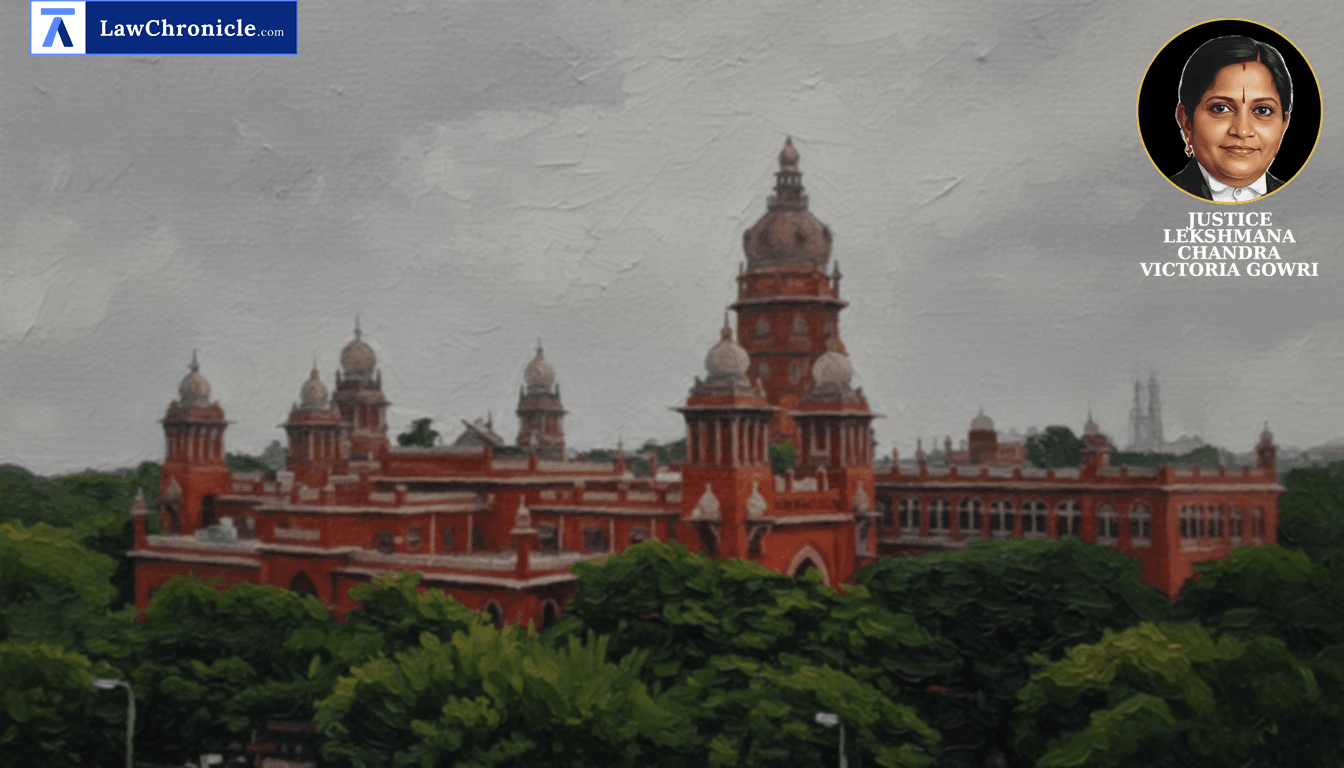
The Madras High Court held that dignity is not a privilege, but a right, and the right to residence is its most intimate expression. The Court further observed that any act seeking to dismantle that dignity, without the sanction of law, would invite the firmest response from the Court. A single-judge bench of Justice L. Victoria Gowri heard a writ petition challenging alleged unlawful demolition and dispossession of a lone woman’s dwelling and directed immediate remedial measures and a criminal probe. The petition raised questions about the State’s duty to protect vulnerable citizens and the limits of actions taken following a police-facilitated survey.
The Court, in its decision summary, held that the demolition could not be justified by a survey and that the State machinery could not remain a passive spectator when a citizen was rendered homeless.
The Court, in its reasoning, observed: "At the outset, this Court must emphasise that the right to property, though no longer a fundamental right, continues to be a valuable constitutional right under Article 300A of the Constitution of India, 1950. No person can be deprived of property except by authority of law." The court therefore directed restoration of the demolished structure, compensation and a time-bound criminal investigation.
Background
The petitioner, a separated woman working as an agricultural coolie, said she purchased land and was in peaceful possession when the adjacent landowner allegedly encroached and, with associates, demolished her house. She had earlier lodged a complaint which was closed purportedly on an undertaking given before village elders, and she made a fresh representation dated 09.04.2026. The respondents explained that earlier court-ordered facilitation of a survey had been complied with and the police limited their role to enabling the survey. The petitioner contended that the demolition amounted to criminal trespass, mischief and unlawful dispossession and that she was denied notice or an opportunity to be heard in prior proceedings that led to a survey.
The Court analysed the matter by reference to constitutional protections, noting that Article 300A, Article 21 and Article 51A of the Constitution of India, 1950 informed its view that property and residence could not be taken away except by authority of law and that dignity and protection of the vulnerable were core constitutional values. The court found that the earlier limited order for survey did not authorise demolition and that the police had been passive at the time of dispossession. No judicial precedents were cited in the judgment; the court primarily relied upon constitutional provisions of the Constitution of India, 1950 to hold that self-help dispossession was impermissible.
Concluding the matter, the Court allowed the writ petition and ordered that respondents who participated in the demolition restore a hollow-block structure of about 100 sq. ft. with tin roof and cement floor within three days, pay Rs.50,000 each by demand draft as compensation, and that the police complete investigation in Crime No.177 of 2026 within four weeks. The District Collector was suo motu impleaded to assist and ensure protection during reconstruction. The petition was allowed and compliance was posted for a return date.
Case Details:
Case No.: W.P.Crl.(MD)No.2270 of 2026
Case Title: V.Malar Vs. The Superintendent of Police and others
Appearances:
For the Petitioner(s): Mr.M.Vivek Kumar for Mr.M.Deepak Kumar
For the Respondent(s): Mr.S.Ravi (R1 to R3), Additional Public Prosecutor; Ms.C.Geetha (R4); Mr.S.Balaji (R5); Mr.K.Raghal Priyan (R6); Mr.M.Muthumanikkam (R7), Government Advocate
Source: 2026 CaseBase(MAD) 229
Similar Articles

 Breaking News


