


Mere Suspicion Cannot Replace Legal Proof: SC Upholds Acquittal in Murder Case
 Copy Link
 Share
 Save
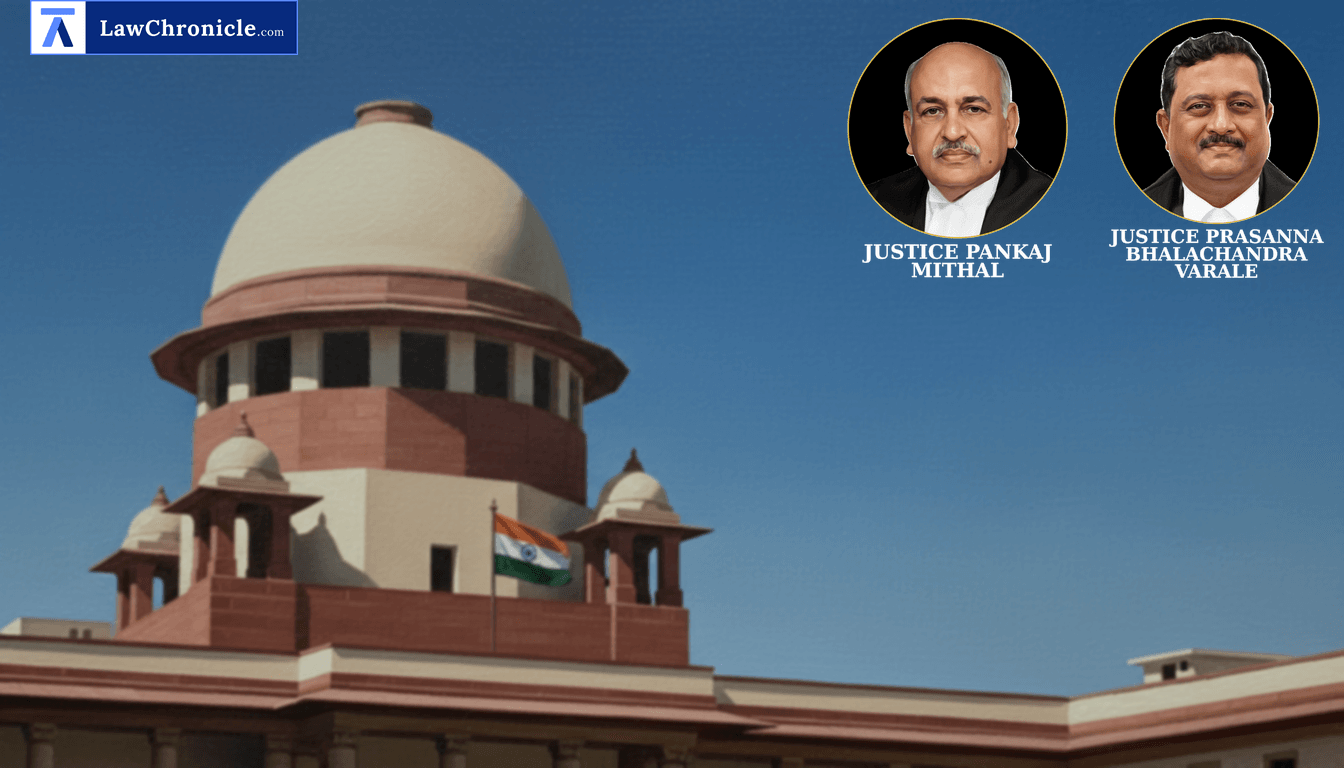
The Supreme Court affirmed that a conviction based solely on circumstantial evidence requires an unbroken chain of events, ruling that suspicion, regardless of its strength, cannot substitute for legal proof. A bench comprising Justice Pankaj Mithal and Justice Prasanna B. Varale delivered this judgment while hearing appeals against a Rajasthan High Court order that had overturned the conviction of four individuals accused of murder and robbery.
The Court emphasized that the prosecution failed to establish a conclusive link between the accused and the crime, particularly doubting the recovery of the dead body and the Bolero jeep. The bench noted significant procedural lapses in the investigation and a lack of independent witnesses, which rendered the circumstantial evidence "disjointed and not interlinked."
Judicial Rationale on Circumstantial Evidence
The Court, in its reasoning, observed: "It is a settled position of law that to convict the accused on the basis of circumstantial evidence, the prosecution must prove beyond reasonable doubt each of the incriminating circumstances on which it proposes to rely; the circumstance(s) relied upon must be of a definite tendency unerringly pointing towards the accused’s guilt and must form a chain so far complete that there is no escape from the conclusion that within all human probability it is the accused and no one else who had committed the crime."
The bench further relied on the landmark principles established in Sharad Birdhichand Sarda v. State of Maharashtra ( "(1984) 4 SCC 116": 1984 CaseBase(SC) 194), noting that all established facts must be consistent only with the hypothesis of the guilt of the accused.
Flaws in Recovery and Identification
The Court scrutinized the alleged recoveries made under Section 27 of the Indian Evidence Act, 1872. It found the recovery of the dead body at the instance of one accused highly suspicious because the police had already mentioned murder sections in the arrest memo before the body was supposedly discovered. Furthermore, the Court cited Jaikam Khan v. State of U.P to highlight that recoveries made from open areas accessible to the public carry little evidentiary weight.
Regarding the identification of the accused and recovered articles, the Court noted the absence of a Test Identification Parade (TIP). Referring to Thammaraya & Anr. v. The State Of Karnataka ( "(2025) 3 SCC 590": 2025 CaseBase(SC) 323), the bench observed that the failure to conduct a TIP for recovered articles like a tape recorder and wrist watch created "holes in the fabric of the prosecution story."
The 'Last Seen' Theory and Section 106
Addressing the 'last seen together' theory, the Court clarified the application of Section 106 of the Indian Evidence Act, 1872. Citing Manoj @ Munna v. State of Chhattisgarh ( "2025 INSC 1466": 2025 CaseBase(SC) 1340), the bench held that while an accused must explain facts within their special knowledge, this does not shift the primary burden of proof from the prosecution. The Court concluded that the evidence of 'last seen' is a weak type of evidence and insufficient for conviction without corroboration.
Background:
The case originated from an incident in April 2007, where a taxi driver went missing after his Bolero jeep was hired by two individuals. His body was later found in a dry well. The Trial Court had convicted four persons Manoj Kumar, Manjeet Kumar, Balraj, and Vijay Singh under Sections 364, 302, 396, and 201 of the Indian Penal Code, 1860, sentencing them to life imprisonment. However, the Rajasthan High Court set aside this conviction in 2015, finding the chain of circumstances incomplete. The complainant and the State of Rajasthan challenged this acquittal before the Supreme Court. The apex court upheld the High Court's decision, maintaining that the prosecution's case was based on conjectures and surmises rather than legal certainty.
Case Details:
Case No.: CRIMINAL APPEAL NOS. 1353-1355 OF 2017
NeutralCitation: 2026 INSC 539
Case Title: PAWAN KUMAR SHARMA VERSUS MANOJ KUMAR & ORS.
Source: 2026 CaseBase(SC) 467
Similar Articles

 Breaking News


