


Motor Accident Claims: Himachal Pradesh High Court Rejects Police Rapat Over Eye Witness Testimony
 Copy Link
 Share
 Save
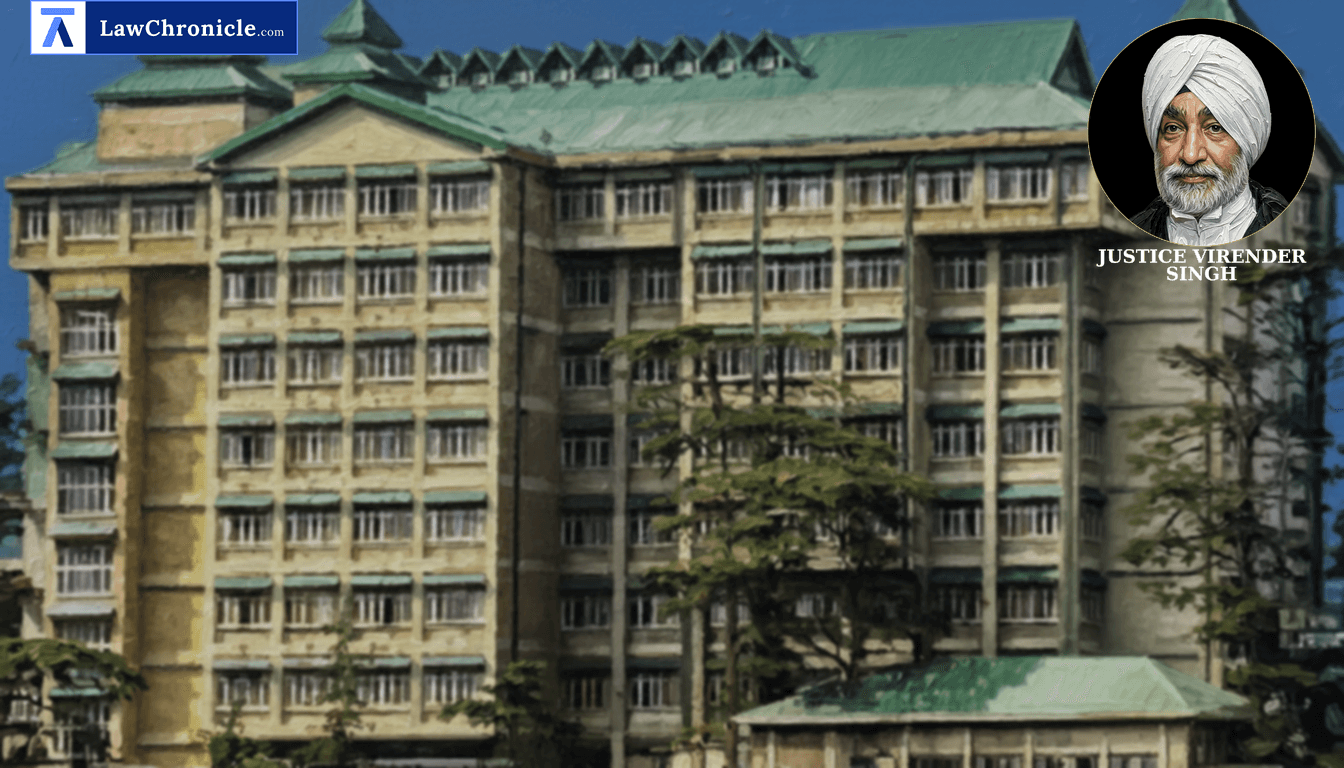
In a decisive affirmation of the 'preponderance of probabilities' standard in motor accident claims, the Himachal Pradesh High Court has ruled that a policeman's unverified record of a victim's statement cannot override the credible testimony of an eye witness. The Court held that a victim referred for emergency management is legally presumed to be in a state of trauma, rendering alleged police recordings without medical certification inadmissible and unreliable.
A single-judge bench of Justice Virender Singh heard the appeal filed by the insurer challenging a Motor Accident Claims Tribunal award. The appellant contended that the accident was not caused by the offending truck but resulted from the deceased's motorcycle skidding on gravel, citing a Daily Diary Report (DDR) and statements allegedly recorded by the Investigating Officer.
Key Takeaways
Primacy of Direct Evidence
Technical police entries like DDRs are not substantive evidence and cannot displace direct oral testimony provided by a witness who actually perceived the accident.
Medical Fitness for Statements
Police officers cannot record statements of critically injured victims without a formal medical opinion certifying their mental and physical fitness to depose.
Trauma Overrides Procedural Delays
Family members of a deceased victim are not expected to rush to the police to lodge an FIR while under immediate trauma; hence, the lack of an FIR does not invalidate a claim.
Standard of Proof in MACT
Liability in motor accident cases is fixed on the touchstone of preponderance of probabilities rather than the 'beyond reasonable doubt' standard of criminal law.
Court Rejects Investigating Officer's Narrative
The Court scrutinized the evidence of the Investigating Officer, who claimed the deceased had made a statement attributing the accident to his own negligence. The Court observed that the deceased was referred to PGI Chandigarh for urgent management, indicating a critical condition that makes the police claim of a recorded statement highly improbable.
The Court, in its reasoning, observed: "RW 4 is not a novice, but a policeman, with long experience of investigating of the cases in his kitty and he has not sought the opinion of the Doctor, who was attending Ashok Kumar, in R.H. Bilaspur. The time of accident is stated to be 8:45 am and he has been referred to PGI Chandigarh at 10:56 am. Meaning thereby, a judicial notice can be taken qua the serious condition of Ashok Kumar."
Furthermore, the Court found the oral evidence of the eye witness to be direct and credible under Section 60 of the Evidence Act, 1872 (corresponding to Section 55 of Bharatiya Sakshya Adhiniyam, 2023). The Court noted that the standard for deciding the claim petition is the preponderance of probabilities, and the evidence of the police witnesses was hit by the rules against hearsay evidence.
Enhanced Compensation for Claimants
While the Insurance Company sought to set aside the award, the High Court, invoking the principle of 'just compensation', actually enhanced the awarded amount. The Court followed the guidelines in National Insurance Company Ltd. Versus Pranay Sethi & Others ( "(2017) 16 Supreme Court Cases 680": 2017 CaseBase(SC) 551) and Sarla Verma Vs Delhi Transport Corportation ( "2009 (6) SCC 121": 2009 CaseBase(SC) 380) to calculate future prospects and multipliers, and applied Magma General Insurance Company Limited versus Nanu Ram alias Chuhru Ram and others ( "(2018) 18 Supreme Court Cases 130": 2018 CaseBase(SC) 597) to award consortium to all family members.
The Court has the following directions:
"Consequently, the appeal is dismissed and the amount of compensation is enhanced from Rs. 66,77,000/- to Rs. 81,66,878/- along with interest at the rate of 7.5% per annum. The ultimate liability to pay the amount of compensation is on the Insurance Company, being insurer of the offending vehicle. The award passed by the learned Tribunal is modified accordingly."
Ratio
In proceedings under the Motor Vehicles Act, 1988, the registration of an FIR is not a sine qua non for seeking compensation. The liability of a tortfeasor is fixed on the touchstone of preponderance of probabilities. Statements recorded by investigating authorities from a victim in a critical condition without a doctor's certificate of fitness are unreliable and cannot override direct oral evidence provided by a credible eye witness under the Evidence Act, 1872.
Background
The dispute originated from a motor accident on June 22, 2014, where Sh. Ashok Kumar, a Music Teacher, died after his motorcycle was hit by a truck. The family filed a claim under Section 166 of the Motor Vehicles Act, 1988. The Insurance Company contested the claim, alleging the vehicle was not involved and that the deceased died due to his own negligence, relying on a DDR entry. The Tribunal had awarded Rs. 66,77,000/-, which the insurer challenged. The High Court, after re-evaluating the income tax slabs and conventional heads for the year 2014-15, modified the calculation to ensure the family received full legal entitlements.
Case Details:
Case No.: FAO (MV) No. 469 of 2017
Neutral Citation: 2026:HHC:47869
Case Title: IFFCO TOKIO General Ins. Co. Ltd. Versus Asha Kumari & Others
Appearances:
For the Petitioner(s): Mr. Jagdish Thakur, Advocate.
For the Respondent(s): Mr. K.B. Khajuria, Advocate, for respondents No. 1 to 4; Mr. Vijay Chaudhary, Advocate, for respondents No. 5 and 6.
Source: 2026 CaseBase(HP) 11183
Similar Articles
 Breaking News


