


No Bail Without Material Change In Circumstances: Himachal Pradesh HC
 Copy Link
 Share
 Save
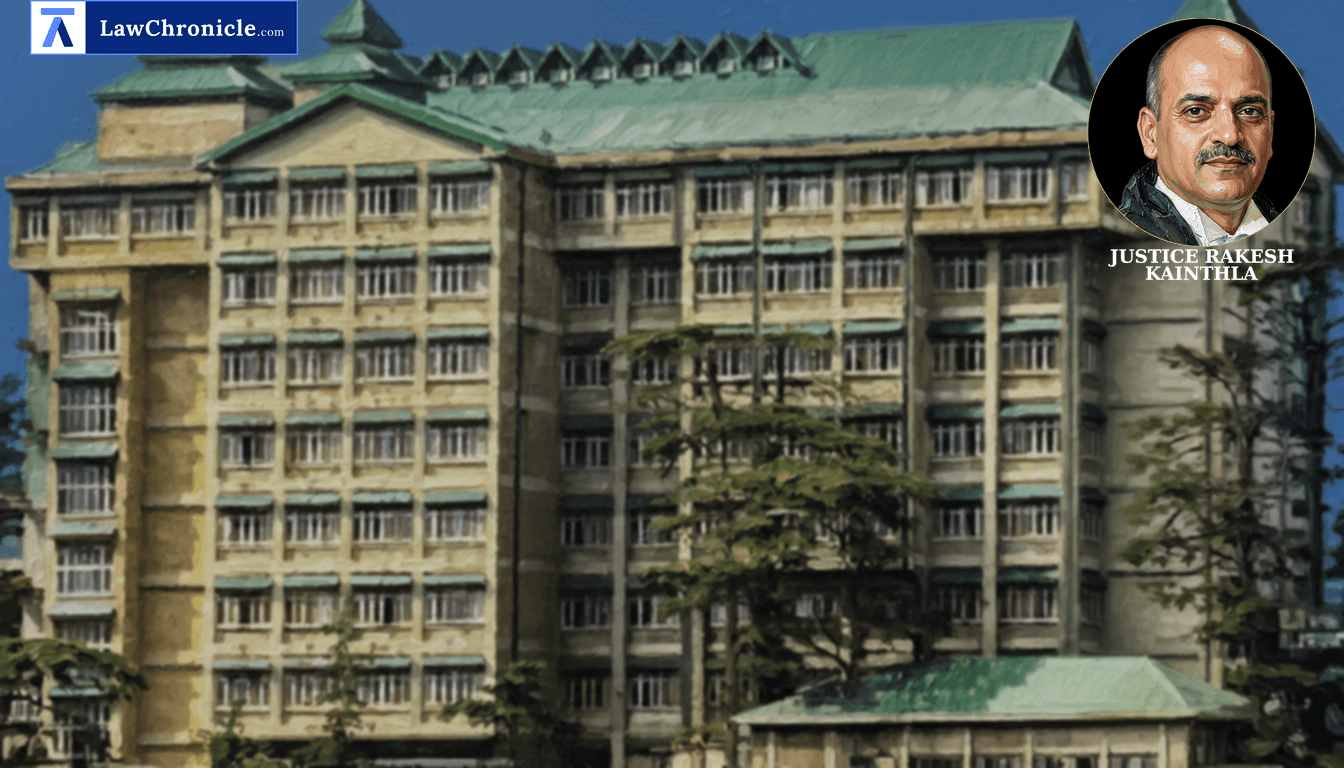
The High Court of Himachal Pradesh has slammed the door on successive bail applications filed without demonstrating a substantial shift in facts or law, reinforcing that such petitions cannot be used as a backdoor to review previous judicial rejections. In a firm stand against procedural abuse, the Court ruled that the mere commencement of a trial or minor discrepancies in witness testimonies do not constitute a 'material change' sufficient to override earlier dismissal orders in heinous murder cases.
Justice Rakesh Kainthla presided over the matter, hearing a regular bail petition involving allegations of a cold-blooded murder involving illicit relationships, strangulation, and electrocution. The Court was tasked with determining whether the petitioner could seek liberty after two previous bail applications had already been dismissed by the same Court.
Key Takeaways
Bar on Review via Bail
Successive bail applications are not a tool for seeking a review of earlier judgments; they are only permissible if there is a substantial change in the fact situation or law.
Trial Discrepancies No Ground for Bail
Discrepancies in witness depositions during an ongoing trial cannot be appreciated by a bail court, as doing so would amount to a premature 'mini-trial' and prejudice the final outcome.
Judicial Discipline and Propriety
Courts must record specific, fresh grounds when taking a view different from earlier rejections to prevent litigants from 'judge-shopping' or pestering the judiciary until they secure a favorable order.
Right to Speedy Trial
While a right to a speedy trial exists, an accused cannot claim bail on grounds of delay if the progress of the trial is consistent and the delay is not solely attributable to the prosecution or the Court.
Court's Observations on Successive Bail and Judicial Discipline
The Court emphasized that judicial discipline and comity demand that once a bail application is rejected, a similar prayer cannot be granted without a substantial change in circumstances. Referring to the precedent in State of Maharashtra. Captain Buddhikota Subha Rao, the Court noted that such changes must be significant and not merely cosmetic.
The Court, in its reasoning, observed: "Once that application was rejected, there was no question of granting a similar prayer. That is virtually overruling the earlier decision without there being a change in the fact situation. And when we speak of change, we mean a substantial one, which has a direct impact on the earlier decision and not merely cosmetic changes, which are of little or no consequence."
Addressing the petitioner's argument regarding witnesses being 'given up' or discrepancies in testimony, the Court relied on Dineet v. State (NCT of Delhi) and X Vs. State of Rajasthan to hold that a bail court must not assess the credibility of witnesses as this function lies squarely within the domain of the trial court. The Court further observed that "the hostility of a witness cannot be interpreted as an automatic declaration of the prosecution's case as unconvincing, and thereby, in essence, result in the conduct of a mini-trial at the stage of bail and return findings upon the ex-facie merit of the accused's innocence/guilt."
The Court has following directions:
"In view of the above, the present petition fails, and it is dismissed. The observation made hereinbefore shall remain confined to the disposal of the instant petition and will have no bearing whatsoever on the merits of the case."
Ratio
A successive bail application is maintainable only upon the existence of a material change in circumstances, defined as a substantial shift in the fact situation or law that renders earlier findings obsolete. A court entertaining a subsequent application has a mandatory duty to record fresh grounds for departing from previous rejections; further, it is impermissible for a bail court to appreciate evidence or witness credibility during an ongoing trial to grant liberty, as such an exercise constitutes an unauthorized 'mini-trial' that prejudices the administration of justice.
Background
The case arose from the death of one Satbeer, whose body was discovered by police just as it was being taken for cremation. Investigations revealed multiple injuries, and a post-mortem report confirmed death by a cumulative effect of asphyxia due to ligature strangulation and electrocution. The prosecution alleged that the petitioner, Darshan Singh, had an illicit relationship with the deceased's wife and, along with co-accused persons, conspired to murder Satbeer under Sections 103 and 61(2) of the Bhartiya Nyaya Sanhita (BNS) 2023.
Evidence including CCTV footage identifying the petitioner's vehicle at the scene and call detail records were cited by the State. The petitioner argued for bail on the grounds of innocence, claiming that key witnesses identifying him in the footage had been given up by the prosecution. However, the Court found that twelve witnesses had already been examined and ten given up, showing no undue delay in trial progress. Following the principles in Kalyan Chandra Sarkar v. Rajesh Ranjan @ Pappu Yadav ( "(2004) 7 SCC 528": 2004 CaseBase(SC) 837), State of T.N. v. S.A. Raja, Prasad Shrikant Purohit v. State of Maharashtra, and State of M.P. v. Kajad ( "(2001) 7 SCC 673; 2001 SCC (Cri) 1520; 2001 SCC OnLine SC 1070": 2001 CaseBase(SC) 1722), the Court dismissed the petition, finding no material change in circumstances since the last rejection in December 2025.
Case Details:
Case No.: Cr.M.P.(M) No.1828 of 2026
Neutral Citation: 2026:HHC:48526
Case Title: Darshan Singh v. State of Himachal Pradesh
Appearances:
For the Petitioner(s): Mr N.S. Chandel, Senior Advocate, with Ms Shwetima Dogra, Advocate.
For the Respondent(s): Mr Ajit Sharma, Deputy Advocate General.
Source: 2026 CaseBase(HP) 11165
Similar Articles
 Breaking News


