


No Liability Without Reliable Vehicle Identification in Motor Accident Claims: Uttarakhand HC
 Copy Link
 Share
 Save
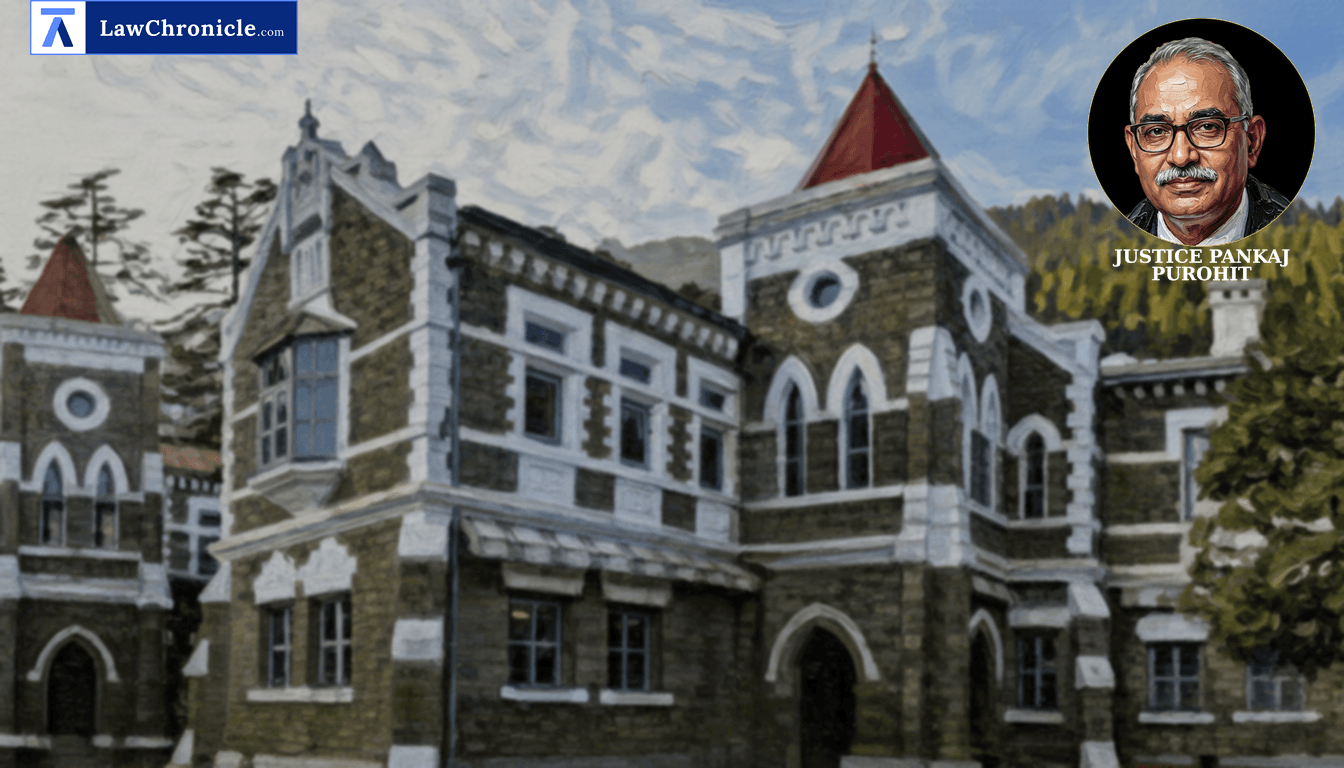
The Uttarakhand High Court has quashed a compensation award against an insurance company, ruling that the failure to establish the specific involvement of a vehicle through cogent evidence at the foundational level absolves the insurer of all liabilities. Reaffirming the standards of proof required in motor accident claims, the court held that mere subsequent attribution of a vehicle number in a hit-and-run case, without credible eyewitness corroboration or independent verification, cannot sustain a claim for damages.
A single-judge bench of Justice Pankaj Purohit heard the appeal and cross-objection arising from a 2012 judgment of the Motor Accident Claims Tribunal, Haldwani. The court was tasked with determining whether the Tribunal's finding regarding the involvement of a specific truck in a fatal accident was sustainable when the primary eyewitness admitted to being unable to see the vehicle's registration number due to darkness.
Key Takeaways
Proof of Identity Mandatory
For a claim to succeed under the Motor Vehicles Act, 1988, the claimant must provide reliable evidence connecting the specific insured vehicle to the accident; mere suspicion is insufficient.
Evidentiary Value of FIR
An FIR lodged against an 'unknown vehicle' places a higher burden of proof on claimants to explain how a specific vehicle was later identified during the investigation.
Limits of Statutory Liability
Insurance companies cannot be fastened with liability if the foundational fact of the insured vehicle's involvement remains unproven or is based on contradictory testimony.
Cross-Objections for Enhancement
If the underlying liability of the insurer is set aside, any cross-objection filed by claimants for enhancement of compensation becomes infructuous and must be dismissed.
Assessing the Testimony of Eyewitnesses
The High Court scrutinized the evidence of the alleged eyewitness, noting significant discrepancies that undermined the case against the insurer. The court observed that while the Tribunal relied on the testimony of PW-2, the witness himself admitted his inability to identify the vehicle. The Court, in its reasoning, observed: "In the present case, the difficulty is not merely that the FIR was initially against an unknown vehicle, rather, the very witness relied upon for subsequently connecting the insured vehicle with the accident admits that he could not see its registration number. There is no satisfactory independent evidence on record explaining how the particular insured vehicle came to be identified thereafter. The learned Tribunal, therefore, erred in treating the involvement of the insured vehicle as proved."
Court Directions
The Court has following directions:
"The judgment and award passed by the learned Motor Vehicle Accident Claims Tribunal/Additional District Judge, Haldwani, is hereby set aside. The claim petition, insofar as it fastens liability upon the appellant-Insurance Company in respect of the alleged accident involving vehicle No.UA-04-C-0548, is dismissed. The appellant-insurance company is at liberty to recover the amount of award (i.e. 50% of the amount deposited by the appellant-insurance company before learned Tribunal) released in favour of the respondent-claimants as per the order passed by this Court vide order dated 10.07.2014. The statutory amount deposited before this Court be remitted by the Registry to the concerned Claims Tribunal to be released in favour of the appellant-insurance company."
Ratio
The involvement of the insured vehicle in an accident is a foundational fact that must be established by cogent and reliable evidence. If an eyewitness admits to an inability to identify the registration number of the offending vehicle due to external factors like darkness, and no independent evidence explains the subsequent identification, the insurer cannot be held liable under the Motor Vehicles Act, 1988. Once the foundational fact of involvement is not proved, findings of negligence and liability cannot be sustained.
Background
The dispute originated from a road accident on February 5, 2007, where the deceased was allegedly struck by a truck while riding his motorcycle. Initially, an FIR was lodged against an unknown vehicle. Later, a specific truck was implicated based on investigation statements. The Tribunal had awarded Rs. 4,14,500/- to the claimants, assessing the deceased's income at Rs. 3,000 per month and applying a multiplier of 15. The Insurance Company appealed, arguing that the vehicle was falsely implicated. The claimants filed a cross-objection seeking enhancement, claiming the deceased earned significantly more. The High Court distinguished this case from The Oriental Insurance Co. Ltd. v. Leeladhar Joshi & Others and Smt. Shanti Joshi & Others v. Salig Ram Saini & Another, noting that unlike those precedents, the evidence here was materially deficient. Consequently, the High Court allowed the appeal of the Insurance Company and dismissed the claimants' cross-objection.
Case Details:
Case No.: Appeal From Order No. 483 of 2012
Neutral Citation: 2026:UHC:8033
Case Title: The New India Assurance Company Limited v. Smt. Suman and others
Appearances:
For the Petitioner(s): Mr. P.C. Maulekhi, learned Counsel
For the Respondent(s): Mr. Z.U. Siddiqui, learned Counsel; Mr. Piyush Srivastava, learned Counsel
Source: 2026 CaseBase(UTT) 4982
Similar Articles
 Breaking News


