


No Right To Seek Re-conveyance Of Lawfully Acquired Land: SC
 Copy Link
 Share
 Save
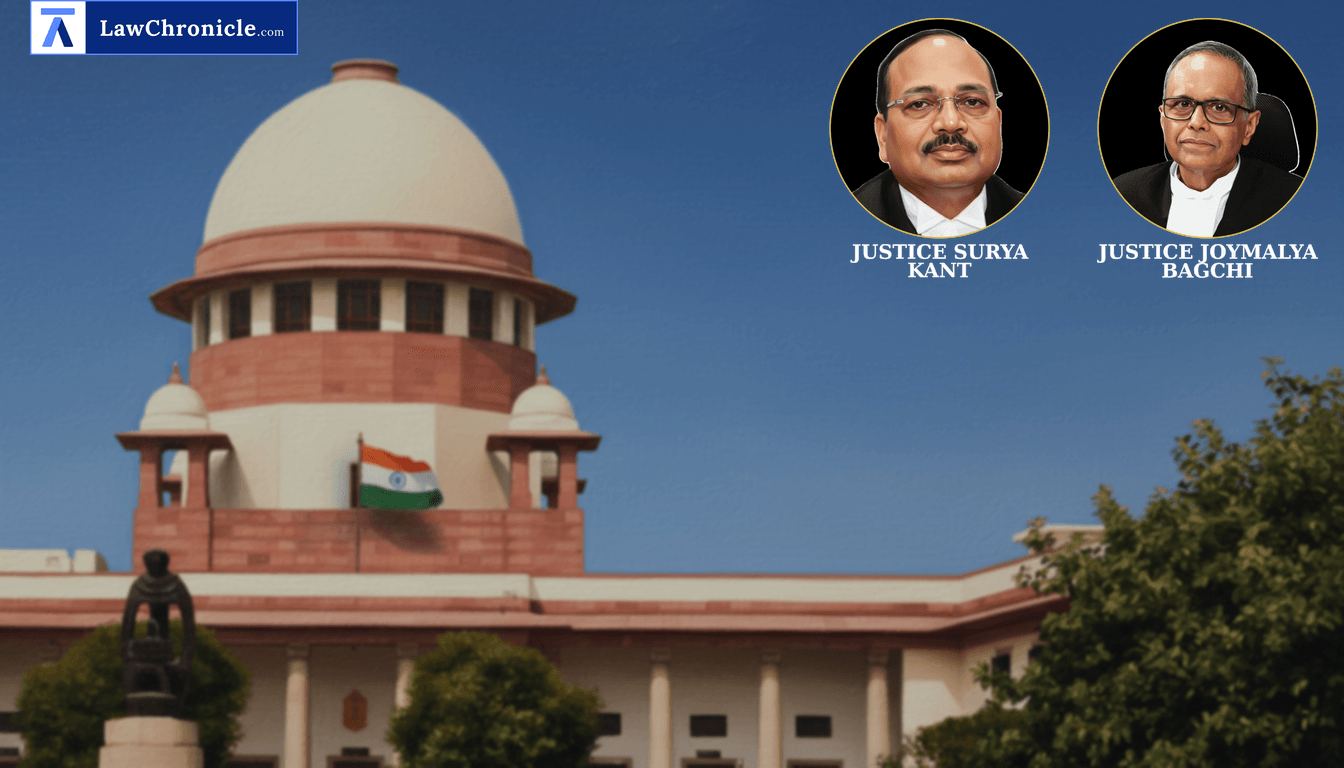
The Supreme Court set aside orders directing the re-conveyance of acquired land to original owners, ruling that Section 48-B of the Land Acquisition Act, 1894 is a discretionary power of the State rather than an enforceable right of the landowner. The Court emphasized that once land vests in the State free from encumbrances, the State maintains the authority to change the public purpose for which the land is utilized.
A bench comprising Chief Justice Surya Kant and Justice Joymalya Bagchi adjudicated on whether the High Court could mandate the return of land that had been lawfully acquired for a bus and truck terminal. The Court clarified that judicial review over State discretion under Section 48-B is limited to examining whether the decision was arbitrary or mala fide, rather than enforcing a perceived right to re-conveyance based on non-utilization.
The Doctrine of State Discretion and Public Purpose
The Court, in its reasoning, observed: "The scheme of Section 48-B of the Land Acquisition Act, 1894, in our considered opinion, does not envisage any enforceable right in favour of the expropriated landowner to seek transfer of the acquired land. Rather, it confers a discretion upon the State to permit re-conveyance of the land to the original landowner in certain circumstances, being that the acquired land can neither be utilised for the original purpose of acquisition nor for any other public purpose. Unless this two-pronged condition is fulfilled, the question of exercise of the State’s discretion does not arise."
No Fixed Timeline for Land Utilization
Addressing the issue of delay in using acquired land, the Bench noted that constitutional courts must be circumspect in directing the release of land simply because it remained unutilized for a period. The Court relied on Nandkishor Babulal Agrawal vs. The State of Maharashtra ( "Civil Appeal No. 7634 of 2023, judgment dated 10.11.2023": 2023 CaseBase(BOM) 1033) to reiterate that municipalities and agencies often maintain land banks for long-term urban planning. It was held that there is no legal prohibition against keeping a portion of acquired land vacant for future development or changing the public purpose to meet evolving needs, such as converting a portion of the site into a truck parking yard.
The Court has the following directions:
"(i) The First Impugned Judgment and the Second Impugned Order passed by the Division Bench of the High Court, as also the orders of the learned Single Judge of the High Court in the 2006 and 2009 Writ Petitions, are set aside;
(ii) The decision of the State Government and the Appellant-Authority to not re-convey the land in question to the original landowners under Section 48-B of the Land Acquisition Act, 1894 is upheld; and
(iii) It is clarified that if the High Court, in any other proceedings pertaining to the same acquisition, has taken any view contrary to that given by us through the instant Judgment, such view shall also be deemed to have been set aside, ensuring that no impediment is caused to the completion of the project."
Background:
The dispute originated from notifications issued between 1982 and 1985 for the acquisition of 80.92 acres in Chennai for a bus and truck terminal. While 64.80 acres were utilized, 16.12 acres remained undeveloped. The Chennai Metropolitan Development Authority (Appellant) initially intended to allot a portion of this residual land to Gunny Bag merchants to resolve residential health hazards. The respondent-landowners sought re-conveyance under Section 48-B of the Land Acquisition Act, 1894 (as applicable in Tamil Nadu), arguing the land was not being used for the original public purpose.
While the High Court had previously directed the release of the land, characterizing the allotment to private merchants as a non-public purpose, the Supreme Court noted that the State eventually corrected this by earmarking the land for a truck parking yard a bona fide public purpose. The Court also rejected the respondents' plea for compensation under the Right to Fair Compensation and Transparency in Land Acquisition, Rehabilitation and Resettlement Act, 2013, noting that since the original compensation had been deposited with the Collector, the acquisition remained valid under the principles of T.N. Housing Board v. Keeravani Ammal and relevant statutory provisions.
Case Details:
Case No.: Civil Appeal Nos. 3234 - 3251 / 2026
NeutralCitation: 2026 INSC 269
Case Title: The Chennai Metropolitan Development Authority vs. Dharmalingam & Ors. etc.
Appearances:
For the Petitioner(s): Mr. V. Krishnamurthy, Additional Advocate General
For the Respondent(s): Mr. Narender Hooda, Senior Counsel; Mr. Gagan Gupta, Senior Counsel; Mr. Pradeep Kumar Yadav, Advocate
Source: 2026 CaseBase(SC) 540
Similar Articles


 Breaking News


