


Non-Bailable Warrants Cannot Be Issued In Routine Manner: Andhra Pradesh HC
 Copy Link
 Share
 Save
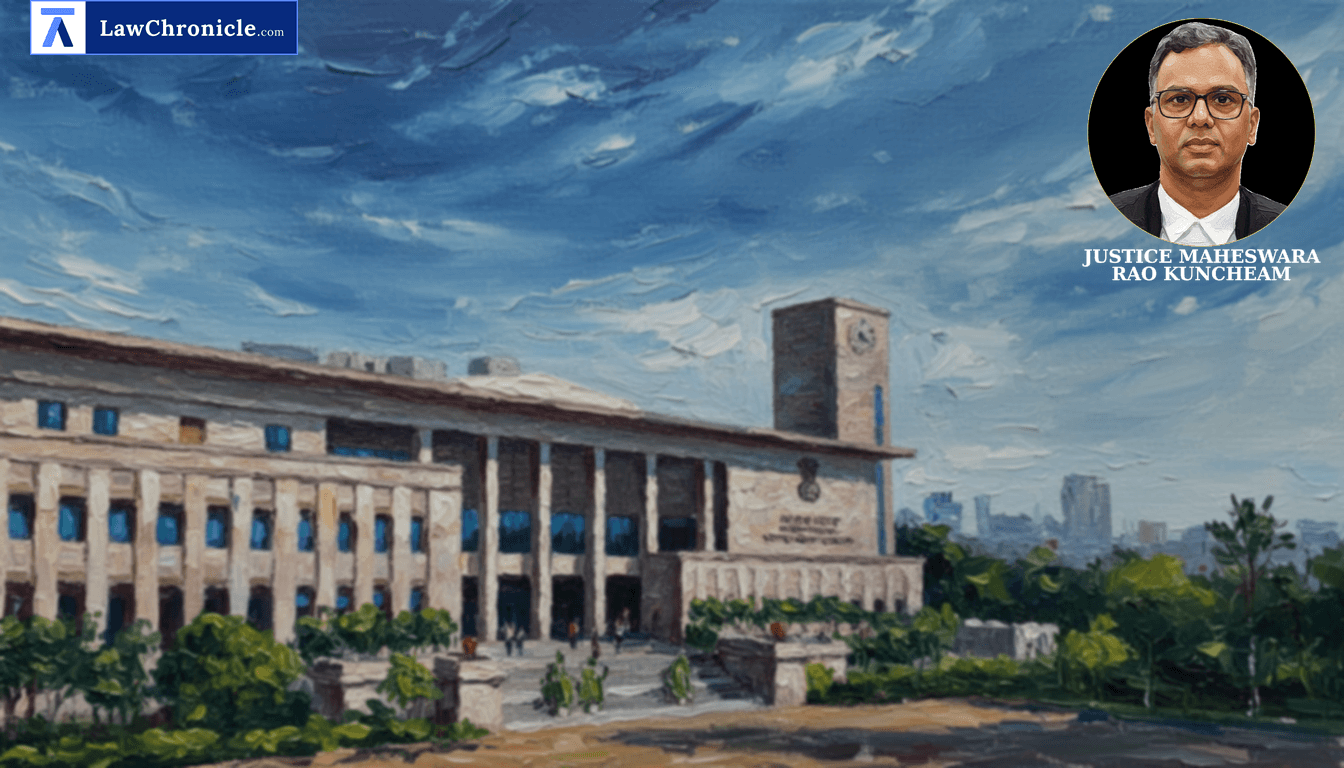
The Andhra Pradesh High Court has reinforced the sanctity of personal liberty by quashing a mechanical issuance of a Non-Bailable Warrant, ruling that judicial discretion must be guided by reason rather than personal whim. In a sharp rebuke to procedural shortcuts, the Court held that warrants should only be a measure of last resort to secure attendance, not a tool for routine harassment.
A Single Judge Bench of Sri Justice Maheswara Rao Kuncheam heard the petition challenging a docket order where a Non-Bailable Warrant (NBW) was issued against a 70-year-old petitioner at the first instance. The Court examined whether the trial court's failure to record reasons and its bypass of summons/bailable warrants violated the statutory framework established under the Bharatiya Nagarik Suraksha Sanhita, 2023.
Key Takeaways
Primacy of Personal Liberty
Issuance of NBWs must be extra-cautious as it directly impacts Article 21 rights, requiring a delicate balance between individual liberty and State interests.
Mandatory Recording of Reasons
Courts are legally bound to record specific reasons in writing before issuing warrants in lieu of summons, ensuring transparency and preventing arbitrary exercise of power.
Sequential Coercion
Judicial officers must generally follow a hierarchy of summons, then bailable warrants, and finally NBWs, unless the accused is likely to abscond or pose a danger.
Procedural Compliance in Complaints
In complaint-based cases, the immediate issuance of an NBW without verifying service of summons or intentional evasion is a jurisdictional error.
Judicial Discretion vs. Arbitrary Power
The Court emphasized that judicial functions are distinct from administrative duties, requiring a high degree of sensitivity and independent thinking. Relying on National Insurance Co. Ltd. v. Keshav Bahadur ( "(2004) 2 SCC 370": 2004 CaseBase(SC) 678), the Court noted that discretion must be legal, regular, and guided by established principles of law, not private opinion. The Bench observed that the power to issue warrants under Section 90 of Bharatiya Nagarik Suraksha Sanhita, 2023 (corresponding to Section 87 of Code Of Criminal Procedure, 1973) is intended to secure appearance and is not a punitive tool.
The Court, in its reasoning, observed: "The warrants either bailable or non-bailable should never be issued without proper scrutiny of facts and complete application of mind, due to the extremely serious consequences and ramifications which ensue on issuance of warrants... Personal liberty is paramount, therefore, we caution courts at the first and second instance to refrain from issuing non-bailable warrants."
The Court has the following directions:
"i. Order dated 10.06.2026 in STC No.7 of 2025 on the file of the Judicial Magistrate of First Class, Puttaparti, Sri Satya Sai District is liable to be interdicted, and the same is hereby recalled;
ii. Petitioner shall appear before the learned trial Court within a period of two (02) weeks from the date of receipt of copy of this Order; and
iii. It is made clear that the petitioner shall continue to appear before the trial Court without any retractions, unless personal appearance of the petitioner is specifically dispensed with by due process of law."
Ratio
Issuance of a Non-Bailable Warrant (NBW) is a coercive measure interfering with personal liberty and must not be resorted to mechanically or as a matter of routine. A Court must record written reasons for issuing a warrant in lieu of summons, satisfying itself that the accused is likely to evade the process of law or that presence cannot be secured through less restrictive means. The statutory discretion to issue warrants must be exercised judiciously, cautiously, and in accordance with the hierarchy of summons and bailable warrants as established by Constitutional Court precedents.
Background
The petitioner, a 70-year-old resident of Karnataka, was an accused in a case involving Section 138 of the Negotiable Instruments Act, 1881. The trial court at Puttaparthi issued an NBW straightaway despite evidence suggesting that the summons were sent to an incorrect address in Andhra Pradesh and returned as "unclaimed." The petitioner moved the High Court under Section 528 of the Bharatiya Nagarik Suraksha Sanhita, 2023, arguing that the warrant infringed upon his right to life under the Constitution of India, 1950.
The High Court analyzed various precedents, including Inder Mohan Goswami v. State of Uttaranchal ( "(2007) 12 SCC 1": 2007 CaseBase(SC) 44) and Satender Kumar Antil v. Central Bureau of Investigation ( "(2022) 10 SCC 51": 2022 CaseBase(SC) 640), which frame strict judicial guidelines for NBWs. It was noted that Raghuvansh Dewanchand Bhasin v. State of Maharashtra emphasizes the need for Courts to be extra-cautious to avoid wrongful detention. Furthermore, the Court cited Sharif Ahmed v. State of UP to reiterate that NBWs should generally be reserved for heinous crimes or cases of clear evasion. Finding that the trial court failed to record reasons and acted mechanically, the High Court set aside the warrant.
Case Details:
Case No.: CRIMINAL PETITION NO: 5978 OF 2026
Neutral Citation: 2026:APHC:38246
Case Title: B. Vijaya Sai v. The State of Andhra Pradesh and P.Ernagappa
Appearances:
For the Petitioner(s): N Ranga Reddy
For the Respondent(s): Seshadri Goalla, Public Prosecutor
Source: 2026 CaseBase(AP) 15680
Similar Articles



 Breaking News


