


Official Reprimands By Boss Not Abetment To Suicide Without Proximate Act: SC
 Copy Link
 Share
 Save
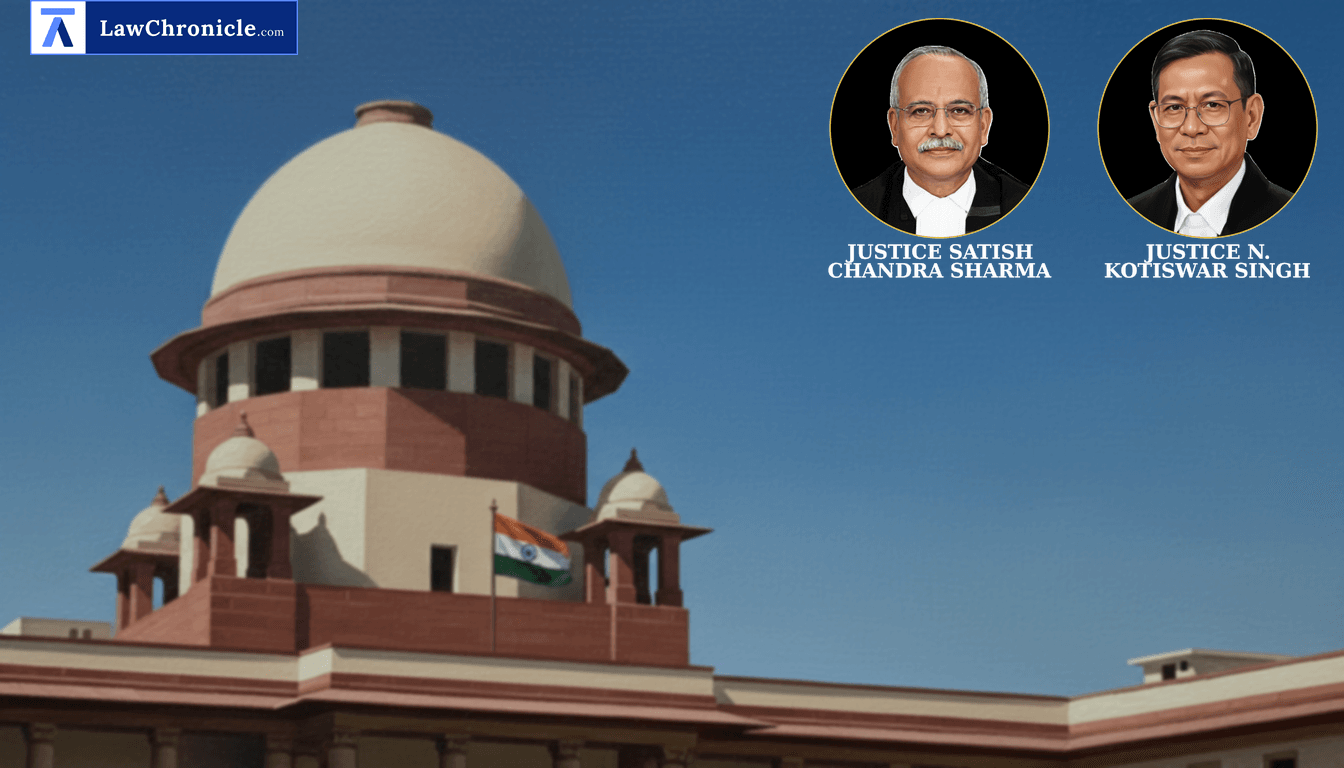
Administrative supervision and routine work reprimands cannot be elevated to criminal abetment of suicide without a proximate act demonstrating clear mens rea to drive a subordinate to take her life. Shedding light on the strict evidentiary threshold required to charge superior officers under criminal law, the apex court discharged a senior forest officer facing prosecution after his subordinate committed suicide.
In an insightful ruling, a bench comprising Justice Satish Chandra Sharma and Justice Nongmeikapam Kotiswar Singh discharged a Deputy Conservator of Forests who was accused of abetting the suicide of a female Forest Range Officer under Section 306 of the Indian Penal Code, 1860.
Key Takeaways
Shielding Administrative Supervision: Routine disciplinary actions, work-related reprimands, or stern official behavior by senior officers do not constitute abetment to suicide.
Requirement of Proximity: Allegations of continuous harassment must be backed by a proximate prior act immediately preceding the suicide to demonstrate direct incitement.
High Threshold for Mens Rea: The prosecution must establish a conscious intent on the part of the accused to drive the victim to commit suicide, rather than relying solely on the victim's subjective mental state.
Protection Against Abuse of Process: Higher courts must scrutinize criminal charges against public officials to prevent statutory machinery from being misused over unfortunate tragedies.
Court's Analysis on Abetment and Administrative Conduct
The court emphasized that to sustain a charge under Section 306 of the Indian Penal Code, 1860, there must be a direct or indirect act of instigation in close proximity to the time of commission of suicide, accompanied by clear mens rea. Relying on legal principles articulated in Ude Singh & Ors. v. State of Haryana ( "(2019) 17 SCC 301": 2019 CaseBase(SC) 4132), Prakash & Ors. v. State of Maharashtra & Anr. ( "(2026) 6 SCC 251": 2026 CaseBase(SC) 125), Pawan Kumar v. State of H.P. ( "2017 (7) SCC 780": 2017 CaseBase(SC) 857), Madan Mohan Singh v. State of Gujarat & Anr. ( "(2010) 8 SCC 628": 2010 CaseBase(SC) 960), Abhinav Mohan Delkar v. State of Maharashtra & Ors. ( "(2026) 6 SCC 233": 2025 CaseBase(SC) 684), and Amalendu Pal v. State of West Bengal ( "(2010) 1 SCC 707": 2009 CaseBase(SC) 286), the bench observed that continuous harassment alone without a proximate act is insufficient.
The Court, in its reasoning, observed: "...ordinary administrative directions, disciplinary supervision, adverse remarks regarding official performance, or even stern behaviour on the part of a superior officer, however unpleasant they may have been perceived by the deceased, cannot, in the absence of additional material demonstrating a conscious intention to drive a subordinate to commit suicide, be elevated to the status of abetment under Section 306 IPC. As observed by this Court in Abhinav Mohan Delkar (supra), merely because the victim was continuously harassed and, at one stage, succumbed to the extreme act of taking his or her own life, cannot by itself lead to a finding of positive instigation constituting abetment. There must exist a proximate act amounting to instigation or intentional aid which creates such circumstances as would drive the victim to commit suicide."
Addressing the lack of intention, the bench further noted that: "We further find that the prosecution has failed to prima facie establish that the Appellant had any intention to instigate, aid or abet the deceased to commit suicide. The suicide notes undoubtedly reflect the anguish of the deceased, however, they do not disclose any act on the part of the Appellant from which the requisite mens rea can reasonably be inferred... No doubt, a young Range Forest Officer lost her life in an unfortunate incident. However, criminal liability under Section 306 IPC cannot rest upon the tragedy of the outcome alone; it must be founded upon the statutory ingredients of Section 306, which are absent in the present case."
Ratio
Ordinary administrative directions, official reprimands, or stern behavior by a superior officer in the discharge of official duties do not constitute the offence of abetment of suicide under Section 306 of the Indian Penal Code, 1860 in the absence of a proximate act of instigation and demonstrable mens rea explicitly intended to drive the victim to commit suicide.
Background
The case arose from the unfortunate demise of a female Forest Range Officer in Harisal Range on March 25, 2021, who committed suicide using her official weapon. She left behind suicide notes levelling allegations of mental harassment, vulgar language, and administrative mistreatment against her superior, the Deputy Conservator of Forests. An FIR was subsequently registered under Sections 306, 312, 504, and 506 of the Indian Penal Code, 1860.
Earlier, the Bombay High Court had quashed the FIR to the extent of Section 312 of the Indian Penal Code, 1860. However, the trial court rejected the appellant's discharge application under Section 227 of the Code Of Criminal Procedure, which was subsequently upheld by the Nagpur Bench of the High Court in a criminal revision application. Aggrieved by the refusal of discharge, the senior officer approached the Supreme Court.
The Supreme Court analyzed the suicide notes and witness statements, noting that the specific incidents cited such as official reprimands, orders for removal of encroachments, and an allegation of forced trekking causing a miscarriage pertained to events that had occurred several months or a year prior to the suicide. Finding no proximate act of instigation or offences under Sections 504 and 506 of the Indian Penal Code, 1860, the Supreme Court allowed the appeal, set aside the judgments of the High Court and Sessions Judge, and discharged the appellant.
Case Details:
Case No.: Criminal Appeal No. of 2026 (Arising out of SLP (Criminal) No. 17179 of 2025)
Neutral Citation: 2026 INSC 867
Case Title: Vinod Shivakumar v. The State of Maharashtra
Source: 2026 CaseBase(SC) 793
Similar Articles
 Breaking News


