


Parliament Competent to Apply BOCW Welfare Cess Act to Jammu and Kashmir: Jammu & Kashmir and Ladakh HC
 Copy Link
 Share
 Save
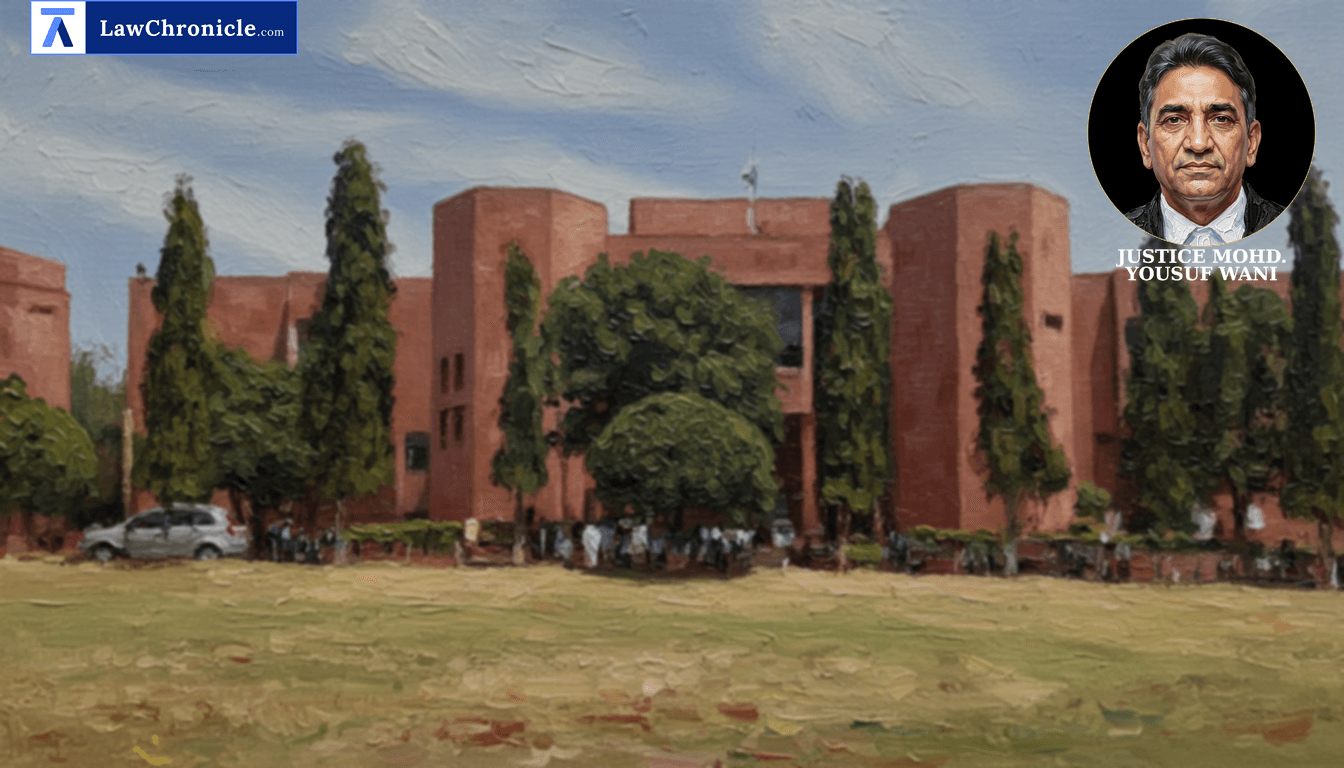
The High Court of Jammu & Kashmir and Ladakh has fortified the legislative reach of the Union, ruling that the imposition of construction labor welfare cess remains constitutionally valid despite the erstwhile special status of the region. By categorizing the levy as a labor welfare measure rather than a tax, the Court has cleared the path for recovering vital funds meant for the protection of building workers, even under the restrictive residuary powers previously applicable to the state.
A Division Bench comprising Acting Chief Justice Sanjeev Kumar and Justice Mohd Yousuf Wani adjudicated on a challenge brought by construction firms questioning the application of labor welfare laws to the former State of Jammu and Kashmir. The petitioners primarily argued that since Building and Other Construction Workers (Regulation of Employment and Conditions of Service) Act, 1996 and its companion legislation were enacted under the residuary powers of Constitution of India, 1950, Parliament lacked the competence to extend them to the State where Entry 97 of the Union List existed in a modified, highly restricted form.
Key Takeaways
Constitutional Reach Secured
By tracing the legislation to the Concurrent List, the Court ensured that Union welfare laws apply to J&K despite modified residuary powers.
Levy Characterized as Fee
Following apex court precedent, the High Court reaffirmed that construction cess is a fee for worker welfare, not a tax on buildings.
Retrospective Factoring of Costs
Contractors are held liable for cess on all contracts issued after the constitution of the Welfare Board, regardless of whether they accounted for it in their bids.
Recovery with Interest
Failure to pay the statutory cess will now attract a 6% per annum interest charge from the date the amount became due.
Court's Rationale on Legislative Competence
The petitioners contended that the levy under Building and Other Construction Workers Welfare Cess Act, 1996 was a tax and that Parliament could not impose it as the relevant residuary powers under Constitution of India, 1950 were not extended to the State. However, the Court rejected this, observing that the pith and substance of the law is labor welfare.
The Court, in its reasoning, observed: "The Cess Act, being an enactment for augmenting the resources of the Workers’ Welfare Boards constituted under the BOCW Act, cannot be said to be merely a revenue-collection legislation. Viewed thus, the Cess Act can very well be said to be an extension of the BOCW Act and enacted with the sole object of taking care of the social security and welfare of labour, including the conditions of work, provident fund, workmen's compensation, invalidity and old-age pensions and maternity benefits, etc. The legislation, in its pith and substance, is a labour welfare legislation and cannot be termed as merely a revenue-collection legislation."
Addressing the specific mechanism for implementation, the Court noted that while the laws were enacted in 1996, they became enforceable in the State only after the formal constitution of the Jammu and Kashmir Building and Other Construction Workers Welfare Board in 2007. Relying on Prakash Atlanta (JV) v. National Highways Authority of India ( "2026 SCC OnLine SC 1998": 2026 CaseBase(SC) 4684), the Court held that the constitution of such boards is a sine qua non for collection.
The Court has following directions:
"(i) The Parliament had the legislative competence to enact the BOCW Act and the Cess Act in relation to the then State of Jammu and Kashmir and, therefore, both the Acts are intra vires the Constitution.
(ii) The petitioners in both the petitions are liable to pay the cess envisaged under the Cess Act at the prescribed rate in respect of all the contracts executed by them pursuant to the NITs issued after 31.07.2007, i.e. the date when the J&K Building and Other Construction Workers’ Welfare Board was for the first time constituted to give effect to the provisions of the BOCW Act and the Cess Act.
(iii) The Building and Other Construction Workers Welfare Cess Rules, 1998, framed under the Cess Act, 1996, are also held constitutionally valid. The cess amount payable by the petitioners in terms of this judgment at the prescribed rate shall be recoverable from the petitioners along with interest at the rate of 6% per annum from the date it was due till it is actually recovered."
Ratio
The Building and Other Construction Workers Welfare Cess Act, 1996 and Building and Other Construction Workers (Regulation of Employment and Conditions of Service) Act, 1996 are labor welfare legislations referable to Entries 23 and 24 of the Concurrent List of the Constitution of India, 1950. Consequently, Parliament possesses the legislative competence to apply these laws to the State of Jammu and Kashmir under Article 246, notwithstanding the modified application of residuary powers under Article 248 and Entry 97 of List I. The levy is a 'fee' aimed at augmenting welfare funds, not a tax on land or buildings.
Background
The dispute arose when the J&K Economic Reconstruction Agency began deducting a 1% cess from the bills of contractors. The petitioners challenged these deductions, arguing that the contracts were awarded before a proper welfare board mechanism was in place and that the Building and Other Construction Workers Welfare Cess Act, 1996 was unconstitutional in its application to J&K. They heavily relied on the distinction between the original and modified Entry 97 of the Union List.
The Court analyzed the 1954 Presidential Order and the subsequent 2019 changes, but evaluated the competence based on the pre-2019 constitutional position. It followed the precedent in Dewan Chand Builders & Contractors v. Union of India to define the levy as a fee and Prakash Atlanta (JV) v. National Highways Authority of India ( "2026 SCC OnLine SC 1998": 2026 CaseBase(SC) 4684) to determine the timing of liability. The petitions were ultimately disposed of with directions for recovery of the cess amount with interest.
Case Details:
Case No.: OWP No. 1599/2013 c/w OWP No. 61/2014
Case Title: R.G. Buildwell Engineers Ltd. & Anr. v. Union of India and others
Appearances:
For the Petitioner(s): Mr. Z.A.Shah, Sr. Advocate with Mr. A. Hanan, Advocate, Mr. Nisar Ahmad, Advocate.
For the Respondent(s): Mr. T.M.Shamsi, DSGI with Ms. Rehana Qayoom Advocate, Mr. Alla Ud Din Ganaie, AAG
Source: 2026 CaseBase(JK) 865
Similar Articles


 Breaking News


