


Partition Decree Does Not Result in Splitting of Government Lease: Delhi HC
 Copy Link
 Share
 Save
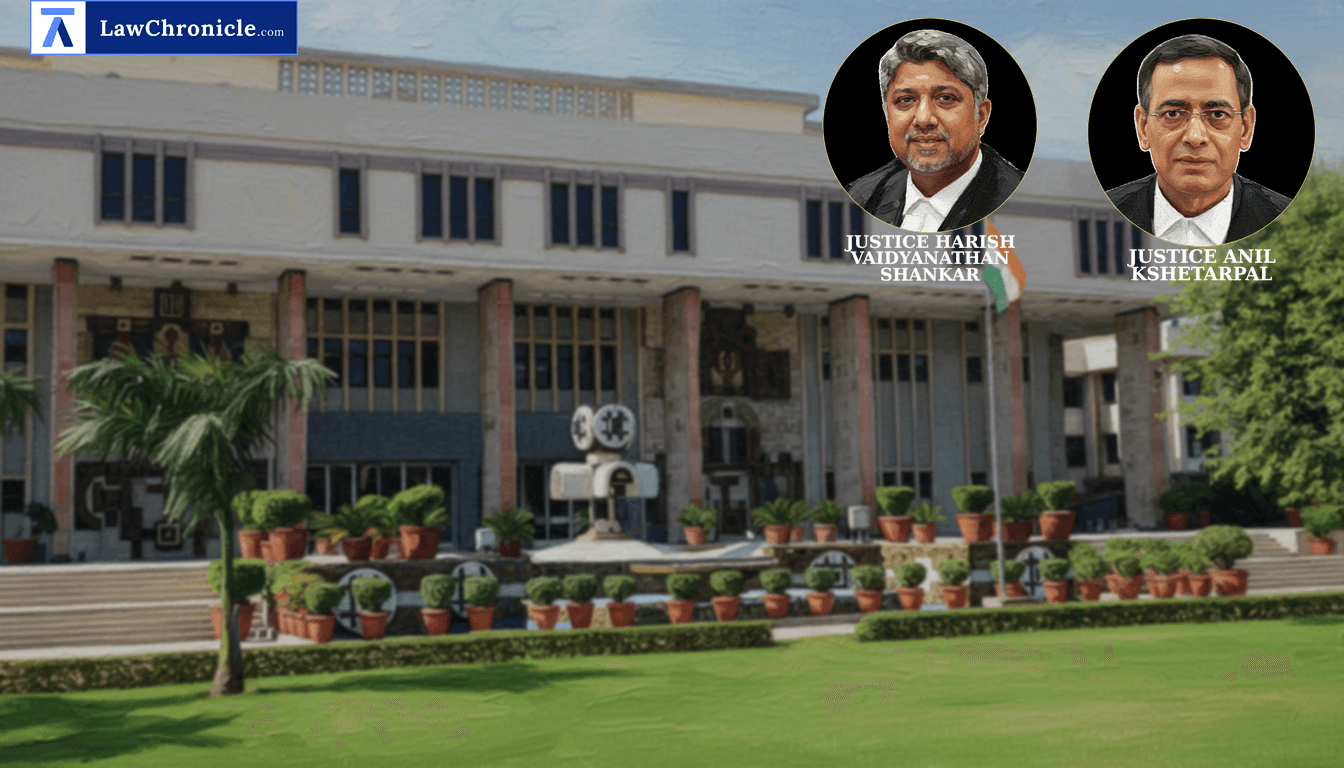
The Delhi High Court has clarified that a partition decree between co-lessees cannot result in the legal severance of a tenancy or bind the lessor to recognize independent leasehold estates without express consent.
A bench of Justice Anil Kshetarpal and Justice Harish Vaidyanathan Shankar set aside directions issued by a Single Judge that had permitted co-lessees to independently deal with their shares and excluded them from misuse charges, emphasizing that the nature of a government grant remains indivisible unless the terms of the grant expressly permit fragmentation.
Legal Indivisibility of Government Leases
The Court observed that a lease granted by the Union of India is a Government grant governed by the Government Grants Act, 1895. Consequently, the rights and obligations of the lessee must be gathered strictly from the terms of the lease deed. The Court found that the lease in question contemplated the property as a single, indivisible residential unit, consistent with the Master Plan for Delhi, 2021 which prohibits the subdivision of residential plots.
The Court, in its reasoning, observed: "The status of the parties, therefore, is that of co-lessees under a single indivisible lease, and not that of independent lessees holding separate tenancies. The principle that splitting of tenancy is impermissible without the consent of the lessor is well established and admits of no exception in the facts of the present case. The partition decree, admittedly passed in proceedings to which the lessor was not a party, cannot bind the lessor or compel it to recognize multiple tenancies."
Challenges to Mutation Without Contesting Lease Cancellation
A pivotal issue in the case was the maintainability of a writ petition seeking mutation when the lease itself had been cancelled by the Land & Development Office (L&DO) in 2006. The Court noted that the petitioners had not challenged the cancellation or the order of re-entry.
The Court held that a writ of mandamus for mutation cannot be issued in a vacuum where the underlying leasehold rights have been extinguished. It stated: "A writ petition seeking mutation of leasehold rights is not maintainable in the absence of a challenge to the subsisting order of cancellation of the lease and re-entry passed by the lessor. Any relief granted in disregard of such foundational order cannot be sustained in law."
Adjudication of Inter Se Disputes and Misuse Charges
The Court further addressed the Single Judge's findings regarding the liability for misuse charges. The Single Judge had previously ruled that the Hingorani family could not be saddled with misuse charges for the period before they were put in possession in 2018. However, the Division Bench held that such determinations involve complex questions of fact and contractual interpretation between private parties, which are not amenable to writ jurisdiction under Constitution of India, 1950.
Directions Issued by the Court
The Court has the following directions:
"The present batch of Letters Patent Appeals, along with all pending applications, is accordingly disposed of in the above terms. It is clarified that the rights and disputes inter se between the co-lessees, including liability towards misuse charges, shall remain open and may be agitated by the parties before the appropriate forum in accordance with law. It is clarified that nothing contained in the present judgment shall preclude the GNCTD/L&DO from taking a decision, in accordance with law and applicable policy, to revoke the cancellation of the lease upon receipt of misuse charges along with applicable interest, if otherwise permissible."
Background:
The dispute concerned a property in West Patel Nagar, New Delhi, originally leased in 1956. Following a series of transfers and civil suits, the property was declared to be held by two families the Tahilramanis and the Hingoranis as co-lessees with 50% undivided shares. A partition decree in 2008 allocated specific portions of the superstructure to the parties. However, in 2006, the L&DO cancelled the lease due to misuse. When the Hingoranis sought mutation in 2019, the L&DO rejected the request based on the prior cancellation. The Hingoranis then moved the High Court via a writ petition, leading to the various impugned orders that allowed mutation and restricted the recovery of misuse charges from them. The Division Bench has now set aside those directions, relegating inter se liability disputes to civil proceedings.
Case Details:
Case No.: LPA 522/2022
Case Title: GAUTAM TAHILRAMANI AND ANR v. UNION OF INDIA AND ORS
Appearances:
For the Petitioner(s): Mr. Vikram Saini, Adv.; Mr. S.R. Mehta, Adv.; Mr. Sandeep Kumar Mahapatra, CGSC with Ms. Mrinmayee Sahu, Mr. Tribhuvan, Mr. Abhimanyu, Ms. Anushka Sarraf, Advs.
For the Respondent(s): Mr. Subhash Tanwar, SPC with Mr. Sandeep Mishra, Mr. Harshit Deshwal, Mr. Mohit Kumar Tomar, Mr. Mayank Sehrawat, Advs.; Mr. Naseem Ahmed, Adv.; Dr. Aman Hingorani, Sr. Adv. with Ms. Shreya Chopra, Adv.; Mr. Shashank Dixit, CGSC with Mr. Kunal Ra, Adv.
Source: 2026 CaseBase(DEL) 359
Similar Articles

 Breaking News


