


Personal Guarantor bound by Composite Loan Agreement Arbitration Clause: Supreme Court
 Copy Link
 Share
 Save
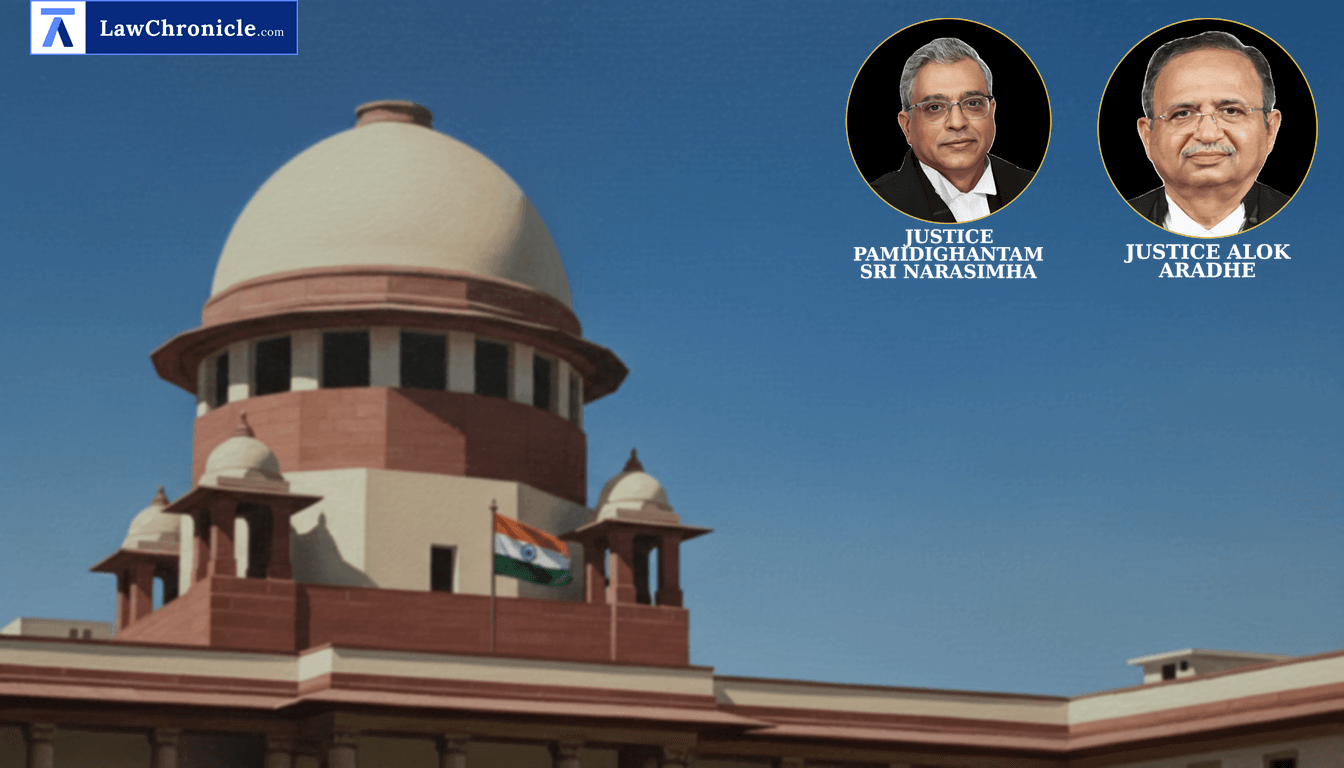
The Supreme Court has clarified the liability of personal guarantor being bound under the Composite Loan Agreement Arbitration Clause. The Bench has ruled that a personal guarantee executed as a mandatory pre-disbursement condition forms an inseparable part of the principal loan agreement, binding the guarantor to its arbitration clause even if the guarantee itself lacks one.
A bench of Justice Pamidighantam Sri Narasimha and Justice Alok Aradhe set aside the decisions of the High Court of Delhi and the Sole Arbitrator which had deleted a personal guarantor from the arbitral proceedings. The Apex Court held that where a cluster of contemporaneous instruments are structured to govern a single transaction, an arbitration clause in main loan agreement binds signatories to integrated facility documents.
Key Takeaways
Composite Commercial Transactions: Interconnected agreements executed for a single commercial arrangement must be read together as part of one composite transaction.
Incorporation by Reference: Under Section 7(5) of the Arbitration and Conciliation Act, 1996, an arbitration clause in a loan agreement extends to ancillary personal guarantees when they are contractually defined as integral facility documents.
Binding Non-Signatories in Personal Capacity: A director signing a main loan agreement in a representative capacity remains bound by its arbitration clause in their personal capacity if they execute a contemporaneous personal guarantee integrated into the deal matrix.
Evolving Commercial Reality: Arbitral mechanisms must remain elastic enough to accommodate multi-party and multi-contract arrangements without compromising foundational consent principles.
Incorporation under Section 7(5)
The Supreme Court thoroughly analyzed the scope of Section 7(5) of the Arbitration and Conciliation Act, 1996 alongside established precedents such as M.R. Engineers and Contractors Private Limited v. Som Datt Builders Limited ( "(2009) 7 SCC 696": 2009 CaseBase(SC) 493), Inox Wind Limited v. Thermocables Limited, Cox and Kings v. SAP India Pvt. Ltd. ( "(2024) 4 SCC 1": 2022 CaseBase(SC) 870), Shinhan Bank v. Carol Info Services Limited ( "(2023) 20 SCC 388": 2023 CaseBase(SC) 923), Ajay Madhusudan Patel and Others v. Jyotrindra S. Patel and Others ( "(2025) 2 SCC 147": 2024 CaseBase(SC) 266), and ASF Buildtech Private Limited v. Shapoorji Pallonji and Company Private Limited ( "(2025) 9 SCC 76": 2025 CaseBase(SC) 667). Re-evaluating the commercial matrix, the Court concluded that the Loan Agreements and Personal Guarantees were explicitly designed to operate as component parts of one composite transaction.
Personal Guarantor's Liability
Addressing the relationship between the loan agreement and facility documents, the Apex Court elaborated the legal text that "The phrase 'as if the provisions thereof were set out herein in extension' operates as a deeming fiction internal to the contract, binding every facility agreement, including the Personal Guarantee, within the same legal and arbitral framework as the Loan Agreement. The Personal Guarantees do not, therefore, stand apart from the Loan Agreements, and are woven into their very fabric."
The Supreme Court further emphasized that training partners under public skill development schemes are often thinly capitalized special-purpose entities, making personal guarantees the primary assurance for financial assistance. The Court ruled that such a guarantee cannot be severed for dispute resolution purposes alone from the very clause governing rights and obligations arising under the primary agreement.
The Court accordingly allowed the appeal to quash and set aside the High Court order that allowed application under Section 16 of the Arbitration and Conciliation Act, 1996.
Ratio
Where parties structure a single commercial transaction through multiple contemporaneous and interconnected instruments, an arbitration clause contained in the principal agreement stands incorporated under Section 7(5) of the Arbitration and Conciliation Act, 1996 into an ancillary personal guarantee that is contractually defined as an integral facility document and executed as a mandatory pre-disbursement condition, thereby binding the guarantor to arbitral proceedings.
Background
The dispute originated from a scheme by the Ministry of Skill Development and Entrepreneurship to establish Model Training Centres known as "Pradhan Mantri Kaushal Kendra" (PMKK). The appellant, National Skill Development Corporation, served as the implementing agency extending financial support. Respondent No. 1 (Surya Wires Private Limited) and Respondent No. 4 (Disha Education Society) jointly submitted proposals and were allotted clusters to set up PMKKs.
On December 20, 2016, and August 18, 2017, the parties executed clusters of contemporaneous agreements, including Loan Agreements, Service Level Agreements, and ancillary Facility Agreements like Deeds of Hypothecation and Personal Guarantees. Respondent No. 2, the Managing Director of the borrower company, executed Personal Guarantees in his individual capacity as a mandatory pre-disbursement condition.
Following defaults in loan repayment, the appellant issued loan recall notices and initiated arbitral proceedings before the Indian Council of Arbitration against all respondents. Respondent No. 2, along with other non-signatories to the primary loan agreements in their personal capacities, filed an application under Section 16 of the Arbitration and Conciliation Act, 1996 seeking deletion from the arbitral proceedings. The Sole Arbitrator allowed the application on October 23, 2024, deleting Respondent No. 2 on the ground that he was not a signatory to the Loan Agreements in a personal capacity and the Personal Guarantees contained no independent arbitration clause.
The High Court of Delhi, in an appeal under Section 37(2)(a) of the Arbitration and Conciliation Act, 1996, affirmed the Arbitrator's ruling, holding that a general reference to documents does not automatically import an arbitration clause without explicit conscious acceptance. Aggrieved, the appellant approached the Supreme Court, which allowed the appeal and restored Respondent No. 2 to the arbitral proceedings.
Case Details:
Case No.: Civil Appeal No. of 2026 (@ S.L.P. (C) No. 10030 of 2026)
Neutral Citation: 2026 INSC 977
Case Title: National Skill Development Corporation v. Surya Wires Private Limited & Ors.
Appearances:
For the Petitioner(s): Mr. J.K. Chaudhary, Counsel
For the Respondent(s): Mr. Sudev Singh Juneja, Counsel
Source: 2026 CaseBase(SC) 6707
Similar Articles
 Breaking News


