


Plaintiff's Absence In Witness Box Not Fatal If Revenue Records Prove Possession: Himachal Pradesh HC
 Copy Link
 Share
 Save
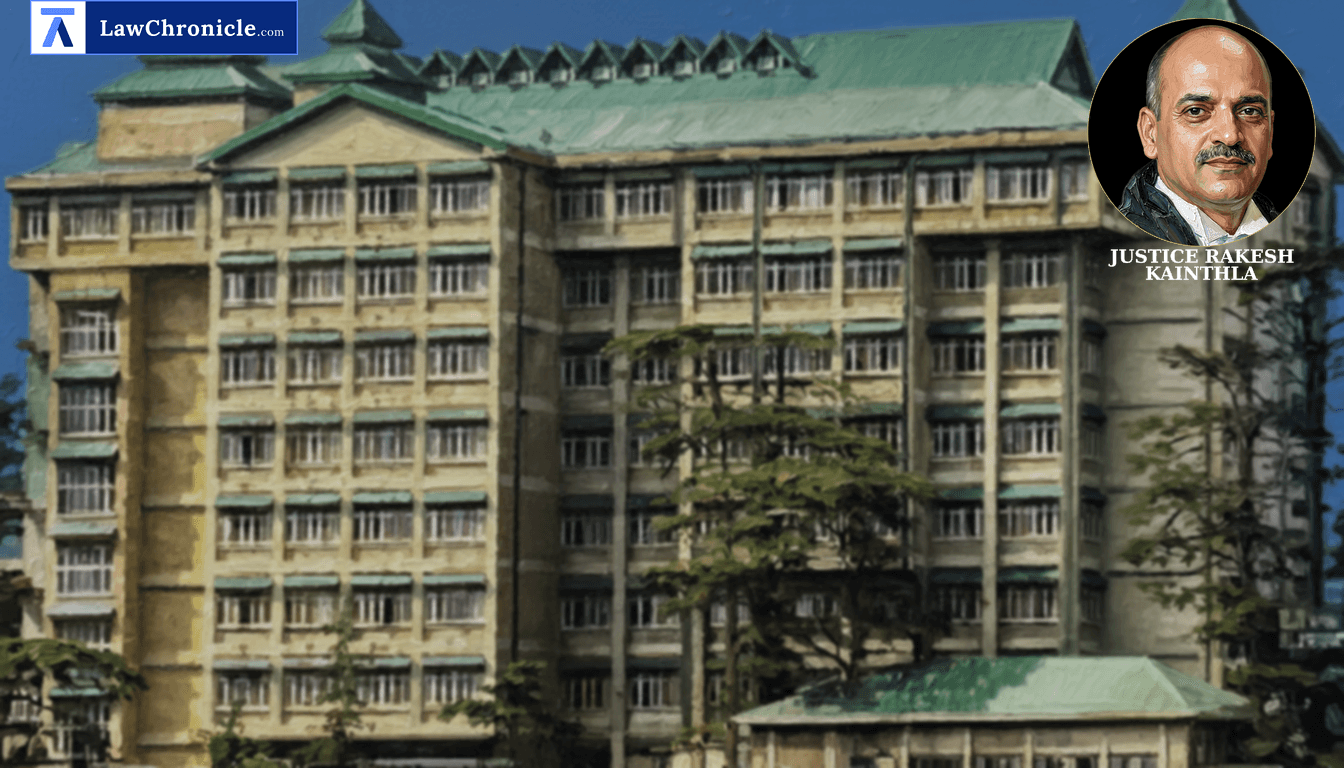
Possession stands protected against external interference as the Himachal Pradesh High Court rules that a plaintiff's failure to personally testify is not a ground for dismissal when ownership is established through official revenue records. The judgment reinforces that a Power of Attorney can validly depose for acts within their knowledge, preventing technicalities from defeating the equitable relief of permanent injunction.
Justice Rakesh Kainthla, sitting as a single-judge bench, heard this Second Appeal challenging an appellate decree that had reversed a trial court's dismissal of a suit for permanent prohibitory injunction. The High Court was called upon to determine if the non-appearance of the plaintiff as a witness and the absence of a site plan were fatal to a claim for injunction when the parties were adjacent landowners.
Key Takeaways
Evidentiary Value of Revenue Records
Presumptions of correctness attached to jamabandi entries can suffice to prove possession even if the primary litigant does not step into the witness box.
Scope of Power of Attorney Testimony
An attorney-holder who manages affairs or has personal knowledge of specific acts can effectively testify for the principal, especially regarding non-exclusive facts.
Injunction as a Shield for Possession
Once lawful possession is established, a reasonable apprehension of interference by an adjacent owner is sufficient to grant discretionary relief under the Code of Civil Procedure, 1908.
Identification of Suit Land
Where a suit involves an entire Khasra number defined in revenue records, the absence of a separate site plan does not violate procedural requirements for identifying immovable property.
Court's Rationale on Witness Testimony and Possession
The Court observed that the defendants did not seriously dispute the plaintiff's ownership but rather contested the extent of vacant land. Relying on Rattan Dev v. Pasam Devi, the Court noted that while adverse inferences can be drawn for withholding a party from the witness box, such abstention becomes insignificant if other oral and documentary evidence like jamabandi entries discharges the onus of proof.
Regarding the competency of the Power of Attorney, the Court referred to Janki Vashdeo Bhojwani v. IndusInd Bank Ltd. ( "(2005) 2 SCC 217: 2004 SCC OnLine SC 1538": 2004 CaseBase(SC) 255) and Man Kaur v. Hartar Singh Sangha, clarifying that an attorney can depose for acts done in the exercise of their power. Since the threat of interference was not within the 'exclusive' knowledge of the plaintiff, the testimony of the General Power of Attorney was held to be valid substituted evidence. The Court further noted that the defendants' failure to produce a demarcation report, which they claimed satisfied the plaintiff, warranted an adverse inference against them.
The Court has following directions:
"In view of the above, the present appeal fails, and it is dismissed. The present appeal stands disposed of, and so also the pending miscellaneous applications, if any. The record of the learned Courts below be returned along with a copy of this judgment."
The Court, in its reasoning, observed: "Once the plaintiff is found to be in possession, the injunction should have been issued on the complaint of interference. An aggrieved person comes to the Court complaining of interference by the defendant; maybe at a particular point of time the defendant has not caused interference, but once the fear stands heavily in the mind of the aggrieved person, there shall be no difficulty for the Court to grant an injunction, especially when it is found that the particular person is in possession."
Ratio
When a plaintiff's possession is corroborated by revenue entries carrying a presumption of correctness, the mere non-appearance of the plaintiff in the witness box is not fatal to the suit, provided the Power of Attorney or other witnesses can testify to the facts. Furthermore, in a suit for injunction involving a whole Khasra number, a specific site plan is not a mandatory requirement under Order 7 Rule 3 of the Code of Civil Procedure, 1908 if the property is otherwise sufficiently identified.
Background
The dispute originated when the plaintiff filed a suit for permanent prohibitory injunction to restrain the defendants from interfering with her land or raising construction. The defendants, who owned adjacent land, claimed the plaintiff had already built upon the entire suit land and that a prior demarcation had settled the boundaries. The Trial Court dismissed the suit, reasoning that the plaintiff's claim of vacant land was falsified by revenue entries and that she had failed to prove an overt act of interference.
However, the First Appellate Court reversed this, holding that the plaintiff was protecting her lawful possession and that the defendants had withheld the best evidence the demarcation report. The High Court, while dismissing the second appeal, relied on precedents such as Smt. Gangavva vs. Arjunsa ( "AIR 2001 Karnataka 231": 2001 CaseBase(KAR) 267), Lakshmamma vs. M.P. Krishnappa, Shri Ram vs. Rakesh Kumar, Atma Ram Vs. Onkar Singh, and Ghisa Ram v. Sukhi Ram to affirm that owners in possession are entitled to protect their enjoyment of property from third-party interference. The Court clarified that the revenue term 'Gair Mumkin' did not necessarily mean the entire area was constructed, thus debunking the Trial Court's factual findings.
Case Details:
Case No.: RSA No. 218 of 2008
Neutral Citation: 2026:HHC:47335
Case Title: Mathra Dass & Anr Versus Sukh Dei (since deceased) through LR Ram Asra
Appearances:
For the Petitioner(s): Mr. N.K. Thakur, Senior Advocate, with Mr Karan Sadyal, Advocate.
Source: 2026 CaseBase(HP) 11151
Similar Articles
 Breaking News


