


Revenue Entries Prove Possession: Gujarat HC Revives Injunction Suit
 Copy Link
 Share
 Save
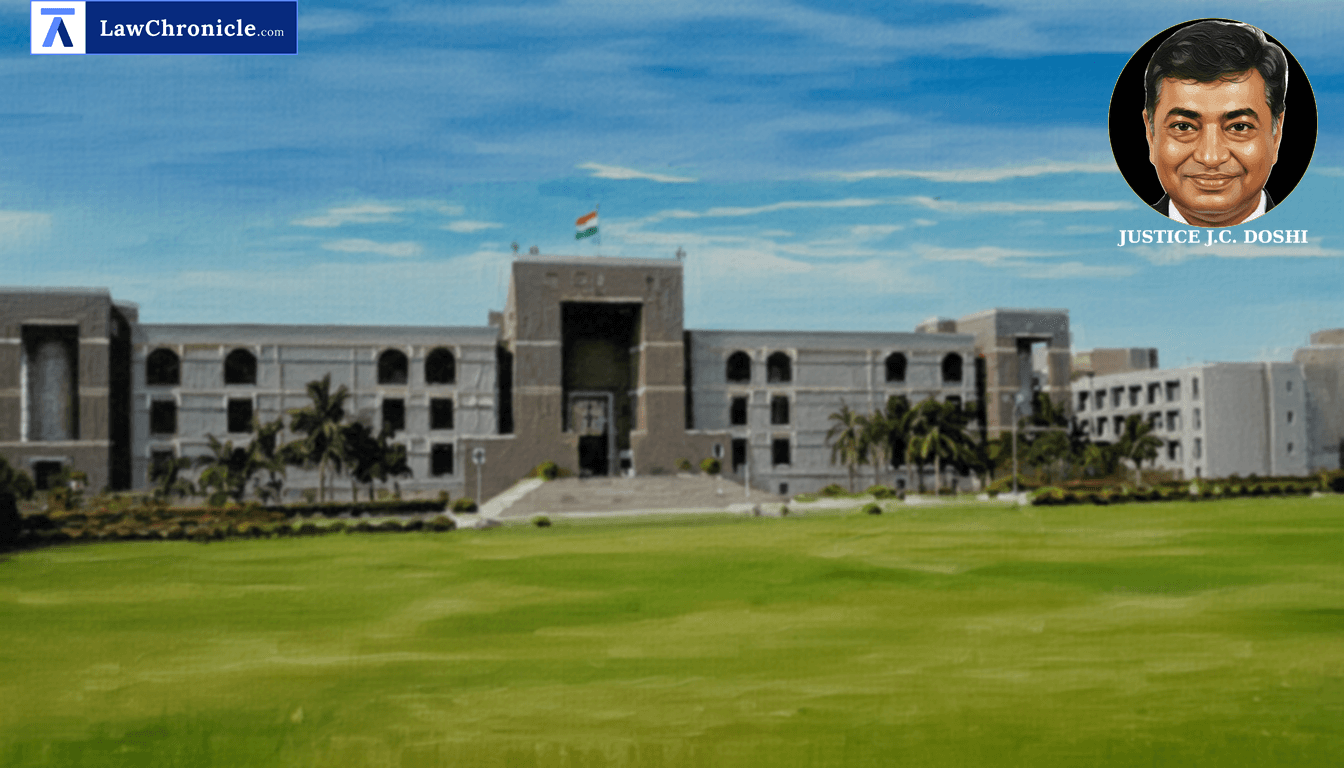
The Gujarat High Court has reaffirmed that possession typically follows title in the absence of contrary evidence, setting aside a Trial Court's reliance on criminal proceedings to determine civil possession. A single-judge bench of Justice J. C. Doshi heard the first appeal challenging the dismissal of a suit for permanent injunction concerning agricultural land in Navsari district.
While adjudicating the appeal filed under Section 96 of the Code of Civil Procedure, 1908, the Court addressed the critical question of whether plaintiffs were entitled to a permanent injunction based on revenue records that had attained finality. The Court found that the Trial Court erred in its assessment of possession by disregarding conclusive revenue orders and erroneously relying on statements made during criminal investigations.
The Primacy of Title and Corrected Revenue Entries
The Court observed that the plaintiffs' ownership was backed by significant revenue proceedings. Specifically, the Mamlatdar had corrected historical errors in mutation entries, removing the names of the defendants' ancestors after finding they had no valid right, title, or interest. This order was never challenged by the defendants and thus attained finality.
The Court, in its reasoning, observed: "In view of the above, it stands established that the plaintiffs are the owners and occupiers of land bearing Survey No.417, Block No.410. The defendants have failed to bring any evidence on record to disprove this title. Needless to state that possession always follow the title unless contrary is proved. In the absence of any contrary evidence, the defence of the defendants that there was a partition and they have a half share in the land is wholly remain unsupported."
Regarding the interpretation of revenue records as evidence, the bench relied on principles established in State of Haryana & Anr. Vs. Amin Lal (Since Deceased) through his Lrs & Ors., noting that while such entries do not confer title, they carry a presumption of correctness under Section 35 of the Indian Evidence Act, 1872 and serve as admissible evidence of possession.
Misplaced Reliance on Criminal Proceedings in Civil Disputes
A pivotal legal point in the judgment was the Trial Court's use of a judgment from a Judicial Magistrate First Class to negate the plaintiffs' claim. The High Court clarified that criminal proceedings cannot be treated as conclusive proof in civil disputes where title and possession must be independently established.
The Court, in its reasoning, observed: "However, the reliance on criminal proceedings to determine possession in civil proceeding is wholly misplaced. Proceedings in criminal matters cannot be treated as conclusive proof in civil disputes where issues of title and possession must be independently established by evidence. Moreover, any statement recorded during criminal investigation, if not duly confronted in civil proceedings, cannot be treated as an admission."
Background:
The dispute originated from a suit for permanent injunction filed by the plaintiffs (appellants) claiming ownership of Block No. 410 (Survey No. 417) at village Panikhadak. The plaintiffs contended that while they had permitted a school and hostel to be built on a portion of the land, the remainder was in their peaceful possession. The defendants contested the suit, claiming they held a 1/2 share via an ancestral partition and that the plaintiffs' suit was barred by res judicata and non-joinder of the school trust.
The Trial Court had dismissed the suit, primarily holding that the plaintiffs failed to prove actual possession, citing alleged admissions in criminal proceedings. On appeal, the High Court scrutinized the wide powers of a first appellate court as discussed in C.Venkat Swamy Vs. H.N.Shivnna, Santosh Hazari Vs. Purshottam Tiwari (Deceased) by L.Rs., Madhukar & Ors. Vs. Sangram & Ors. ( "(2001) 4 SCC 756": 2001 CaseBase(SC) 858), and H.K.N. Swami v. Irshad Basith. Following a fresh report from the Mamlatdar during the appeal, which confirmed the plaintiffs' houses and occupation on the land, the Court concluded that the defendants' theory of partition was baseless and the plaintiffs were entitled to protect their property rights under Section 38(3) of the Specific Relief Act, 1963.
Case Details:
Case No.: R/FIRST APPEAL NO. 1153 of 2003
NeutralCitation: 2026:GUJHC:31915
Case Title: BHARATBHAI MAGJIBHAI PATEL & ORS. Versus CHUNILAL MERVANBHAI PATEL & ORS.
Appearances:
For the Petitioner(s): MR BS PATEL, MR CHIRAG B PATEL, MRS RANJAN B PATEL
For the Respondent(s): MR JV JAPEE
Source: 2026 CaseBase(GUJ) 248
Similar Articles

 Breaking News


