


Post-Assessment Investigation Report Serves Tangible Basis to Reopen Assessment: SC
 Copy Link
 Share
 Save
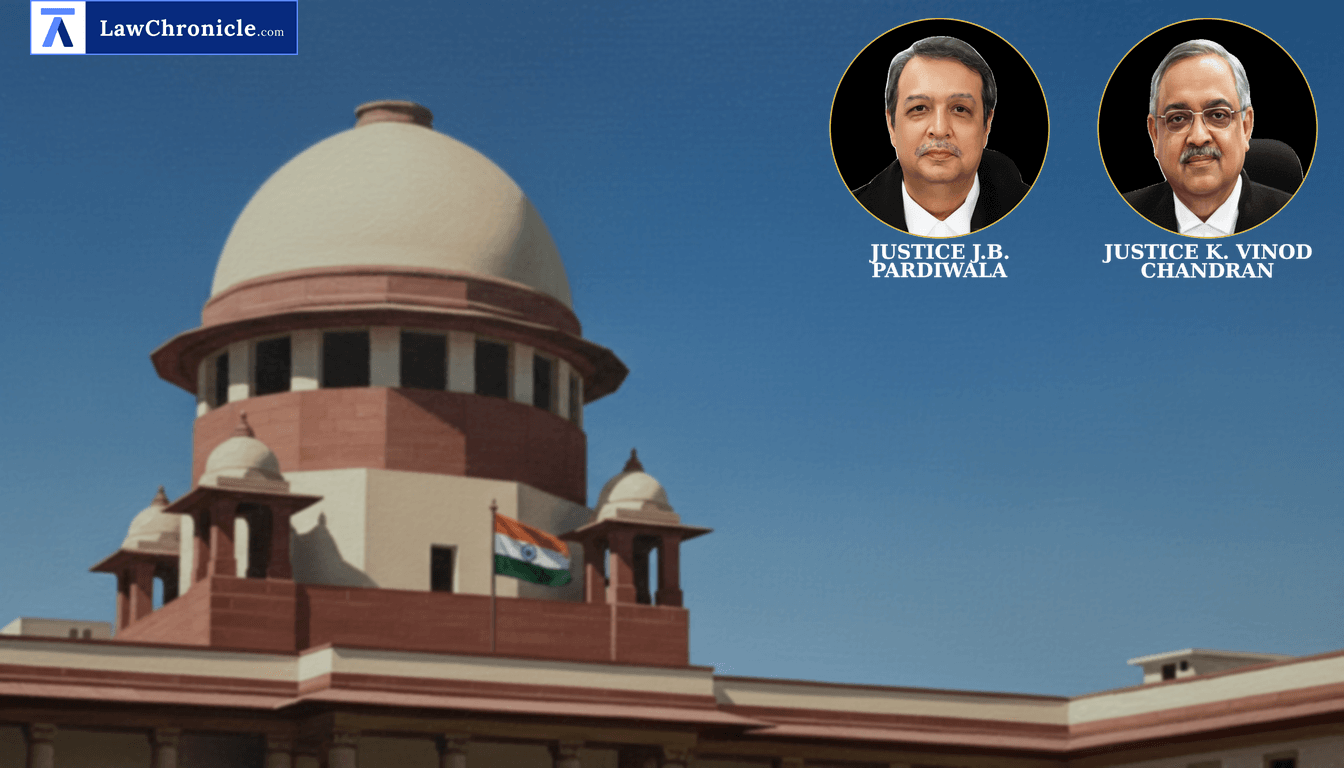
The Supreme Court has ruled that an investigation report revealing the overvaluation of shares received after completion of original proceedings constitutes tangible material establishing a 'reason to believe' that income escaped assessment. Upholding the validity of reassessment notices, the Apex Court emphasized that an assessment order reflecting no conscious application of mind or explicit opinion on an issue cannot bar reopening on the pretext of a change of opinion.
A bench of Justice J.B. Pardiwala and Justice K. Vinod Chandran dismissed civil appeals challenging the judgment of the Delhi High Court, which had upheld reassessment notices issued under Section 147 and Section 148 of the Income Tax Act, 1961 for Assessment Years 2008-09 and 2009-10.
Key Takeaways
Post-Assessment Reports Constitute Tangible Material: Investigative reports received after assessment completion provide valid legal grounds to form a 'reason to believe' under tax laws.
Scope of Change of Opinion Check: A plea of change of opinion is legally untenable if the original assessment order fails to express an opinion explicitly or by necessary implication.
Non-Assessment Under Intimation: Processed returns accepted under Section 143(1) involve no judicial assessment, leaving no room for a change of opinion defense.
Sufficiency of Material Non-Justiciable: Courts cannot examine the adequacy or sufficiency of reasons recorded by an Assessing Officer, provided a direct live link exists between the material and the belief.
Analyzing the statutory limits of reassessment powers, the Court outlined the essential prerequisites governing Section 147 and Section 148 of the Income Tax Act, 1961.
The Supreme Court reasoned to observe that “The expression “reason to believe” in Section 147 of the Act means cause or justification. The AO must have tangible material having a rational connection or a live link with the formation of the belief that income has escaped assessment, and need not have finally ascertained the fact by legal evidence or conclusion. At the stage of the notice, the only question is whether there was relevant material on which a reasonable person could have formed the requisite belief, and the sufficiency of the reasons is not a justiciable issue. Further, a mere “change of opinion” cannot be a reason to reopen, as the AO has the power to reassess and not the power to review. A change of opinion presupposes a conscious application of mind and the formation of an opinion in the original assessment, which the court must verify, either expressly or by necessary implication, before interfering with the reopening. The non-exhaustive principles governing “reason to believe” and “change of opinion” are at paragraph nos. 41 and 46 of this judgment, respectively.”
The Court accordingly upheld the validity of the notice.
Evaluating the legal framework behind reassessment, the Supreme Court, in its reasoning, observed: "To decide whether the Assessing Officer has a “reason to believe” that income chargeable to tax has escaped assessment, it is only those materials which were before the Assessing Officer at the time of initiating proceedings that have to be taken into account, and not any further materials which subsequently came to light in the course of the proceedings under this section. The expression “reason to believe” has been interpreted by this court to mean that the Assessing Officer must have some “tangible material” in his possession to come to the conclusion that there is escapement of income from assessment, before assuming jurisdiction under section 147."
Ratio
Reassessment under Section 147 of the Income Tax Act, 1961 is valid if initiated on the basis of tangible material obtained post-assessment that establishes a rational nexus to the belief that income escaped assessment. Where an assessment order does not express an opinion on a specific issue either explicitly or by necessary implication, initiating reassessment on fresh material does not constitute an impermissible 'change of opinion'.
Background
The dispute stemmed from Share Purchase Agreements entered into in October 2007 for the sale of shares in two companies for a consideration of Rs. 195 Crore and Rs. 60 Crore, respectively. The taxpayers, holding a one-fourth share, disclosed advance amounts in their initial returns and later claimed LTCG exemptions under Section 54F of the Income Tax Act, 1961 after depositing gains into specified savings accounts and purchasing residential property in New Delhi.
Scrutiny assessment under Section 143(3) of the Income Tax Act, 1961 was completed for AY 2008-09 in December 2010, accepting the returned loss. However, subsequent inquiries conducted by the Investigation Unit, Noida, concluded that the shares were substantially overvalued compared to the underlying land and building costs. Relying on this report, the Assessing Officer issued reopening notices under Section 148 of the Income Tax Act, 1961 in March 2015.
The taxpayers challenged the notices, contending that the reopening beyond four years lacked jurisdiction, was based on a mere change of opinion on fully disclosed facts, and that overvaluation of shares could not lead to escapement of income in the hands of the seller. The High Court rejected these pleas.
Tracing the historical evolution of precedents, the Supreme Court relied on Constitutional and landmark decisions, including Calcutta Discount Co. Ltd. v. ITO, S. Narayannappa v. CIT, Chhugamal Rajpal v. S.P. Chaliha ( "(1971) 1 SCC 453": 1971 CaseBase(SC) 578), Sheo Nath Singh v. Appellate Assistant Commissioner of Income Tax, Calcutta ( "1972 (3) SCC 234": 1971 CaseBase(SC) 76), ITO vs. Lakhmani Mewal Das, Ganga Saran & Sons (P). Ltd. v. ITO, Phool Chand Bajrang Lal v. ITO, CIT v. Rajesh Jhaveri Stock Brokers (P) Ltd., Income Tax Officer, Ward No. 16(2) v. Techspan India Private Limited and Another, CIT v. Kelvinator of India Ltd., and Sanand Properties (P) Ltd. v. CIT. Reaffirming these authorities, the Bench highlighted that 'reason to believe' requires cause or justification rather than established facts of escapement at the threshold stage.
Rejecting the appellants' arguments, the Supreme Court held that the post-assessment investigation report served as fresh tangible material displaying a live link with the belief formed by the officer. The Court concluded that the original non-speaking assessment order contained no conscious adjudication on the valuation or deferment of gains, ruling out any change of opinion. Consequently, the Supreme Court dismissed the appeals.
Case Details:
Case No.: Civil Appeal No. 13953 of 2026
Neutral Citation: 2026 INSC 1163
Case Title: Chetan Sabharwal v. Assistant Commissioner of Income Tax Circle 28(1) New Delhi
Appearances:
For the Petitioner(s): Mr. Mukul Rohatgi, Senior Advocate
For the Respondent(s): Ms. Nisha Bagchi, Senior Advocate; Mr. K.M. Nataraj, ASG
Source: 2026 CaseBase(SC) 9501
Similar Articles

 Breaking News


