


Prolonged Separation and Declared Unwillingness to Cohabit Constitute Cruelty: Madras HC
 Copy Link
 Share
 Save
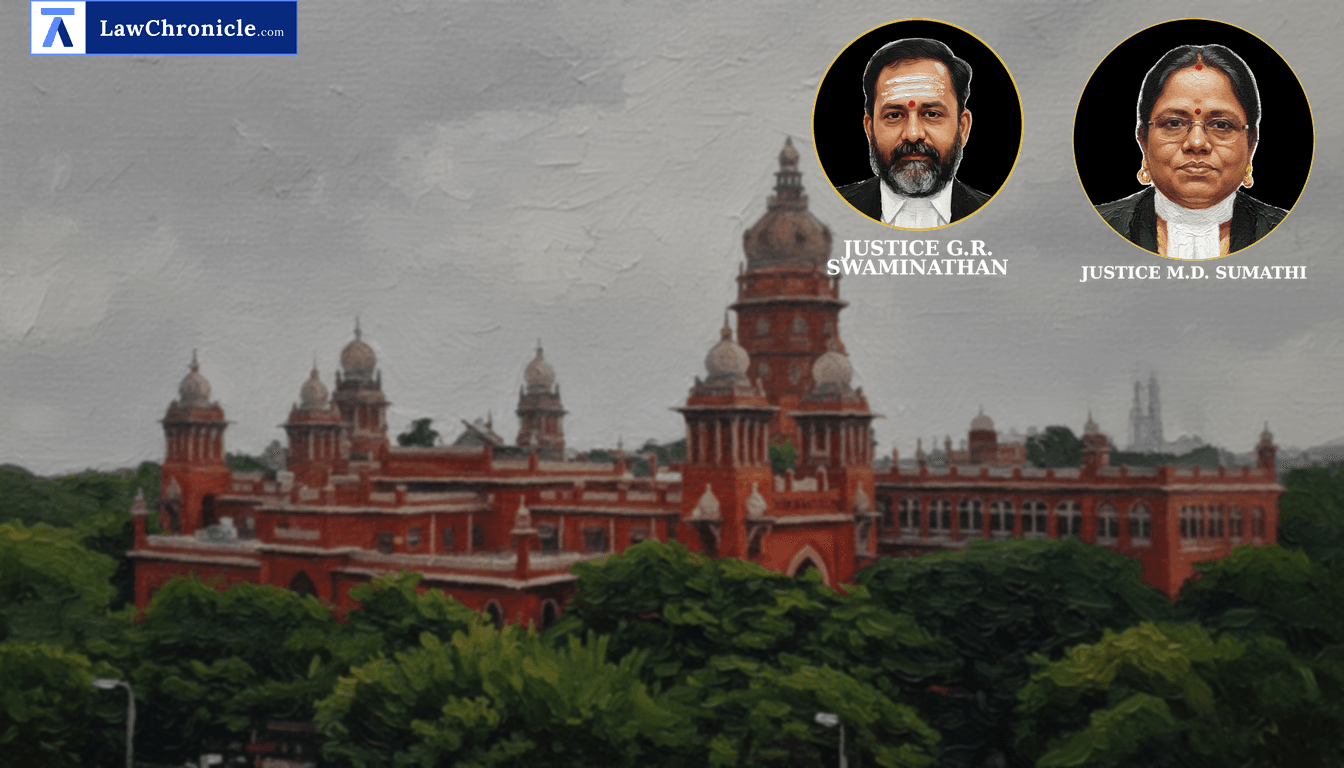
The Madras High Court has held that a spouse's categorical refusal to resume cohabitation, coupled with long-term separation, transforms a legal tie into a source of continuing distress, justifying a decree of divorce on grounds of mental cruelty.
Justice G.R. Swaminathan and Justice M.D. Sumathi, while setting aside a Family Court order, emphasized that while irretrievable breakdown is not a standalone statutory ground, the cumulative effect of prolonged separation and the absence of meaningful companionship establishes mental cruelty under Section 13(1)(i-a) of the Hindu Marriage Act, 1955.
Key Takeaways
Redefining Cumulative Cruelty
Individual incidents of trivial quarrels must be viewed through the lens of the entire matrimonial history to determine if the bond has lost its substance.
Impact of Declared Unwillingness
An express statement in court by a spouse refusing to live with their partner is a crucial evidentiary factor that cannot be ignored when assessing the state of the marriage.
Conditional Willingness is Insufficient
A spouse's readiness to live together solely for the welfare of children, rather than for the sake of the marital relationship itself, does not constitute a restoration of the matrimonial bond.
Mandatory Financial Disclosure
While non-compliance with the Rajnesh v. Neha "(2021) 2 SCC 324": 2020 CaseBase(SC) 717) asset disclosure format may not result in denial of alimony, Courts will apply cautious assessment to ensure equitable financial protection.
Judicial Analysis of Marital Deterioration
The Madras High Court observed that the Family Court erred by examining incidents in isolation. The Bench noted that the parties had lived apart for several years and that the wife had explicitly stated during cross-examination that she was not willing to reunite with the husband. The Court observed that "The fact that the respondent is prepared to consider living with the appellant only for the sake of the children does not demonstrate restoration of the marital relationship. On the contrary, it establishes that the matrimonial bond, as a relationship between husband and wife, has ceased to have the substance ordinarily associated with marital companionship."
The Madras High Court clarified that “We are not granting divorce merely because the parties have differences of opinion. Nor are we treating every allegation made by the appellant as proved. The decree rests upon the cumulative effect of the proved circumstances, particularly the prolonged separation, the absence of meaningful matrimonial companionship and the respondent's own categorical statement regarding her unwillingness to resume matrimonial life.”
Ratio
Where there exists a prolonged separation and a spouse expresses a categorical unwillingness to resume matrimonial cohabitation, or conditions such willingness solely on the welfare of children, the cumulative circumstances establish that the marriage has become oppressive and devoid of meaningful companionship, amounting to mental cruelty under Section 13(1)(i-a) of the Hindu Marriage Act, 1955.
Background
The appellant husband had initially approached the Family Court seeking divorce on grounds of cruelty, alleging frequent quarrels and desertion by the wife. The wife resisted the petition, claiming she was subjected to demands for money and jewellery. While the Family Court dismissed the divorce petition as 'ordinary wear and tear' of marriage, it also dismissed the wife's applications for Rs. 50 lakhs in permanent alimony under Section 25 of the Hindu Marriage Act, 1955 and the return of 12 sovereigns of gold jewellery.
In appeal, the Madras High Court scrutinized the evidence of the wife (R.W.1), where she admitted she did not intend to seek restitution of conjugal rights. Referring to Shri Rakesh Raman V.Kavita, the Bench held that continuation of a broken marriage serves no purpose. Although the husband's financial disclosure did not strictly follow the guidelines in Rajnesh v. Neha ( "(2021) 2 SCC 324": 2020 CaseBase(SC) 717), the Madras High Court determined an equitable permanent alimony of Rs. 25,00,000, noting the wife's responsibility in raising three children. The claim for return of jewellery was rejected due to material contradictions in the wife's prior statements.
Case Details:
Case No.: CMA(MD) NO. 1188 of 2025
Case Title: M.Ramkumar v. P.Muruheswari @ Nevetha Lakshmi
Appearances:
For the Petitioner(s): Mr.S.Selvakumar
For the Respondent(s): Mr.B. Azhagesh
Source: 2026 CaseBase(MAD) 28367
Similar Articles

 Breaking News


