


Proof of Marriage Essential to Claim Property Rights Under HMA Section 16: Madras HC
 Copy Link
 Share
 Save
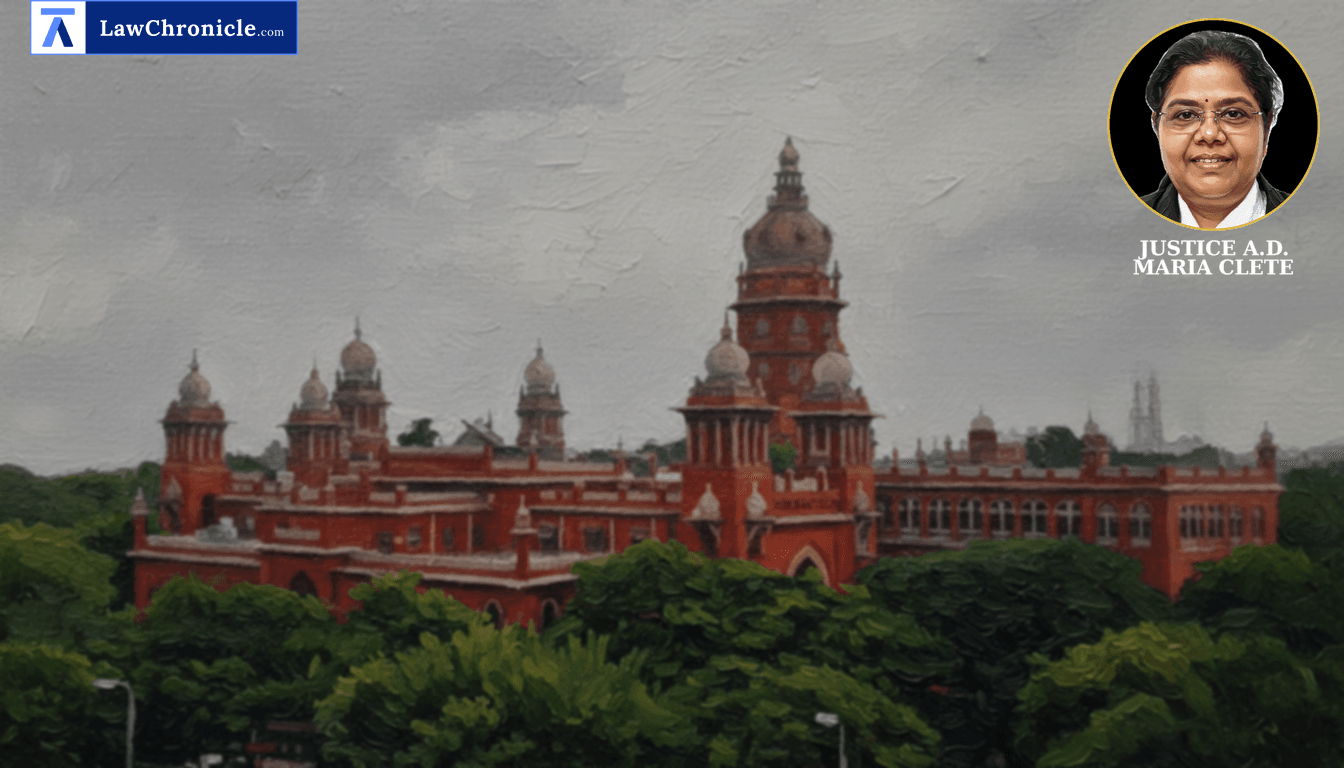
In a crucial clarification on Hindu succession and legitimacy, the Madras High Court held that biological paternity alone does not confer property rights under Section 16 of the Hindu Marriage Act, 1955 without proof of an actual solemnized marriage.
Justice Dr. A.D. Maria Clete dismissed an appeal filed by two daughters seeking partition in their alleged father's estate, upholding the trial court's dismissal of their suit.
Key Takeaways
Solemnization Required: Section 16 of the Hindu Marriage Act, 1955 protection applies strictly to void marriages, not non-existent ones.
Paternity vs Legality: Mere proof of biological paternity is insufficient to claim inheritance rights without proving marriage ceremonies.
Appellate Restrictions: Order XLI Rule 27 of the Code of Civil Procedure, 1908 cannot be used to fill lacunae or patch up weak points on appeal.
Court's Observations and Legal Principles
The High Court emphasized that the statutory protection legitimizing children born out of void marriages under the Hindu Marriage Act, 1955 requires proof of solemnization.
The Court, in its reasoning, observed: "To attract Section 16(1) of the Hindu Marriage Act, 1955, there must first have been a solemnisation of marriage between the parents... However, where no marriage at all was solemnised between the parents, the relationship cannot be treated as a void marriage merely for the purpose of invoking Section 16."
Addressing the request for additional appellate evidence, the Court noted: "Additional evidence cannot be admitted merely to 'fill in the lacunae or to patch up the weak points' in a party's case."
The Court has following directions:
"In view of the findings rendered on Point Nos. 1 to 3, the plaintiff is not entitled to the relief of partition. Consequently, the judgment and decree of the Trial Court are liable to be confirmed, and the appeals A.S. No. 720 of 2019 and C.M.P. No. 19560 of 2025 are dismissed. There shall be no order as to costs."
Ratio
To claim property inheritance under Section 16(1) of the Hindu Marriage Act, 1955, the party must establish that a marriage was solemnized between the parents. Proof of biological paternity in the absence of a solemnized marriage does not confer statutory legitimacy or succession rights in the parents' property.
Background
The plaintiffs filed a partition suit claiming two-thirds share in the properties of late Sundarathirusangu, alleging that he married their mother Savithri Ammal as his second wife according to caste custom and cohabited for 25 years. The first defendant, the legally wedded wife Mrs. Marimuthu, denied the marriage and disputed the plaintiffs' paternity.
The trial court dismissed the suit, noting the absence of proof of marriage, non-examination of the mother, and reliance on patta describing her as the wife of another individual. Appellants then approached the High Court alongside C.M.P. No. 19560 of 2025 under Order XLI Rule 27 read with Sections 107 and 151 of the Code of Civil Procedure, 1908 to adduce additional evidence, citing decisions in Madhvi Amma Bhawani Amma v. Kunjikutty Pillai Meenakshi Pillai ( "(2000) 6 SCC 301": 2000 CaseBase(SC) 267) and Joginder Pal v. Indian Red Cross Society ( "(2000) 8 SCC 143": 2000 CaseBase(SC) 1981) on succession certificates and Bharat Petroleum Corporation Ltd. and another v. N.R. Vairamani and another ( "AIR 2004 SC 4778": 2004 CaseBase(SC) 512) on precedent application.
The High Court held that the appellants failed to prove the date, place, or ceremonies of marriage, and rejected the application for additional evidence citing Satish Kumar Gupta v. State of Haryana ( "2017 (4) DCC 760": 2016 CaseBase(PNH) 591). Consequently, the High Court confirmed the trial court decree and dismissed both the appeal and C.M.P. No. 19560 of 2025.
Case Details:
Case No.: A.S. No. 720 of 2019 and C.M.P. No.19560 of 2025
Case Title: Ranimuthu and another v. Anbazhagan and another
Appearances:
For the Petitioner(s): Mr. M.V. Seshachari, Advocate.
For the Respondent(s): Mr. A. Senthil Kumar, Advocate.
Source: 2026 CaseBase(MAD) 10394
Similar Articles
 Breaking News


