


Punjab and Haryana HC: Statutory Minimum Wages Sole Benchmark for Assessing Notional Income
 Copy Link
 Share
 Save
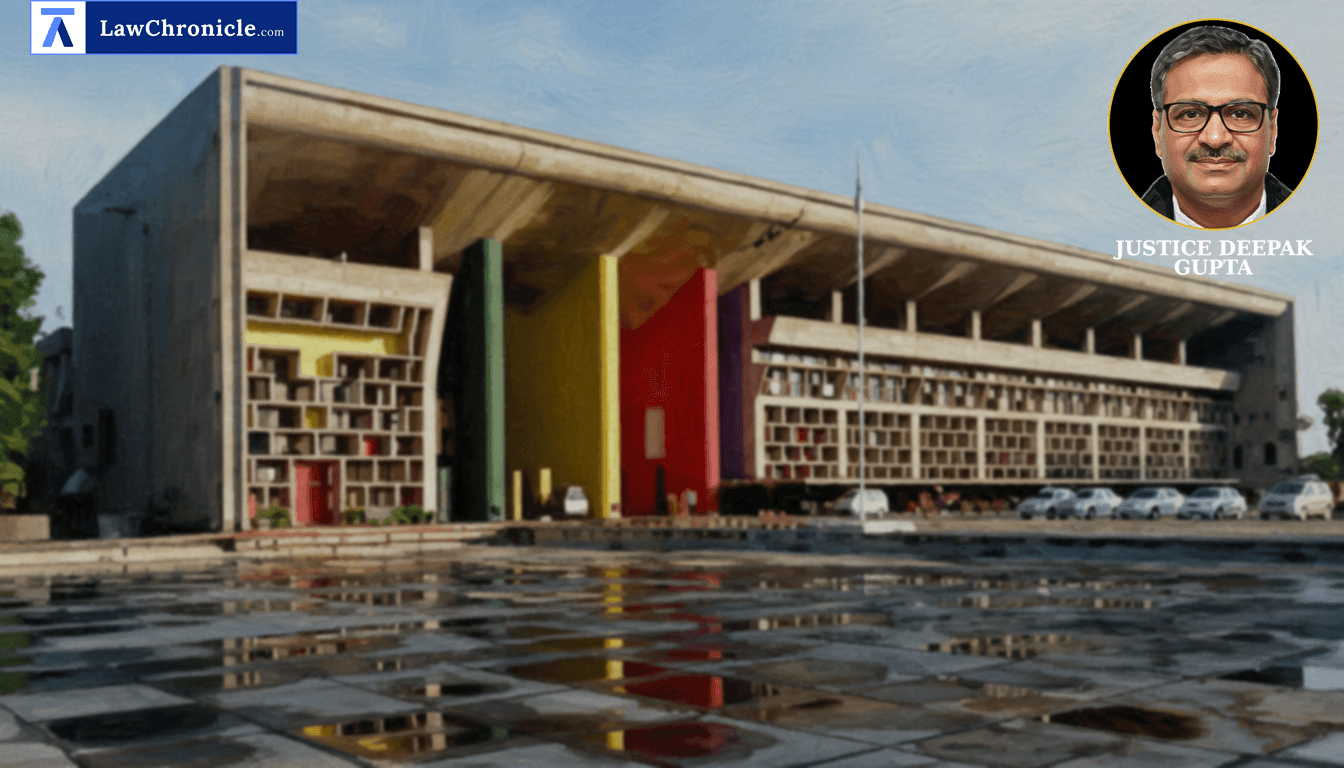
The Punjab and Haryana High Court has reinforced the mandatory application of statutory minimum wages as the only objective criterion for determining notional income in motor accident claims where documentary proof of earnings is absent. In a significant intervention against judicial guesswork, the Court ruled that Tribunals cannot substitute arbitrary assumptions for government-notified wage benchmarks, while simultaneously affirming that an insurer’s failure to prove a 'wilful breach' of policy conditions precludes its exoneration from liability.
In a common judgment delivered by Justice Deepak Gupta, the Court adjudicated two cross-appeals: one by the claimants seeking enhancement of compensation and another by Iffco Tokio General Insurance Company Ltd. challenging its liability. The dispute originated from a 2017 fatal accident involving a scooter and a canter, where the Motor Accident Claims Tribunal had initially awarded compensation based on a self-assumed daily wage of an ordinary labourer.
Tribunal’s Notional Income Assessment Set Aside
The High Court took strong exception to the Tribunal’s method of assessing the deceased's monthly income at ₹6,000/- based on simple guesswork. The Court noted that while the claimants failed to prove the deceased's specific income as a photographer, the Tribunal's reliance on a perceived daily wage of ₹200/- lacked rational basis. Invoking Section 168 of the Motor Vehicles Act, 1988, the Court emphasized that 'just compensation' must be derived from objective parameters.
The Court, in its reasoning, observed: "The expression 'just compensation' postulates determination of compensation on rational, objective and legally acceptable parameters rather than on guesswork or personal notions of the Court. In such circumstances, the notified minimum wages issued by the appropriate Government furnish the safest and most reliable benchmark for assessing notional income. The statutory minimum wages represent the minimum remuneration legally payable to a workman and, therefore, constitute a reasonable yardstick for computing loss of dependency where no better evidence regarding income is forthcoming."
Accordingly, the Court revised the income to ₹7,570/- per month, aligned with the minimum wages for unskilled workers in Punjab at the time of the accident.
Future Prospects And Medical Reimbursement Mandated
Justice Gupta further identified legal lapses in the Tribunal's refusal to award future prospects and medical expenses. Relying on the landmark ruling in National Insurance Company Limited v. Pranay Sethi and others ( "(2017) 16 SCC 680": 2017 CaseBase(SC) 551), the Court held that a 40% addition towards future prospects is mandatory for self-employed individuals below 40 years, even when income is assessed notionally. The Court also corrected the omission of medical expenses, noting that unrebutted medical bills totaling ₹53,000/- deserved full reimbursement. Following the principles in Sarla Verma and others v. Delhi Transport Corporation and another ( "(2009) 6 SCC 121": 2009 CaseBase(SC) 380) and Magma General Insurance Co. Ltd. v. Nanu Ram alias Chuhru Ram and others ( "(2018) 18 SCC 130": 2018 CaseBase(SC) 597), the Court standardized consortium awards for the widow, child, and mother of the deceased.
Insurer Liability And Breach Of Policy Standards
Addressing the Insurance Company’s plea for recovery rights, the Court held that the mere submission of an investigation report (Ex.R12) and RTI information (Ex.R13) regarding a 'fake' driving licence is insufficient. The Court noted that the insurer failed to examine the investigator or licensing officials as witnesses. Furthermore, the Court reiterated the principles established in National Insurance Co. Ltd. v. Swaran Singh and others ( "(2004) 3 SCC 297": 2004 CaseBase(SC) 114) regarding the burden of proof placed on insurers.
The Court, in its reasoning, observed: "Under Section 149(2) of the Motor Vehicles Act, 1988, the burden of establishing breach of policy conditions squarely lies upon the insurer. The defence relating to absence of a valid driving licence is a statutory defence available to the insurer, but the same cannot be accepted merely on pleadings or suspicion. The insurer must affirmatively establish notional not only that the driving licence was fake, invalid or ineffective, but also that there was a conscious and willful breach of the terms of the policy by the insured."
The Court has following directions:
"Consequently, FAO-3562-2019 filed by the claimants succeeds partly. The compensation awarded by the Tribunal is enhanced by ₹8,33,500/-. The enhanced amount shall carry interest at the rate of 7.5% per annum from the date of filing of the claim petition till realization and shall be payable jointly and severally by the driver, owner and insurer of the offending vehicle. The manner of apportionment and disbursement directed by the Tribunal shall remain unaltered. FAO-25-2019, filed by the Insurance Company, being devoid of any merit, is accordingly dismissed."
Key Takeaways:
Primacy of Minimum Wages
When actual income proof is missing, Tribunals must strictly follow government-notified minimum wages instead of relying on subjective daily-wage assumptions.
Mandatory Future Prospects
Courts must grant future prospects even in notional income cases for self-employed deceased persons, as per the established binding precedents.
Stringent Burden of Proof for Insurers
Insurance companies cannot secure recovery rights simply by labelling a licence 'fake'; they must prove the contents of verification reports through witnesses and demonstrate 'wilful breach' by the vehicle owner.
Standardization of Conventional Heads
Consortium is not limited to spouses but extends to parental and filial consortium, requiring individual payouts to each eligible dependent.
Ratio Decidendi:
Just compensation under Section 168 of the Motor Vehicles Act, 1988 must be based on rational and objective criteria; in the absence of documentary evidence of income, statutory minimum wages serve as the mandatory legal benchmark for assessing notional income. Furthermore, to escape liability under Section 149(2), an insurer must prove through admissible evidence both the invalidity of the licence and a conscious, wilful breach of policy by the insured.
Background:
The case arose from a 2017 accident where Rakesh Kumar’s scooter collided with a canter that had abruptly braked without signalling. The Motor Accident Claims Tribunal at Barnala held the canter driver negligent and awarded ₹8,41,000/-. The claimants appealed for enhancement, arguing the Tribunal wrongly assessed the income of the deceased (a photographer) at ₹6,000/- and ignored future prospects and medical expenses. The Insurance Company appealed for exoneration, alleging the driver’s Nagaland-issued licence was fake. The High Court dismissed the insurer's appeal, noting they had voluntarily closed evidence without proving their investigation documents, and partially allowed the claimants' appeal by enhancing the compensation to ₹16,74,328/- total.
Case Details:
Case No.: FAO-3562-2019 and FAO-25-2019
Case Title: Jyoti and others v. Dilbagh Singh and others
Appearances:
For the Petitioner(s): Ms. Parul, Advocate and Mr. Dheeraj Singla, Advocate
For the Respondent(s): Mr. Vishal Aggarwal, Advocate
Source: 2026 CaseBase(PNH) 152
Similar Articles
 Breaking News


