


SC Quashes Criminal Case Against Husband’s Kin Over Omnibus Allegations
 Copy Link
 Share
 Save
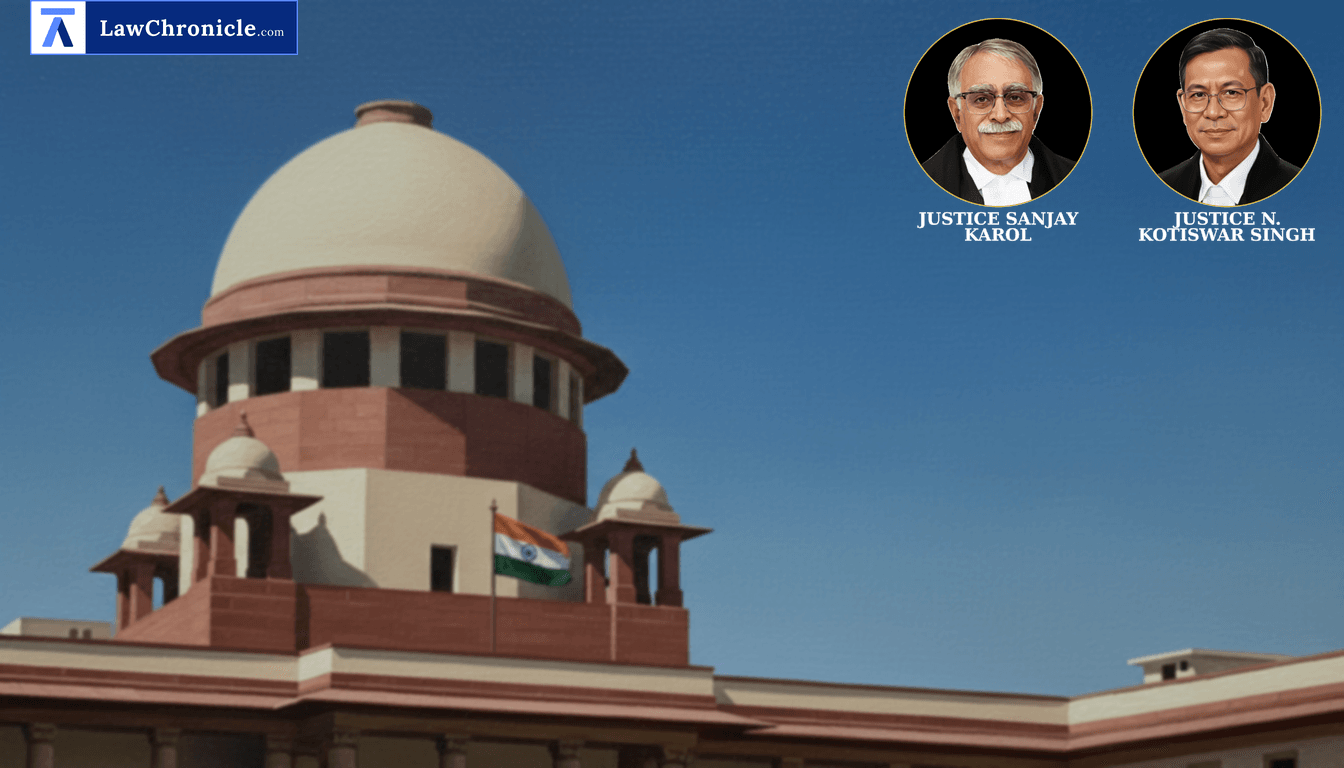
The Supreme Court has set aside criminal proceedings against the relatives of a husband in a matrimonial dispute, observing that vague and omnibus allegations cannot be used to rope in the entire family without specific overt acts. A Bench comprising Justice Sanjay Karol and Justice Nongmeikapam Kotiswar Singh emphasized that while matrimonial laws protect women, they should not become tools for personal vendetta against passive family members.
Court Quashes Proceedings Against In-Laws
The Bench was hearing appeals filed by the sister-in-law, mother-in-law, brother-in-law, and another relative of the husband, who were arrayed as accused in a case under Section 498A of the Indian Penal Code, 1860 and the Dowry Prohibition Act, 1961, as well as proceedings under the Protection Of Women From Domestic Violence Act, 2005. The appellants contended that they were falsely implicated immediately after the husband filed for restitution of conjugal rights under the Hindu Marriage Act, 1955. The Court noted that the primary allegations of physical assault and hidden cameras were directed solely at the husband.
Observations on Matrimonial Acrimony and Relative Liability
The Court observed that matrimonial disputes often involve heightened emotions, leading to the implication of the spouse's entire family. The Bench highlighted that mere familial association or failure to support a complainant does not equate to criminal culpability. The Court, in its reasoning, observed: "...mere familial association with the husband, or failure to support the complainant in a marital dispute, cannot by itself constitute a criminal offence in the absence of specific allegations disclosing active participation in acts amounting to cruelty, harassment or unlawful demand of dowry. ...criminal law cannot be permitted to become an instrument for venting personal grievances or settling familial scores in the absence of clear, specific and legally sustainable allegations."
Scope of Section 319 CrPC for Future Trial
While quashing the current proceedings based on the lack of prima facie material, the Supreme Court clarified that the Trial Court maintains the power to summon the appellants at a later stage if cogent evidence emerges during the trial of the husband. The Bench referenced the principles laid down in State of Haryana and Ors. v. Bhajan Lal and Ors. ( "1992 Supp (1) SCC 335": 1990 CaseBase(SC) 91) and Hardeep Singh v. State of Punjab ( "(2014) 3 SCC 92": 2014 CaseBase(SC) 496) regarding the exercise of powers under Section 319 of the Code Of Criminal Procedure, 1973 (now Section 358 of Bharatiya Nagarik Suraksha Sanhita, 2023). The Court further clarified that this quashing does not attract the bar of double jeopardy under Article 20(2) of the Constitution of India, 1950 as no full trial on merits occurred.
The Court has the following directions:
"(i) The impugned judgment and order dated 21.11.2024, passed by the High Court of Madhya Pradesh at Gwalior in Misc. Criminal Case No. 14615 of 2023 is hereby set aside and FIR/Crime No. 0041/2023 dated 13.01.2023 registered at Police Station Guna, District Guna, Madhya Pradesh under Sections 498A and 34 IPC and Sections 3 and 4 of the Dowry Prohibition Act, 1961, together with all consequential proceedings arising therefrom, including the charge-sheet/challan pending before the competent Court, stand quashed qua the present appellants namely, Arti Mehta, Shrivati Bai Dhakad, Manisha Dhakad and Vikram Dhakad.
(ii) The impugned judgment and order dated 21.11.2024, passed by the High Court of Madhya Pradesh at Gwalior in Misc. Criminal Case No. 20269 of 2023 is hereby set aside, and the proceedings in D.V. Complaint No. 1752 of 2023 pending before the Court of the Judicial Magistrate First Class, Guna, Madhya Pradesh, under Section 12 of the Protection of Women from Domestic Violence Act, 2005, stand quashed qua the present appellants, namely, Arti Mehta, Shrivati Bai Dhakad, Manisha Dhakad and Vikram Dhakad."
Background:
The dispute arose from the marriage of Sapna Dhakad and Divyaraj Dhakad in 2019. The complainant alleged that shortly after the wedding, her husband and his relatives began demanding additional dowry and subjecting her to cruelty. However, her own divorce petition indicated that she resided primarily with her husband in Sheopur, while the relatives lived in Shivpuri. The High Court of Madhya Pradesh had earlier refused to quash the FIR and the Domestic Violence complaint, prompting the relatives to approach the Apex Court. The Supreme Court relied on the landmark guidelines in State of Haryana and Ors. v. Bhajan Lal and Ors. ( "1992 Supp (1) SCC 335": 1990 CaseBase(SC) 91) to determine that the uncontroverted allegations failed to disclose a specific criminal role for the appellants. The Court followed the logic in Anand Kumar Mohatta v. State (NCT of Delhi) to maintain that Section 482 of Code Of Criminal Procedure, 1973 is applicable even after a charge-sheet is filed. Finding the allegations to be omnibus and generalized, the Court allowed the appeals.
Case Details:
Case No.: CRIMINAL APPEAL NO. OF 2026 (@ SLP (Crl.) NO. 18345 of 2024)
NeutralCitation: 2026 INSC 533
Case Title: ARTI MEHTA & ORS. v. THE STATE OF MADHYA PRADESH & ANR.
Source: 2026 CaseBase(SC) 457
Similar Articles

 Breaking News


