


Railways Is Consumer, Not Deemed Distribution Licensee Under Electricity Act: SC
 Copy Link
 Share
 Save
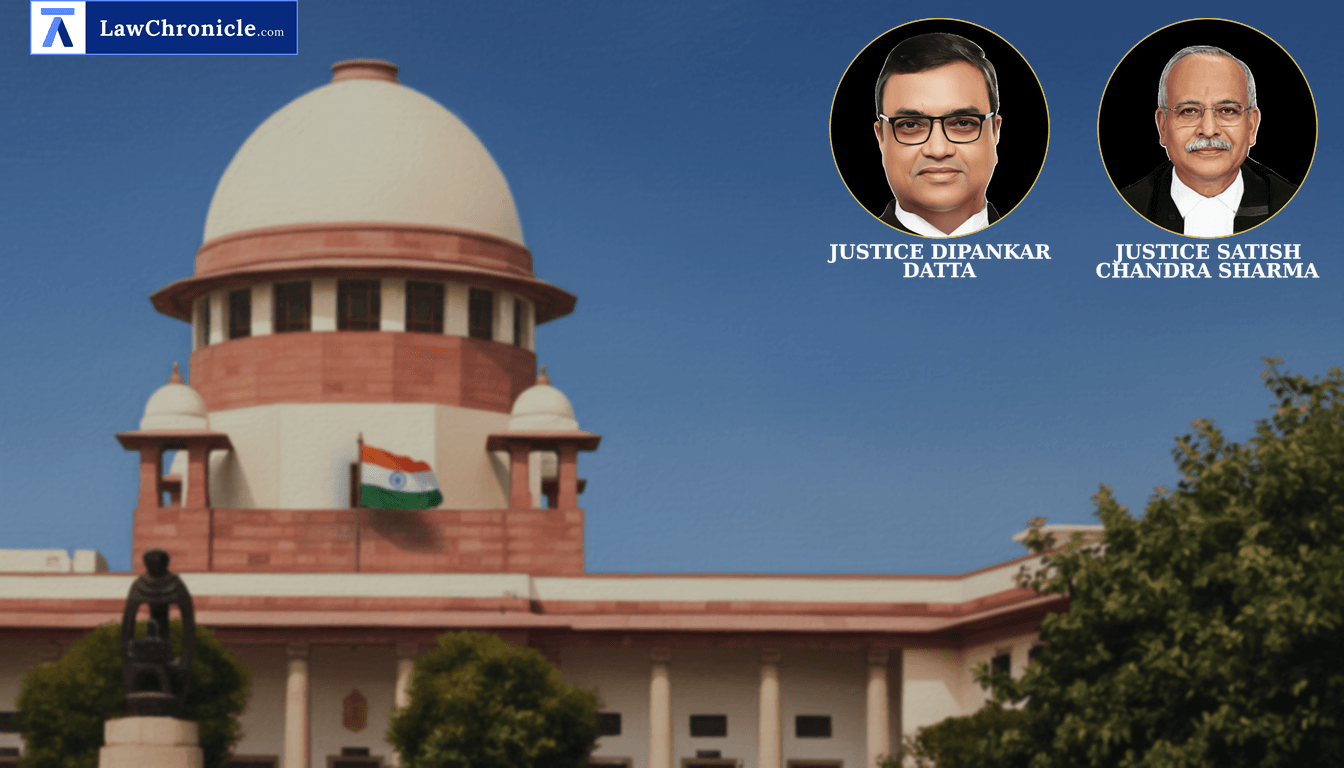
The Supreme Court of India has categorically held that the Indian Railways, despite being a central government entity, qualifies as a consumer rather than a deemed distribution licensee under the Electricity Act, 2003 when it procures electricity for its own operational use. This landmark ruling settles a decade-long dispute regarding the liability of the Railways to pay Cross-Subsidy Surcharge and Additional Surcharge for availing open access to power.
In an analytical judgment delivered by a bench comprising Justice Dipankar Datta and Justice Satish Chandra Sharma, the Court examined the intersection of the Railways Act, 1989 and the Electricity Act, 2003. The Court concluded that the internal conveyance of electricity for traction and station operations does not constitute the 'distribution' of electricity as contemplated under the legal framework.
The Functionality Test for Distribution Licensees
The Court emphasized that a distribution licensee must fulfill twin requirements: operating a distribution network and supplying electricity to consumers for consideration. It noted that the Railways' infrastructure exists for captive self-consumption and not for commercial supply to third parties. The Court, in its reasoning, observed: "A distribution installation which merely conveys electricity within the integrated railway system, from the overhead equipment to the power locomotives, communication systems, signals and station facilities, for its own consumption and use, and does not translate into sale or supply of electricity to a consumer against consideration, cannot be held to be within the meaning and scope of a distribution system under the Electricity Act."
Distinguishing the Railways from other entities like the Military Engineering Services, the Bench noted that the latter actually performs the function of distribution to residents and establishments, whereas the Railways consumes the power itself. The Court further clarified that Section 11 of the Railways Act, 1989, while granting the Railways authority to erect electrical installations, does not provide a blanket immunity from the regulatory licensing framework of the Electricity Act, 2003. Paraphrasing the principle in Sri Venkataramana Devaru & Ors. v. State of Mysore &Ors., the Court held that statutes should be read harmoniously, and the non-obstante clause in the Railways Act, 1989 only operates in cases of direct, irreconcilable inconsistency.
Liability for Cross-Subsidy and Additional Surcharges
On the issue of financial obligations, the Court relied on the rationale in Sesa Sterlite Limited v. Orissa Electricity Regulatory Commission & Ors. to affirm that surcharges are essential to maintain the financial health of distribution companies (DISCOMs) who bear the burden of stranded costs and subsidized tariffs. The Court remarked: "In a nutshell, CSS is a compensation to the distribution licensee irrespective of the fact whether its line is used or not... a consumer situated in an area is bound to contribute to subsidising a low end consumer if he falls in the category of subsidising consumer."
Background:
The dispute originated in 2015 when the Maharashtra State Electricity Transmission Co. Ltd. (MSETCL) refused to grant connectivity to the Railways for procuring 100 MW power through inter-state open access without a declaration of its status. The Railways approached the Central Electricity Regulatory Commission (CERC), which initially ruled in its favor, declaring it a deemed distribution licensee under the third proviso to Section 14 of the Electricity Act, 2003.
However, various State Electricity Regulatory Commissions (SERCs) and DISCOMs from West Bengal, Odisha, Kerala, and other states challenged this, leading to the impugned common judgment by the Electricity Act, 2003 Appellate Tribunal (APTEL) on February 12, 2024. APTEL had reversed the CERC order, holding that the Railways is an end-consumer.
The Supreme Court also looked at the legislative history, noting that the Draft Electricity Amendment Bill, 2025 proposed to exempt the Railways from these surcharges over five years. Citing Vodafone International Holdings BV v. Union of India & Anr. ( "(2012) 6 SCC 757": 2011 CaseBase(SC) 989), the Court interpreted this proposed change as evidence that no such exemption currently exists under the law. The Court held that the Railways cannot "approbate and reprobate" by taking positions contrary to the proposed statutory schemes. Consequently, the appeals filed by the Indian Railways were dismissed.
Case Details:
Case No.: CIVIL APPEAL NO. 4652 OF 2024
NeutralCitation: 2026 INSC 464
Case Title: INDIAN RAILWAYS v. WEST BENGAL STATE ELECTRICITY DISTRIBUTION COMPANY LIMITED & ORS.
Appearances:
For the Petitioner(s): Mr. M.G. Ramachandran, Senior Counsel; Ms. Aishwarya Bhati, ASG
For the Respondent(s): Mr. C.A. Sundaram, Senior Counsel; Mr. Vaidyanathan, Senior Counsel; Mr. Maninder Singh, Senior Counsel; Mr. S. Poovayya, Senior Counsel; Mr. Parag Tripathi, Senior Counsel
Source: 2026 CaseBase(SC) 417
Similar Articles
 Breaking News


