Recovery of Deceased's Ornaments Alone Cannot Prove Murder: Supreme Court
 Copy Link
 Share
 Save
Reinforcing the strict standards of proof required in murder cases, the Apex Court acquitted an individual who had spent over 13 years in incarceration due to broken links in the prosecution's evidentiary chain. The Bench emphasized that unexplained delay in recording witness statements coupled with doubtful recovery under Section 27 cannot form the sole basis of a murder conviction in a case resting entirely on circumstantial evidence.
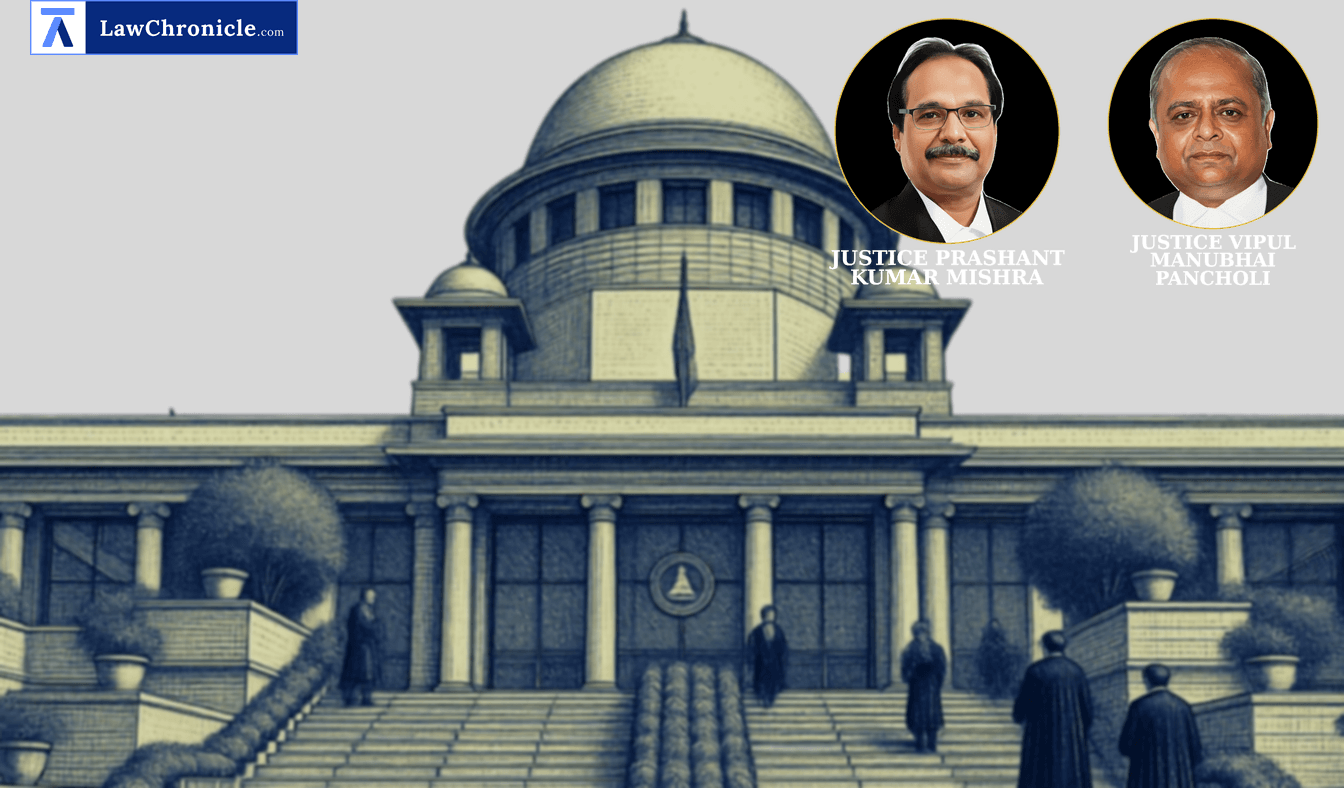
A Division Bench comprising Justice Prashant Kumar Mishra and Justice Vipul M. Pancholi heard an appeal challenging the judgment of the Karnataka High Court, which had affirmed a conviction under Section 302 of the Indian Penal Code, 1860. The primary issue before the Bench was whether the circumstantial evidence presented, comprising alleged motive, last seen theory, and recovery of ornaments, was sufficient to satisfy the five golden principles governing circumstantial cases.
Key Takeaways
Delay In Section 161 Statements Is Fatal: Unexplained delay of nearly two months in recording witness statements under Section 161 of the Code Of Criminal Procedure, 1973 completely undermines the reliance on the "last seen together" theory.
Section 27 Recovery Cannot Solely Prove Murder: Mere recovery of stolen items under Section 27 of the Indian Evidence Act, 1872 raises a presumption of theft under Illustration (a) to Section 114, but cannot infer murder unless both acts form part of the same transaction.
Motive Requires Concrete Proof: General knowledge of a relationship between parties cannot automatically be converted into a proved motive for murder without concrete evidence of dispute or suspicion.
Incomplete Chain Entitles Benefit Of Doubt: To sustain a conviction in a circumstantial case, the mental distance between 'may be' and 'must be' guilty must be fully bridged by the prosecution.
Court Observations and Directions
The Bench critically evaluated the lower court decisions and noted that the High Court erred in reversing the trial court's rejection of the "last seen" theory without addressing the 58-day delay in recording witness statements. Furthermore, the recovery of ornaments under Section 27 of the Indian Evidence Act, 1872 was found to be riddled with procedural gaps and lacking attestation by reliable independent witnesses. The Court, in its reasoning, observed that "Certainly, it is a primary principle that the accused must be and not merely may be guilty before a court can convict and the mental distance between ‘may be’ and ‘must be’ is long and divides vague conjectures from sure conclusions."
Ratio
In a case relying solely on circumstantial evidence, every link in the chain of circumstances must be proved beyond reasonable doubt. Unexplained long delays in recording statements of "last seen" witnesses, combined with recovery evidence that fails to strictly meet the requirements of Section 27 of the Indian Evidence Act, 1872, break the evidentiary chain, disentitling the court from drawing an inference of murder.
Background
The dispute originated from an incident in September 2013, when the body of an unidentified woman was found inside an iron drum at a limestone furnace. Investigations identified the deceased as a woman who was last seen returning from a family function. The prosecution alleged that the appellant had an illicit relationship with the deceased and, suspecting her character, strangled her with a plastic strap, robbed her ornaments, and dumped her body. The trial court convicted the appellant under Section 302 of the Indian Penal Code, 1860 based heavily on the recovery of gold ornaments under Section 27 of the Indian Evidence Act, 1872, while rejecting the "last seen" theory due to a 58-day delay in witness statements. The trial court had also acquitted him under Section 201 of the Indian Penal Code, 1860.
On appeal, the High Court affirmed the conviction under Section 302 of the Indian Penal Code, 1860 and additionally relied on the "last seen" theory to complete the chain of circumstances. However, the Supreme Court, applying established precedents including Sharad Birdhichand Sarda v. State of Maharashtra ( "(1984) 4 SCC 116": 1984 CaseBase(SC) 194), Sanwat Khan v. State of Rajasthan ( "(1952) 2 SCC 641": 1952 CaseBase(SC) 47), Raj Kumar @ Raju v. State (NCT of Delhi) ( "(2017) 11 SCC 160": 2017 CaseBase(SC) 528), Kanhaiya Lal v. State of Rajasthan ( "(2014) 4 SCC 715": 2014 CaseBase(SC) 522), Indrajit Das v. State of Tripura ( "(2023) 18 SCC 506": 2023 CaseBase(SC) 467), and Shivaji Sahabrao Bobade v. State of Maharashtra ( "(1973) 2 SCC 793": 1973 CaseBase(SC) 123), held that the motive was speculative, the last seen theory was unproven, and the recovery was unreliable. Consequently, the Supreme Court allowed the appeal, set aside the judgment of the High Court, and acquitted the appellant.
Case Details:
Case No.: Criminal Appeal No. 5402 of 2026
Neutral Citation: 2026 INSC 1239
Case Title: Bheemanagouda @ Bheemajja v. State by Harapanahalli Police
Appearances:
For the Petitioner(s): Mr. A. Sirajudeen, Senior Advocate
For the Respondent(s): Mr. Avishkar Singhvi, Additional Advocate General
Source: 2026 CaseBase(SC) 10302
Similar Articles
 Breaking News