


Referee Bench Can Decide Appeal Merits If Reference Lacks Explicit Points: SC
 Copy Link
 Share
 Save
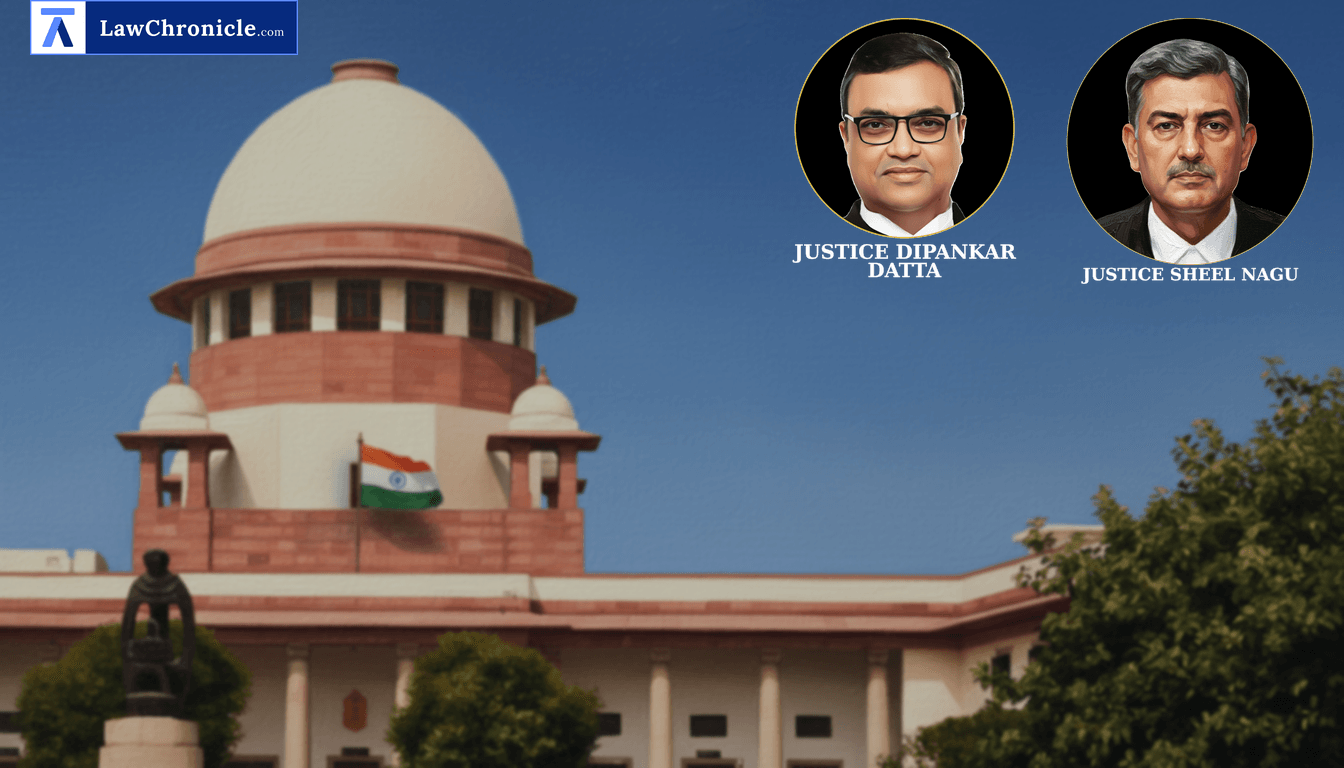
Taking a pragmatic stance on jurisdictional limits during split-verdict references, the Supreme Court ruled that a third member hearing a reference can decide the appeal on merits if the referring bench fails to delineate explicit points of difference and instead frames questions entwined with facts.
A bench comprising Justice Dipankar Datta and Justice Sheel Nagu set aside an order of the High Court of Judicature at Allahabad, which had interfered under Article 227 of the Constitution against a third member's decision in the National Consumer Disputes Redressal Commission.
Key Takeaways
Pragmatic Interpretation of Reference Limits: Where a referring bench formulates broad factual questions instead of specific legal points of difference, the referee member is justified in adopting a common-sense approach to decide the appeal on merits.
Strict Versus Pragmatic Scope in Consumer Disputes: While Section 58(3) of the Consumer Protection Act, 2019 mandates opining solely on points of difference, procedural defects in the referring order allow latitude to evaluate the full evidentiary record.
High Court Remand for Merits Examination: Interfering with reference procedure under Article 227 without examining the substantive merits warrants a remand back to the High Court for fresh consideration.
Court's Analysis and Observations
The Supreme Court analyzed the statutory framework of Section 58(3) of the Consumer Protection Act, 2019 alongside general principles governing references. The Court noted that while normally a referee bench must return answers to the referring bench, exceptional circumstances allow a broader evaluation when questions refer directly to the root of the dispute.
The Court, in its reasoning, observed: "The objection as to scope of the reference, in our view, is technical. While the statutory mandate under the CP Act requires the third member to confine himself to the point(s) of difference, the present case stands on a different footing. The referring order did not delineate the point(s) of difference; instead, it formulated questions which went to the root of the complaint and are inseparable from the evidence on record. The third member, necessarily, had to survey the entire gamut of material and the rival contentions raised before the referring Bench. It is in this backdrop that the third member, while answering the questions referred, also decided the appeal on merits based on the majority opinion... Viewed thus, the approach of the third member does reflect a common sense approach, which this Court in Salil Sabhlok (supra) acknowledged is available in exceptional cases."
Addressing the procedural misstep by the lower tribunal, the Court stated that by not returning the reference with answers and instead deciding the appeal, the third member did not commit such an illegality that warranted interference under Article 227.
Ratio
When a referring bench fails to state explicit points of difference under statutory reference provisions and instead formulates questions requiring a comprehensive review of facts and evidence, the referee bench does not commit a fatal jurisdictional error by deciding the appeal on merits based on the emerging majority opinion.
Background
The appellants lodged a consumer complaint before the State Consumer Disputes Redressal Commission, Uttar Pradesh, which awarded compensation of Rs. 95 lakh with 15% interest. On appeal, a two-member bench of the National Consumer Disputes Redressal Commission delivered a split verdict the presiding member sought to dismiss the complaint, while the companion member modified the award to Rs. 93 lakh with 12% interest.
Following a reference under Section 58(3) of the Consumer Protection Act, 2019, five specific factual questions were referred to a third member. The third member answered the questions, concurred with the companion member, and proceeded to dispose of the appeal itself with specific directions. The first respondent challenged this before the High Court, which quashed the third member's order on the ground that he acted in excess of jurisdiction by deciding the appeal rather than remitting it back to the Division Bench, relying on Kesho Nath Khurana vs Union of India and Others ( "1981 (Supp) SCC 38": 1981 CaseBase(SC) 189), Commissioner of Income Tax, Delhi & Bansi Dhar and Sons, and Shriram Industrial Enterprises Limited vs. The Union of India and Others.
Examining precedents including Kerala State Science & Technology Museum v. Rambal Co. ( "(2006) 6 SCC 258": 2006 CaseBase(SC) 1067), T.A. Hameed v. M. Viswanathan, Saquib Abdul Hameed Nachan v. State of Maharashtra ( "(2010) 9 SCC 93": 2010 CaseBase(SC) 367), and State of Punjab v. Salil Sabhlok ( "(2013) 5 SCC 1": 2013 CaseBase(SC) 589), the Supreme Court acknowledged the general rule laid down in Kesho Nath Khurana vs Union of India and Others ( "1981 (Supp) SCC 38": 1981 CaseBase(SC) 189) and reaffirmed in State of Punjab v. Salil Sabhlok ( "(2013) 5 SCC 1": 2013 CaseBase(SC) 589) that larger or referee benches must strictly answer referred questions. However, drawing reliance on State of Punjab v. Salil Sabhlok ( "(2013) 5 SCC 1": 2013 CaseBase(SC) 589), the Supreme Court recognized that referee benches may address subsidiary issues using a common-sense approach.
Finding that the High Court only addressed procedural aspects without examining the substantive findings, the Supreme Court set aside the High Court's order and remanded the Article 227 petition to the High Court for fresh determination on merits.
Case Details:
Case No.: Civil Appeal No. 11988 of 2026
Neutral Citation: 2026 INSC 929
Case Title: Askari Hussain and Ors. v. Dinesh Kumar and Ors.
Source: 2026 CaseBase(SC) 899
Similar Articles
 Breaking News


