


Repeat Offenders Cannot Escape Externment Orders Over Procedural Delays: Kerala HC
 Copy Link
 Share
 Save

The Kerala High Court has reinforced the state's power to curb habitual criminal activity, ruling that a brief procedural delay in issuing an externment order does not snap the 'live link' between the crime and the preventive measure if the delay is reasonably explained by the need for meticulous documentation. This decision underscores the judiciary's refusal to interfere with the subjective satisfaction of law enforcement authorities when dealing with 'known rowdies' who persistently violate the law even after previous punitive actions.
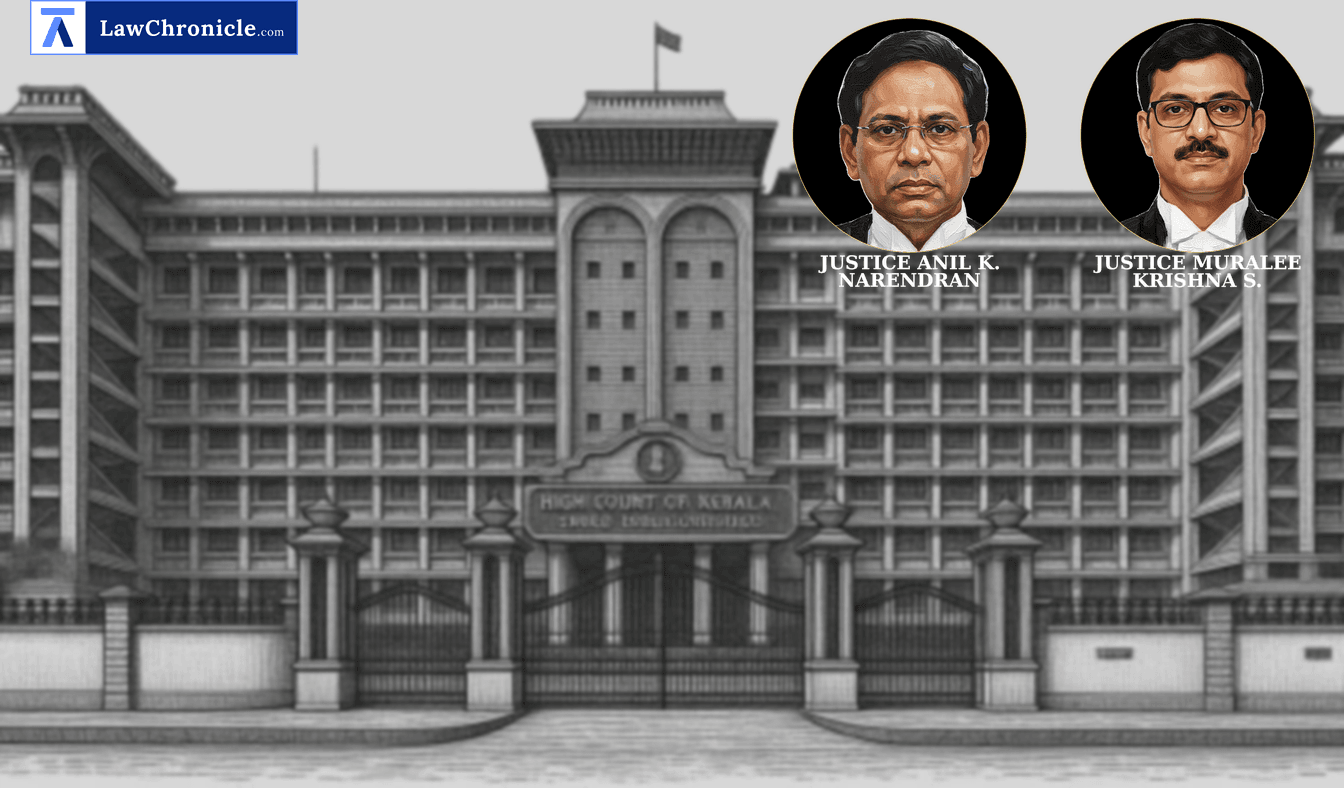
A Division Bench comprising Justice Anil K. Narendran and Justice Muralee Krishna S. delivered this ruling while hearing a challenge against an externment order issued by the Deputy Inspector General of Police. The petitioner, classified as a 'known rowdy' under the Kerala Anti-Social Activities (Prevention) Act, 2007, sought to set aside the order primarily on the grounds of a 1.5-month delay between the grant of anticipatory bail and the sponsoring report.
Key Takeaways
- Live Link Preservation: A delay in externment proceedings does not automatically invalidate the order if the time was spent collecting necessary criminal records.
- Subjective Satisfaction Supremacy: Courts will not act as appellate bodies over the subjective satisfaction of detaining authorities unless there is a total lack of material or evidence of mala fides.
- Habitual Offender Accountability: Previous involvement in multiple crimes and the violation of earlier bonds are critical factors in justifying preventive restraints under anti-social prevention laws.
Court's Rationale on Procedural Delay
The Court dismissed the petitioner's argument regarding the 'snapped live link' by noting that the delay was accounted for by the administrative necessity of gathering records for 13 prior criminal cases. The bench observed that the authorities had demonstrated application of mind by reducing the externment period from one year to six months and providing specific exemptions for family functions.
The Court, in its reasoning, observed: "When considering the fact that, apart from the aforementioned six criminal cases considered for issuing Ext.P3 externment order, the petitioner was involved in 13 other criminal cases registered on various periods, this explanation offered in Ext.P3 can be treated as a reasonable explanation."
The Court further emphasized that its jurisdiction under Constitution of India is limited in matters of preventive restraint. The Court has following directions:
"In the result, this writ petition stands dismissed."
Ratio
Under the Kerala Anti-Social Activities (Prevention) Act, 2007, a delay in issuing an externment order does not vitiate the proceedings if the authorities provide a reasonable explanation for the time taken, such as the collection of records for numerous past offenses. The High Court, exercising jurisdiction under Constitution of India, cannot substitute its own opinion for the subjective satisfaction of the detaining authority regarding the necessity of an externment order, provided there is sufficient material on record to justify the classification of the individual as a 'known rowdy'.
Background
The petitioner was classified as a 'known rowdy' under Section 2(p)(iii) of the Kerala Anti-Social Activities (Prevention) Act, 2007 following his involvement in multiple criminal cases, including those registered under the Bharatiya Nyaya Sanhita, 2023 and IPC. Despite having undergone a previous externment order in 2023, the petitioner was subsequently involved in three additional crimes, including incidents involving charges of assault and attempt to murder. The Deputy Inspector General of Police, Thrissur Range, issued an order on June 27, 2026, restraining the petitioner from entering Palakkad District for six months. The petitioner challenged this order, alleging that the delay in the sponsoring report snapped the live link and that he was provided with illegible copies of the case documents. The Court, after perusing the files, found the documents legible and the delay reasonably explained, citing precedents such as George v. State of Kerala ( "[2010 (4) KLT 416]": 2008 CaseBase(KER) 56) and Aaliya Ashraf v. State of Kerala ( "[2025 (1) KLT SN 15]": 2025 CaseBase(KER) 20661) to affirm the limited scope of judicial interference in such preventive measures.
Case Details:
Case No.: WP(CRL.) NO. 1209 OF 2026
Neutral Citation: 2026:KER:69498
Case Title: Ratheesh v. State of Kerala & Ors.
Appearances:
For the Petitioner(s): Sri. Anil K. Muhamed, Shri. Krishnakumar G., Shri. Ajin Salam, Shri. Amith Leo James, Advocates
For the Respondent(s): Shri. Chethan Krishna R., Government Pleader
Source: 2026 CaseBase(KER) 21031
Similar Articles



 Breaking News


