


Revenue Entries Cannot Extinguish Title In Property: Supreme Court
 Copy Link
 Share
 Save
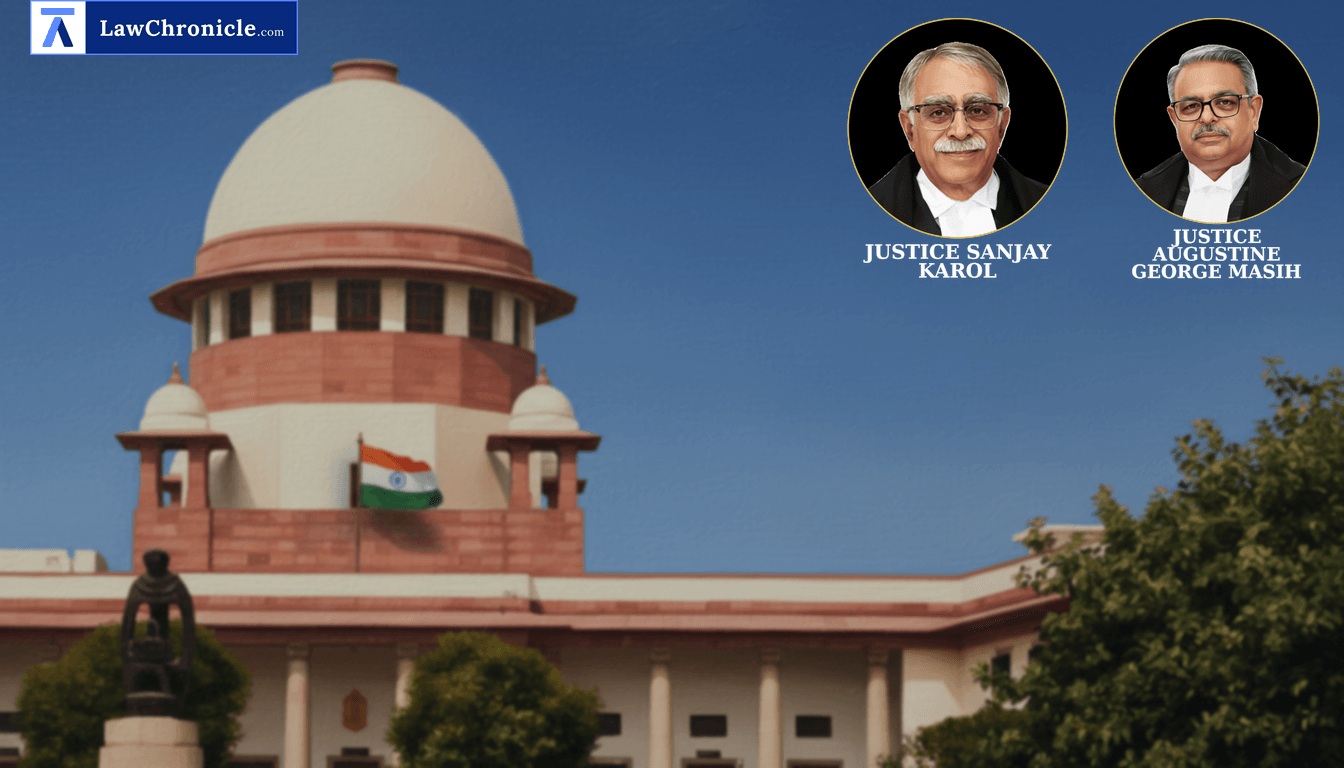
Revenue record mutations lack the legal efficacy to extinguish or create title in immovable property, nor do they act as an absolute bar to civil suits for declaration of ownership. Reaffirming that administrative entries exist primarily for fiscal purposes, the Supreme Court restored a decree for partition and co-ownership in an agricultural property dispute.
A Division Bench comprising Justice Sanjay Karol and Justice Augustine George MasIH addressed an appeal challenging a High Court decision that had overturned concurrent factual findings under Section 100 of the Code of Civil Procedure, 1908. The primary issue before the apex court revolved around whether an unchallenged revenue mutation and an unproved consent document could legally divest a co-owner of his inherited title and bar a civil suit on the grounds of limitation.
Key Takeaways
Revenue Entries Do Not Create Title: A revenue mutation order cannot operate as a conveyance or relinquish proprietary rights in immovable property.
Restricted Scope Under Section 100 CPC: High Courts cannot reappreciate evidence under second appellate jurisdiction merely to adopt an alternative plausible view.
No Ouster Among Co-Owners Without Explicit Notice: Possession by one co-owner is legally presumed to be on behalf of all unless hostiles ouster is unequivocally proven.
Omission to Seek Mutation Cancellation Not Fatal: A suit for declaration of title and partition remains maintainable even without a specific prayer to cancel a revenue entry.
Court's Analysis on Revenue Mutations and Scope of CPC
The Supreme Court underscored that the High Court exceeded its jurisdiction by reappreciating evidence and overturning the consistent factual findings of the trial court and the first appellate court. Addressing the impact of revenue proceedings, the Court observed that entries in revenue records do not confer or extinguish title.
The Court, in its reasoning, observed: "It is settled law that an entry in the revenue record neither creates nor extinguishes title and exists essentially
for fiscal purposes, as held by this Court in Sawarni v. Inder Kaur and Others. The order of the Naib Tehsildar may regulate the revenue record, but it cannot, merely by recording one person's name in place of another, operate as a conveyance or a relinquishment of proprietary rights, and the civil court remains fully competent to determine the underlying title, which the revenue entry follows rather than creates."
On the question of limitation and the bar under Section 34 of the Specific Relief Act, 1963, the Court clarified that the right to sue accrued when the threat to title became clear upon public notice, rather than the date of an administrative mutation order.
The Court has following directions:
"The judgment and order dated 09.05.2025 passed by the High Court is set aside, and the judgment and decree dated 02.05.2019 passed by the first appellate court, affirming the judgment and decree dated 04.05.2016 passed by the trial court, stand restored. The appellants and the other legal heirs of the late Ramprasad shall accordingly be entitled to the share declared in their favour, subject to lawful partition in accordance with the applicable provisions of the Madhya Pradesh Land Revenue Code, 1959. The respondents shall remain restrained from alienating the disputed property or from creating any third-party rights therein contrary to the decree of the trial court until such lawful partition takes place."
Ratio
A revenue entry is a rebuttable evidentiary presumption under fiscal law and does not constitute a document of title or conveyance. Where title by succession is claimed by a co-owner, the cause of action for a civil suit for declaration and partition accrues upon an open denial or threat to such title, and the mere existence of an adverse revenue entry without proof of ouster does not trigger limitation under Article 58 or Article 100 of the Limitation Act, 1963, nor does the absence of a prayer to cancel such entry attract the proviso to Section 34 of the Specific Relief Act, 1963.
Background
The dispute pertained to 12.41 acres of agricultural land in Village Kanadia, Indore, originally owned by Bhagwansingh and inherited jointly by his two sons, Ramprasad and Vasudev. Following Ramprasad's death, his wife Jamnabai and children filed a civil suit in 2008 seeking declaration of co-ownership, partition, and injunction after discovering that Ramprasad's name had been removed from revenue records in 1990 and mutated entirely under Vasudev and his son's names, followed by a 2008 public notice to sell a portion of the property.
The respondents resisted the suit alleging that Ramprasad had relinquished his rights pursuant to a family partition and an unrecorded consent letter (Ex.D5) alongside revenue proceedings (Ex.D22) under the Madhya Pradesh Land Revenue Code, 1959. The trial court decreed the suit in favour of the appellants, finding Ex.D5 vague and the mutation unlawful. The first appellate court affirmed this decree after evaluating additional evidence under Order XLI Rule 27 of the Code of Civil Procedure, 1908.
However, the High Court of Madhya Pradesh reversed the concurrent decrees in Second Appeal, holding the suit barred by limitation under Articles 58 and 100 of the Limitation Act, 1963 and barred by Section 34 of the Specific Relief Act, 1963 for failing to seek explicit cancellation of the 1990 mutation order. The Supreme Court relied upon precedents such as Bholaram v. Ameerchand ( "(1981) 2 SCC 414": 1981 CaseBase(SC) 325), Kulwant Kaur and Others v. Gurdial Singh Mann (Dead) by LRs. and Others ( "(2001) 4 SCC 262": 2001 CaseBase(SC) 1071), P. Kishore Kumar v. Vittal K. Patkar ( "(2024) 13 SCC 553": 2023 CaseBase(SC) 61), Sawarni v. Inder Kaur and Others, and P. Lakshmi Reddy v. L. Lakshmi Reddy ( "(1956) 2 SCC 759": 1956 CaseBase(SC) 62) to hold that the High Court erred in law, set aside the High Court's judgment, and fully restored the appellate decree favoring the appellants.
Case Details:
Case No.: Civil Appeal No. of 2026 (Arising out of SLP (C) No.39 of 2026)
Neutral Citation: 2026 INSC 900
Case Title: Jamnabai and Others v. Vasudev and Others
Source: 2026 CaseBase(SC) 814
Similar Articles

 Breaking News


