


Revenue Entry does not confer Title, nor Proves Adverse Possession: Supreme Court Reiterates
 Copy Link
 Share
 Save
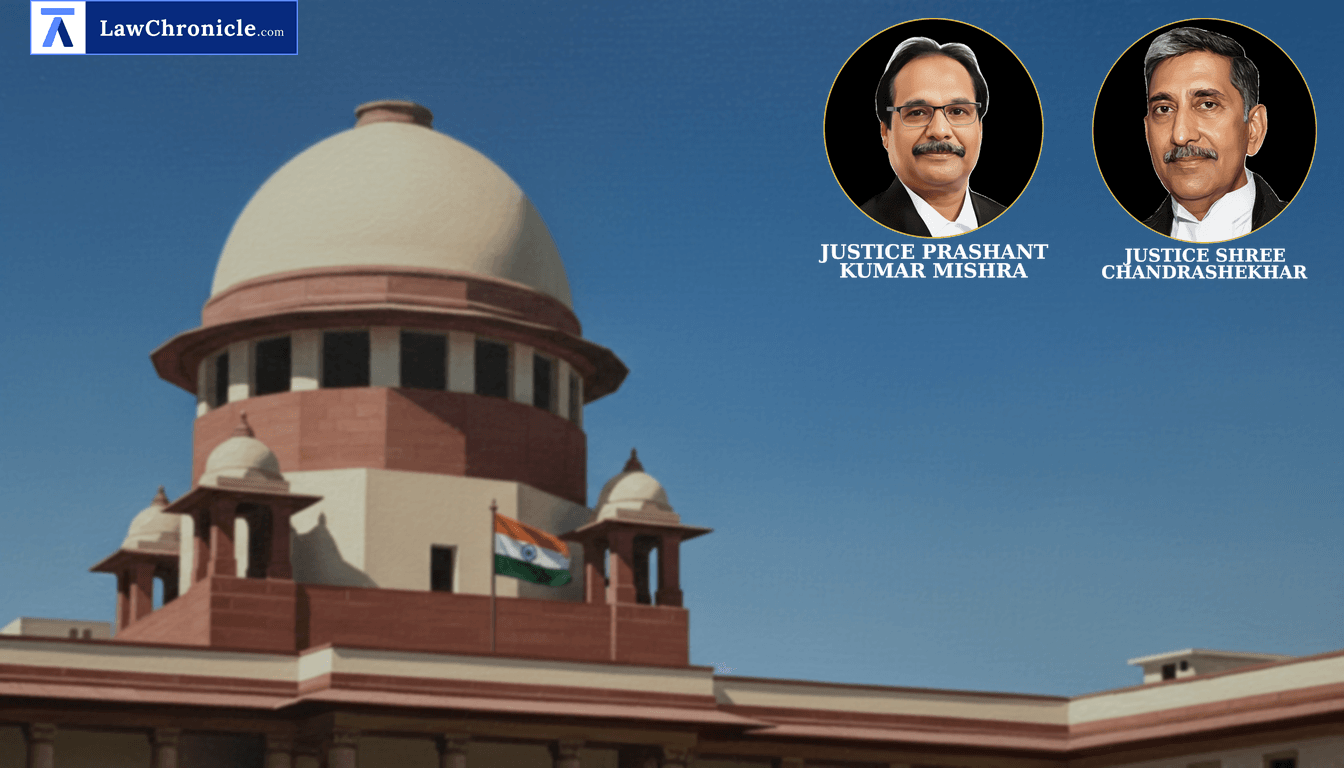
Revenue Entry does not confer Title, as confirmed by the Supreme Court, nor do they automatically prove adverse possession without explicit hostile intent against the true owner.
A bench comprising Justice Prashant Kumar Mishra and Justice Shree Chandrashekhar dismissed a civil appeal challenging a Punjab and Haryana High Court judgment, affirming that continuous occupation for religious purposes does not inherently mature into ownership by adverse possession under Section 100 of the Code of Civil Procedure, 1908.
Key Takeaways
Revenue Entry does not confer Title: Land entries maintained for fiscal purposes prove possession but can neither create nor extinguish ownership.
Hostile Animus Is Mandatory: Long, uninterrupted occupation without a clear, hostile assertion against the true owner cannot establish adverse possession.
Mutually Destructive Pleas: Asserting ownership through dedication to a religious institution contradicts a simultaneous claim of acquiring title via adverse possession.
Section 100 CPC Scope: The High Court legitimately interferes with concurrent factual findings if lower courts misapply settled legal principles.
Revenue Entry does not confer Title: Supreme Court
Reiterating settled principles on land records, the Supreme Court highlighted that revenue entries are primarily fiscal tools. As clarified by the Apex Court, "Revenue records, including Jamabandis and Khasra Girdawaris, are undoubtedly relevant pieces of evidence for determining the nature and continuity of possession. They neither create nor extinguish title, nor can they, by themselves, constitute conclusive evidence of ownership."
Requisites for Adverse Possession
Addressing the failure to establish adverse possession, the bench noted that the origin of possession was permissive and for religious purposes, which precluded hostile animus. The Apex Court observed: "Where possession can be referred to a lawful or permissive origin, it cannot be regarded as adverse merely by lapse of time... The doctrine of adverse possession does not reward longevity of occupation alone. It protects only such possession as is accompanied by a conscious and hostile assertion of ownership in denial of the rights of the true owner."
The Supreme Court also affirmed the High Court's exercise of second appellate jurisdiction, ruling that misapplication of law by lower courts justifies interference under Section 100 of the Code of Civil Procedure, 1908. Relying on Suraj Bhan and Others vs. Financial Commissioner and Others ( "(2007) 6 SCC 186": 2007 CaseBase(SC) 789) and Vadiyala Prabhakar Rao and Others vs. Government of Andhra Pradesh and Others ( "2026 SCC OnLine SC 815": 2026 CaseBase(SC) 386), the Court reiterated that fiscal entries do not confer title, while referencing T. Anjanappa and Others vs. Somalingappa and Another ( "(2006) 7 SCC 570": 2006 CaseBase(SC) 270) and Government of Kerala and Another vs. Joseph and Others ( "2023 SCC OnLine SC 961": 2023 CaseBase(SC) 53) regarding the strict requirements of adverse possession. On the scope of second appeals, the Court adverted to Kondiba Dagadu Kadam vs. Savitribai Sopan Gujar and Others ( "(1999) 3 SCC 722": 1999 CaseBase(SC) 3) and A. Shahul Hameed vs. N. Malligarjuna and Others ( "2026 SCC OnLine SC 969": 2026 CaseBase(SC) 491), while noting the principles governing burden of proof as laid down in Ramchandra Sakharam Mahajan vs. Damodar Trimbak Tanksale (Dead) and Others ( "(2007) 6 SCC 737": 2007 CaseBase(SC) 1204) and Dharampal (Dead) Through Legal Representatives vs. Punjab Wakf Board and Others.
Ratio
Revenue entries do not confer title to immovable property and are limited to proving possession for fiscal purposes. A party claiming adverse possession must explicitly plead and prove the precise time when possession turned open, continuous, and hostile to the true owner's title; long permissive possession or entries indicating use for religious purposes ("gair marusi bila lagan bawaja Dharam Arth") cannot automatically mature into ownership by adverse possession.
Background
The dispute pertained to 4 Kanals 18 Marlas of agricultural land in Muktsar, Punjab. The original plaintiffs instituted a civil suit in 1981 seeking a declaration of ownership and permanent injunction based on a registered sale deed dated May 13, 1965, executed by Gajjan Singh and Baggu Singh. The defendants, representing Dera Bhai Mastan Singh, contested the suit claiming the land was irrevocably dedicated for Dharam-Arth (charitable/religious purposes) and that successive Mahants had been in continuous possession, thereby acquiring title by adverse possession. They relied on Jamabandi records from 1945–46 recording Mahant Attar Singh as "gair marusi bila lagan bawaja Dharam Arth".
Both the Trial Court and the First Appellate Court dismissed the plaintiffs' suit, holding that the land stood dedicated to the Dera and that the Dera had perfected its title by adverse possession. However, in a second appeal under Section 100 of the Code of Civil Procedure, 1908, the Punjab and Haryana High Court reversed the concurrent decrees and decreed the suit in favor of the plaintiffs, ruling that revenue entries showing permissive religious use do not establish hostile possession or absolute dedication. The Supreme Court upheld the High Court's decision and dismissed the appeal.
Case Details:
Case No.: Civil Appeal No. 1718 of 2016
Neutral Citation: 2026 INSC 983
Case Title: Bhag Singh (D) Thr. Mahant Kashmir Singh v. Basant Kaur (D) Thr. LRs. and Others
Source: 2026 CaseBase(SC) 6994
Similar Articles
 Breaking News


