


Rights of Prisoners With Disabilities Must Be Recognized: SC Empowers High-Level Committee
 Copy Link
 Share
 Save
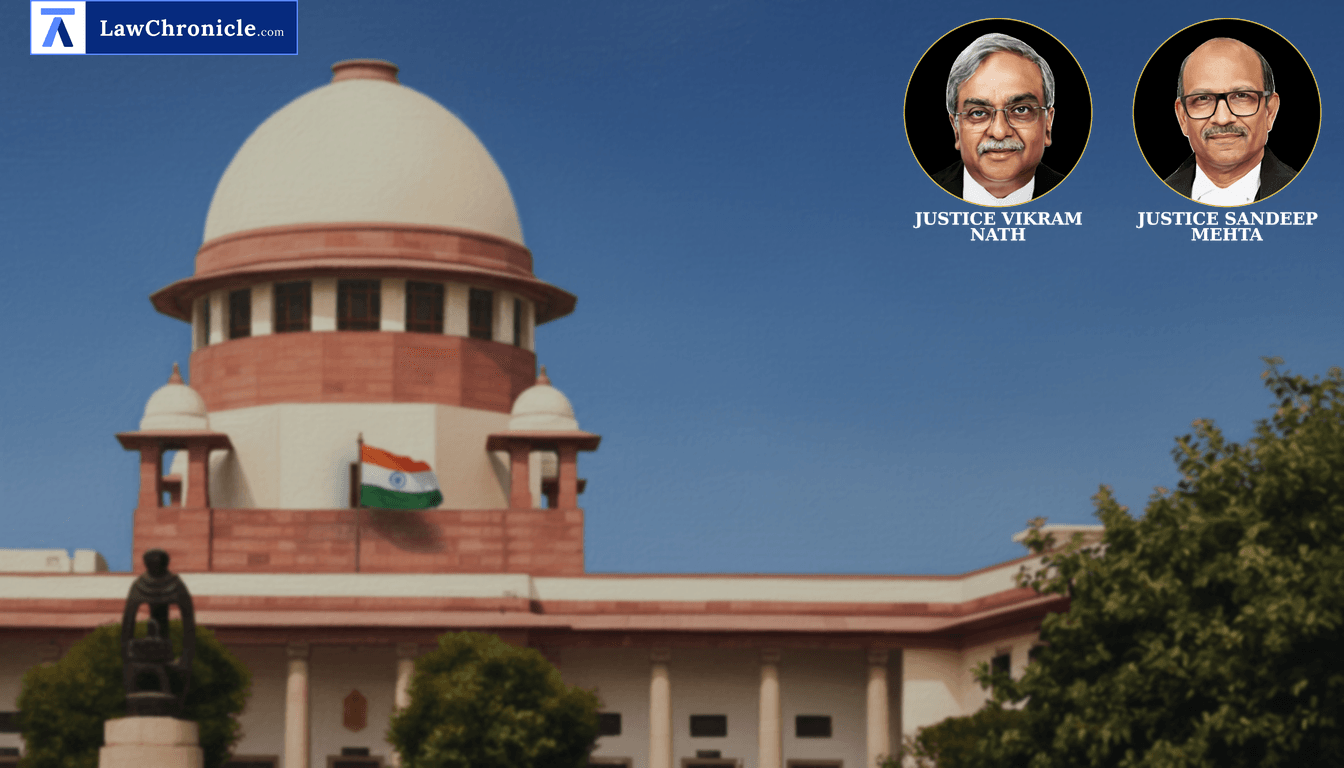
The Supreme Court examined systemic deficiencies in the treatment and safeguards provided to prisoners with disabilities, as well as the enforcement of statutory and constitutional protections guaranteed to them. The matter came before a bench comprising Justice Vikram Nath and Justice Sandeep Mehta, which was hearing a public interest petition challenging the adequacy of facilities and mechanisms available to such prisoners.
The Court summarized its principal direction and reasoning and then issued consequential institutional measures. The Court observed that earlier remedial measures already set out a comprehensive framework and that additional, nation wide directions were required to ensure uniform implementation.
The Court issued the following directions:
“A. The Secretary, Department of Empowerment of Persons with Disabilities, Union of India (or his nominee not below the rank of Additional Secretary), shall forthwith start active participation in the proceedings before the High-Powered Committee.
B. The Secretaries of the Department of Social Justice and Empowerment/Department of Social Welfare of all States and Union Territories (or their nominees not below the rank of Additional Secretary) shall also join the proceedings and ensure effective representation before the High-Powered Committee with immediate effect.
C. All the States and Union Territories shall place their compliance affidavits before the High-Powered Committee within a period of six weeks from the date of this order.
D. The petitioners as well as the intervenor(s) are permitted to participate in the proceedings before the High-Powered Committee and shall be at liberty to file their representations along with any relevant material, before it. The High-Powered Committee shall duly consider such representations in accordance with law while discharging its mandate.
E. The High-Powered Committee shall ensure due and effective compliance by all States and Union Territories with the directions issued by this Court in L. Muruganantham v. State of Tamil Nadu and Others ( "(2025) 10 SCC 401": 2025 CaseBase(SC) 737), as well as those mandated vide order dated 2nd December, 2025 in the present proceedings. For the said purpose, it shall be empowered to issue such directions to the concerned departments of the States/Union Territories, as may be necessary for effective implementation.
F. The High-Powered Committee shall formulate a comprehensive and implementable action plan for the provision of appropriate assistive devices, mobility aids, and other necessary support equipment to prisoners with disabilities, ensuring that such measures are tailored to their specific needs and functional requirements. The said action plan shall also lay down uniform standards, modalities of procurement, maintenance protocols, and safeguards, while duly taking into account the security considerations inherent in prison administration, so as to facilitate its effective and consistent adoption by all the States and Union Territories.
G. The High-Powered Committee shall be at liberty to seek assistance from expert institutions, specialised bodies, and organisations working in the field of persons with disabilities, and may engage with domain experts, civil society organisations, and other stakeholders, as may be required, for the effective and informed discharge of its functions. The expenses incurred in this exercise shall be borne by the Ministry of Social Justice and Empowerment, Union of India as may be directed by the High-Powered Committee.
H. The Chairperson of the High-Powered Committee shall devise appropriate modalities governing its functioning and schedule of meetings, so as to suitably delineate and, where necessary, segregate its consideration of issues pertaining to Open Correctional Institutions from those arising in the present proceedings, ensuring focused and effective examination of both domains.
I. The High-Powered Committee shall, as far as feasible within a period of four months, submit a consolidated status report before this Court indicating the progress made, challenges encountered, and further measures proposed for ensuring full compliance with the directions issued by this Court.
J. All the States and Union Territories shall extend full cooperation to the High-Powered Committee and ensure that all requisite data, records, and logistical support are made available to it in a timely manner.”
Background
The petitioner contended that prisons across States and Union Territories lacked adequate mechanisms to identify inmates with disabilities, provide accessible infrastructure, assistive devices, healthcare and inclusive education, and that monitoring and grievance redressal systems were weak. The Court recorded that many of these concerns had been substantially addressed by the framework set out in L. Muruganantham v. State of Tamil Nadu and Others ( "(2025) 10 SCC 401": 2025 CaseBase(SC) 737), which the Court described as having laid down exhaustive directions including identification at admission, accessible infrastructure, availability of assistive devices, staff sensitisation, accessibility audits, maintenance of disability related data, inclusive prison manuals and periodic compliance reporting. The Court therefore extended the scope of those directions to all States and Union Territories and added further measures, noting that "Section 89 of the Rights of Persons with Disabilities Act, 2016 shall mutatis mutandis be made applicable to prison establishments across the country" and requiring awareness and sensitisation of prison personnel.
At the hearing on 8th April, 2026 the Court noted that only twelve States and Union Territories had filed compliance affidavits. After considering submissions, the Court held that the broader and continuous oversight required for cohesive implementation would be best achieved by entrusting the task to the High Powered Committee constituted in Suhas Chakma v. Union of India & Ors. ( "2026 SCC OnLine SC 317": 2026 CaseBase(SC) 168), which was already mandated to oversee the harmonisation of rules for Open Correctional Institutions. The Court therefore directed participation by senior officers from the Department of Empowerment of Persons with Disabilities and the Departments of Social Justice and Empowerment/Social Welfare of all States and Union Territories before the High‑Powered Committee, required all States and Union Territories to place compliance affidavits before that Committee within six weeks, and permitted petitioners and intervenors to file representations with the Committee.
The High Powered Committee was empowered to formulate an implementable action plan for provision, procurement, maintenance and secure dispensation of assistive devices and mobility aids, to evolve uniform standards balancing security and accessibility, to call for reports, to engage expert institutions and civil society, and to submit a consolidated status report to the Court within four months. The Court recorded that these directions were issued to ensure coordinated, uniform and rights‑based implementation across jurisdictions and directed transmission of the order to the Chairperson of the High Powered Committee for compliance.
Resultantly, the petition was directed to be monitored through the High Powered Committee with specific institutional mandates and timelines; the Court required comprehensive compliance reporting and retained supervisory control by listing the matter for further consideration.
Case Details:
Case No.: WRIT PETITION (CIVIL) NO(S). 182 OF 2025
NeutralCitation: 2026 INSC 397
Case Title: SATHYAN NARAVOOR VERSUS UNION OF INDIA & ORS.
Source: 2026 CaseBase(SC) 357
Similar Articles
 Breaking News


