


SC Orders Disability Rights Act Compliance; Upholds Upward Movement for Meritorious PwBD Candidates
 Copy Link
 Share
 Save
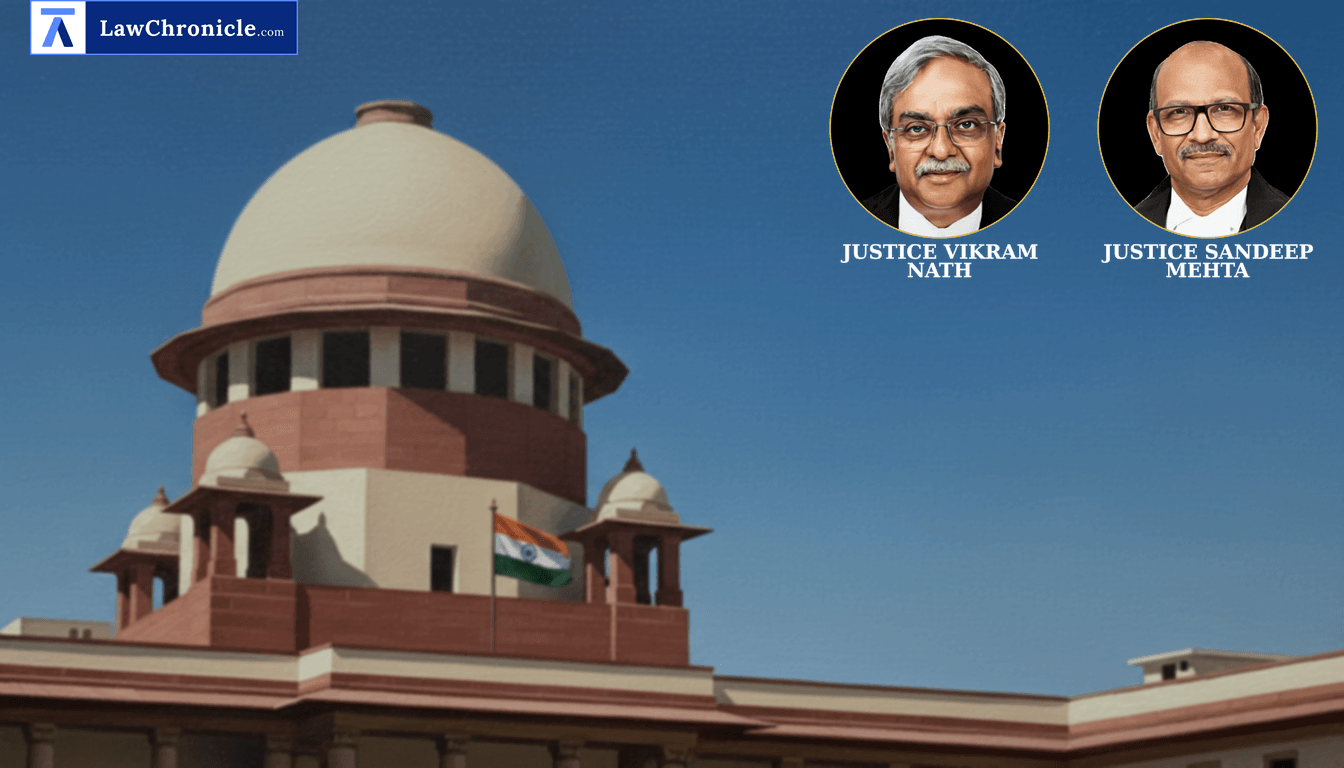
To strengthen the rights of persons with disabilities, the Supreme Court mandated a rigorous, audit-style assessment of the implementation of the Rights of Persons with Disabilities Act, 2016 across India, while clarifying that meritorious candidates with disabilities must not be confined to reserved quotas.
A Division Bench comprising Justice Vikram Nath and Justice Sandeep Mehta issued these directions while monitoring the progress of institutional mechanisms intended to support vulnerable sections of society. The Court's intervention comes amid persistent delays by several States and Union Territories in appointing Nodal Officers, a requirement previously established to facilitate the effective functioning of National Law Universities in implementing judicial mandates.
Upward Movement and the 'Own Merit' Principle
The Court addressed a critical query regarding whether persons with benchmark disabilities who secure marks higher than the unreserved category cut-off should be adjusted against unreserved seats. The Union of India, through the Department of Personnel and Training, clarified that its policy framework already supports the 'own merit' principle.
The Court, in its reasoning, observed: "The position in law, as clarified, ensures that meritorious candidates belonging to the PwBD category are entitled to be considered against unreserved vacancies on the basis of their own merit, while preserving the efficacy and purpose of reservation. We, accordingly, endorse the said position and exhort the Union of India, as well as all States and Union Territories, to scrupulously adhere to and implement the policy of upward movement in its true letter and spirit, so as to advance the constitutional mandate of equality, dignity and inclusion for persons with disabilities."
Guidelines on Relaxed Standards
It was clarified that facilitative measures, such as the use of a scribe or compensatory time, do not constitute 'relaxed standards.' However, relaxations in age, cut-off marks, or number of attempts would mean the candidate is adjusted against the reserved quota. Furthermore, the Court noted that a person's disability should not be treated as a relaxed standard during medical fitness tests when determining 'own merit.'
Project Ability Empowerment: Monitoring Statutory Compliance
Expressing concern over the "minimal compliance" reported nearly eight years after the enactment of the Rights of Persons with Disabilities Act, 2016, the Court shifted the monitoring responsibility to National Law Universities. This decision followed a status report in Justice Sunanda Bhandare Foundation v. Union of India & Ors. highlighting longstanding deficiencies, including the failure to establish State Funds for Persons with Disabilities.
The Court has the following directions:
"The Union Territories of Lakshadweep Islands and Ladakh to appoint Nodal Officers in terms of the directions issued by this Court. The said exercise shall be completed positively on or before 15th May, 2026. ... The National Law Universities entrusted with the exercise under 'Project Ability Empowerment', in terms of the directions issued by this Court, undertake a detailed and structured assessment of the implementation of the Rights of Persons with Disabilities Act, 2016 across all States and Union Territories. ... National Law University, Delhi shall undertake the exercise of mapping the extent of compliance with the provisions of the Rights of Persons with Disabilities Act, 2016 achieved by the Union of India. ... The Secretary, Department of Social Justice and Empowerment, Union of India, shall depute an officer not below the rank of Joint Secretary to participate in the meetings to be convened by National Law University, Delhi."
Background:
The matter originated from a long-running litigation, Justice Sunanda Bhandare Foundation v. Union of India & Ors., alongside other appeals such as Civil Appeal No. 11938 of 2016, focusing on the faithful execution of disability laws. Historically, the Court noted that even under the Persons with Disabilities (Equal Opportunities, Protection of Rights and Full Participation) Act, 1995, compliance by States remained inadequate. Despite a landmark judgment on 12th September, 2025, several states like Kerala, Jharkhand, and Odisha had failed to appoint Nodal Officers for seven months. While most states complied following a threat of personal appearance by Chief Secretaries in an order dated 15th April, 2026, the Court remains focused on the broader failure of institutional mechanisms. The next hearing is scheduled for 22nd September, 2026, to review updated status reports from the National Law Universities.
Case Details:
Case No.: Writ Petition (Civil) No(s). 116 of 1998
NeutralCitation: 2026 INSC 441
Case Title: Justice Sunanda Bhandare Foundation v. Union of India & Ors.
Appearances:
For the Petitioner(s): Mr. Colin Gonsalves, Senior Counsel
For the Respondent(s): Mr. K.M. Nataraj, Additional Solicitor General; Mr. Vatsal Joshi, Advocate-on-Record
Source: 2026 CaseBase(SC) 561
Similar Articles



 Breaking News


