


SC Acquits Accused Over Flawed Investigation and Unreliable Eyewitnesses
 Copy Link
 Share
 Save
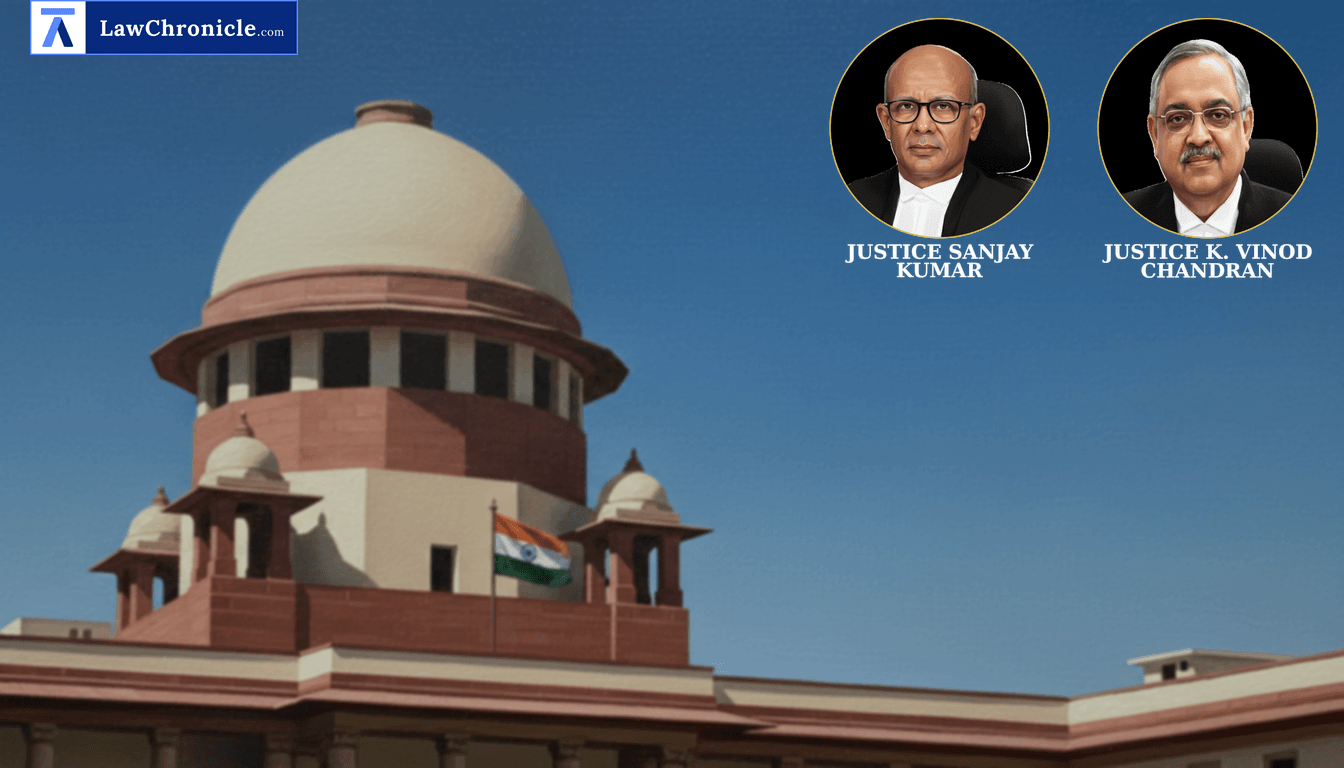
The Supreme Court of India in Sadek Ali @ Md. Sadek Ali & Anr. v. State of Assam & Anr. acquitted 12 convicts in a murder case, holding that the criminal investigation was not initiated in accordance with the mandatory procedure prescribed under the Code of Criminal Procedure, 1973. A bench of Justices Sanjay Kumar and K. Vinod Chandran heard appeals challenging convictions in a brutal homicide and related offences, and considered whether the investigation and the testimony of closely-related eyewitnesses supported the trial court and High Court findings.
A bench of Justices Sanjay Kumar and K. Vinod Chandran heard appeals challenging convictions in a brutal homicide and related offences, and considered whether the investigation and the testimony of closely-related eyewitnesses supported the trial court and High Court findings.
The Court summarized its conclusion and clarified that the prosecution case miscarried chiefly because of investigative lapses and serious doubts about the eyewitness evidence.
The Court, in its reasoning, observed: "An inept investigation or a scripted enquiry, both are fatal to criminal prosecution; but the latter has lethal consequences when there is a possibility of totally innocent persons being crucified. In the present case 16 persons were charge-sheeted as accused, of which one died during the trial. Out of the remaining, 12 were convicted and sentenced under Sections 147, 341, 326, 307, 323 and 302 read with Section 149 of the Indian Penal Code, 1860. Eighteen witnesses were examined before the trial court, of which six were eyewitnesses: one disbelieved by the trial court and the High Court. The defense examined two witnesses and denied their culpability. The appellants are the convicted accused, two of whom have passed away."
Background
The appellant accused were convicted after trial for offences alleged to have been committed during a concerted attack in July 2008. The prosecution case, as reflected in the FIR and accompanying documents, was that the deceased and five others were waylaid, assaulted with sharp cutting weapons and one victim suffered amputation of a hand. The trial court convicted and the High Court largely affirmed those convictions. The appeals addressed the delayed registration of the FIR, the genesis and reliability of the general diary entry, the credibility of five eyewitnesses who were close relatives of the deceased, and the shortcomings in on-scene procedures adopted by the investigating officer.
The Court analyzed the sequence of police action, noting that a GD entry prompted police attendance but that the FIR was registered two days later on a written complaint. The Court observed that statements allegedly recorded under Section 161 of the Code Of Criminal Procedure, 1973 were not produced and that statements under Section 164 of the Code Of Criminal Procedure, 1973 were recorded much later, raising questions about the formation of the accused array and the integrity of the investigation. The Court further found that seized weapons were not forensically examined and that seizure documents and motorbike ownership were not substantiated at trial. The judges noted infirmities in the proof of injuries of the so-called injured eyewitnesses, and that the testimony of close relatives, even if consistent, was clouded by the absence of independent corroboration.
The judgment stated that the investigative lapses and evidentiary gaps made the prosecution case unsustainable and concluded: "The appeals are allowed, acquitting the appellants and cancelling the bail bonds of the accused who is/are on bail." The Court therefore allowed the appeals and acquitted the appellants, observing that the State must strengthen training and procedures so that investigations conform to the requirements of the Code Of Criminal Procedure, 1973 and that prosecutions rest on reliable evidence.
Case Details:
Case No.: Criminal Appeal No.558 of 2021
NeutralCitation: 2026 INSC 421
Case Title: Sadek Ali @ Md. Sadek Ali and Anr. v. The State of Assam and Anr.
Appearances:
For the Petitioner(s): Ms. Vibha Datta Makhija, learned Senior Counsel
For the Respondent(s): Mr. Chinmoy Sharma, learned Senior AAG
Source: 2026 CaseBase(SC) 369
Similar Articles


 Breaking News


