


SC: Bureaucratic Delays Cannot Curtail Personal Liberty; ₹11 Lakh Compensation Awarded
 Copy Link
 Share
 Save
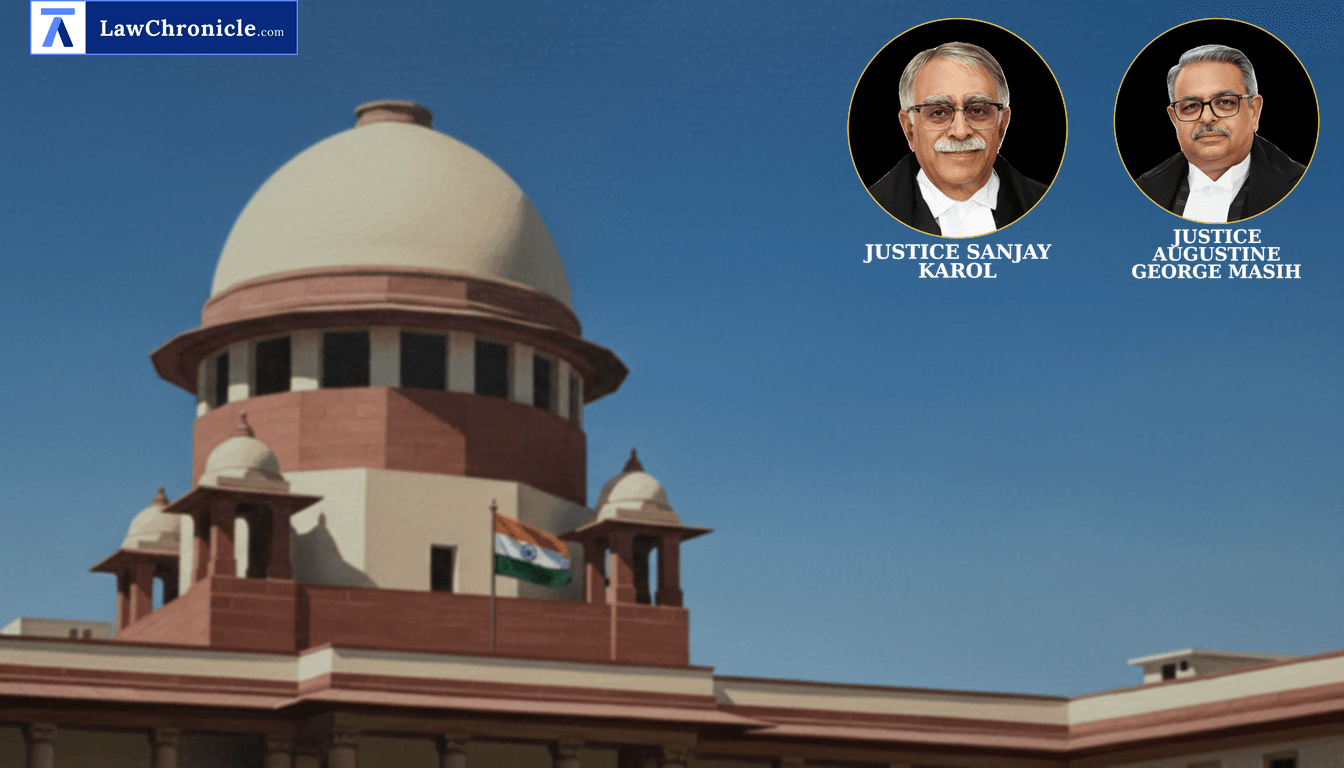
Upholding the sanctity of personal liberty, the Supreme Court held that the State cannot delay a prisoner's release on the pretext of administrative decision-making or a potential appeal once a court has ordered the prisoner's release.
A division bench comprising Justice Sanjay Karol and Justice Augustine George Masih heard an appeal concerning the 24-day delay in releasing a convict despite a judicial order for parole. The Court emphasized that once a person secures their liberty through a court order, bureaucratic processes must not be allowed to infringe upon that right.
The Definition of Illegal Detention
The Court observed that illegal detention occurs when there is a deprivation of liberty by the State without lawful authority or in violation of Constitutional provisions. The Court, in its reasoning, observed: "The deprivation of liberty by the State without lawful authority or in violation of provisions of the Constitution is illegal detention. It involves actual custody such that the individual is not free to leave. The detention lacks a valid legal basis such as where there is a lack of authorisation, or where any said authority is void/expired. Even where a law permits detention, it becomes illegal if the procedure followed is not just, fair, and reasonable, including failure to observe essential safeguards. It would also cover situations where the power to detain is exercised arbitrarily, for an improper purpose, or in bad faith."
'Obey First, Appeal Later': Rule of Law Over Bureaucracy
Addressing the State's defense that the parole order was erroneous and they were considering a challenge, the Court reiterated the principle established in Atma Ram Properties (P) Ltd. v. Federal Motors (P) Ltd., noting that a judicial order remains in operation unless stayed or set aside. The Court further noted that even unsuccessful parties must adhere to judicial directions immediately. It highlighted that the State’s internal administrative calls regarding filing an appeal cannot override the immediate implementation of a release order.
Public Law Remedy and Compensation
The Bench relied on a series of precedents including DK Basu v. State of West Bengal, Khatri (2) v. State of Bihar ( "(1981) 1 SCC 627": 1980 CaseBase(SC) 209), and Rudal Shah v. State of Bihar to affirm that monetary compensation is a recognized public law remedy for the violation of rights under Article 21 of the Constitution of India, 1950. The Court stated that just because a person has been convicted does not mean their rights weigh less on the scales of justice.
Court Directions
The Court issued the following directions:
"We award compensation to the tune of Rs.11,00,000/- (Eleven lakhs Only). Amount to be deposited directly into the bank account of the appellant, details of which shall be furnished by the learned counsel for the appellant to the learned counsel for the State. Appeal is allowed. Pending application(s) if any shall stand disposed of."
Background:
The appellant was convicted under Sections 148, 448, 304 Part II r/w Sections 149 and 323 of the Indian Penal Code, 1860 and sentenced to four years of rigorous imprisonment. After serving over three years, he applied for permanent parole. Although a Single Judge of the High Court ordered his release on November 5, 2024, and sureties were verified by November 13, he was only released after a Division Bench intervened via a Habeas Corpus petition on December 6, 2024. The State argued the release was contrary to Rule 9 of the Rajasthan Prisoners Release On Parole Rules, 1958, but the Supreme Court rejected this, noting the State never challenged the original order. The Court ultimately found the 24-day period between verification of sureties and actual release to be illegal detention.
Case Details:
Case No.: Criminal Appeal No. ____ of 2026 (Arising out of SLP (Crl.) 5036 of 2025)
NeutralCitation: 2026 INSC 599
Case Title: DAUDAYAL v. THE STATE OF RAJASTHAN & ORS.
Source: 2026 CaseBase(SC) 513
Similar Articles

 Breaking News


