


Rajasthan HC: Personal Liberty Sacrosanct, Tehsildar Faulted for Illegal Detention
 Copy Link
 Share
 Save
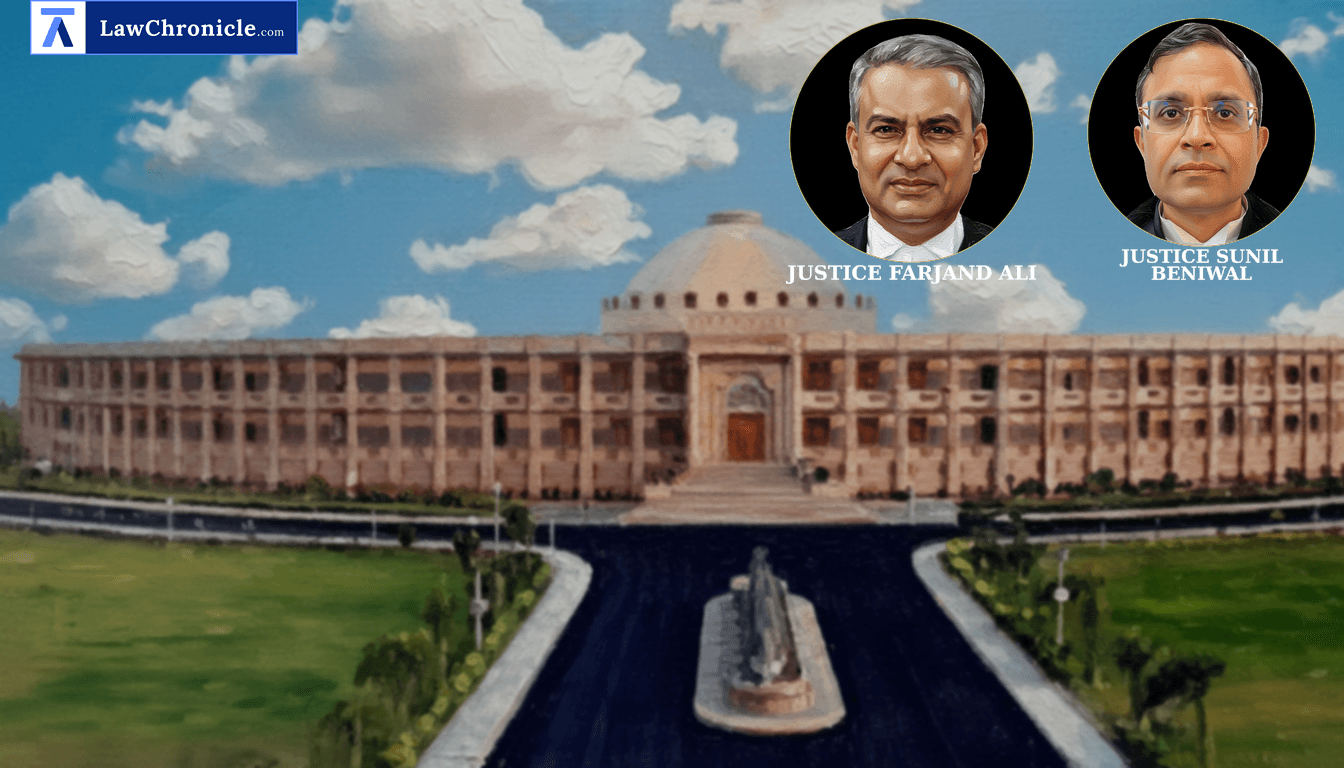
In a stern reaffirmation of the sanctity of personal liberty, the Rajasthan High Court recently held a public official personally liable for the illegal confinement of a citizen. A vacation bench comprising Justice Farjand Ali and Justice Sunil Beniwal addressed a habeas corpus petition filed by the wife of a man who was kept in custody for approximately 53 days despite a valid appellate order suspending his civil imprisonment. The Court observed that such conduct by a State functionary is a "brazen defiance" of the rule of law and a direct infringement of the fundamental rights guaranteed under the Constitution of India, 1950.
Court's Rationale on Personal Liberty and Accountability
The Court, in its reasoning, observed: "The present case has compelled this Court to confront a situation where that promise was brazenly dishonoured by a functionary of the State in a manner that this Court finds shocking, reprehensible, and wholly unworthy of anyone sworn to serve the constitutional order. Personal liberty is not a luxury that the powerful alone enjoy and the poor must beg for. It is a constitutional guarantee equally available to every person regardless of economic status, social position, or physical condition."
Highlighting the severity of the violation, the bench noted that the detenue, suffering from HIV, and his wife, a cancer patient, were subjected to immense distress. Relying on the precedent set in Daudayal v. State of Rajasthan & Ors. ( "2026 INSC 599, decided on 29th May 2026": 2026 CaseBase(SC) 513), the Court reiterated that any deprivation of liberty without lawful authority or in violation of constitutional provisions constitutes illegal detention. The Court emphasized that the principle of 'obey first, appeal later' as discussed in Atma Ram Properties (P) Ltd. v. Federal Motors (P) Ltd. and Karnataka Housing Board v. C. Muddaiah ( "(2007) 7 SCC 689": 2007 CaseBase(SC) 100) must be followed by administrative authorities to maintain the rule of law.
Directons
The Court has the following directions:
"(i) It is hereby declared that the continued detention of Shri Ghamandnath after 01.06.2026 was illegal, unconstitutional, and violative of his fundamental right to personal liberty guaranteed under Article 21 of the Constitution of India. Insofar as the period commencing from 01.06.2026 until his eventual release is concerned, the illegality of the detention stands established on the admitted case of respondent No. 4 himself, who acknowledges having acquired knowledge of the order dated 15.04.2026 suspending the sentence. As regards the period preceding 01.06.2026 and subsequent to the passing of the suspension order dated 15.04.2026, the precise commencement and extent of the illegal detention shall be subject to and dependent upon the findings recorded in the departmental inquiry directed by this Court. In the event the inquiry establishes that respondent No. 4 or his office had actual or constructive knowledge of the suspension order at any earlier point of time, the period of illegal detention shall stand correspondingly extended from such date, and respondent No. 4 shall be liable for all legal and disciplinary consequences flowing therefrom.
(ii) This Court directs the concerned Tehsildar, who is responsible for the unlawful detention of the detenue Shri Ghamandnath, to pay compensation of ₹2,00,000/- (Rupees Two Lakhs Only) personally from his own income or property, to the detenue Shri Ghamandnath, who has since been released from detention, within a period of forty-five (45) days from the date of receipt of a copy of this order. The said amount shall be deposited directly into the bank account of Shri Ghamandnath, details of which shall be furnished by the learned counsel for the petitioner to the concerned Tehsildar within seven (7) days from the date of this order. The compensation shall be borne and paid personally by the Tehsildar concerned, and under no circumstances shall the State of Rajasthan or any Government Department bear, reimburse, or facilitate the payment of this amount on his behalf. The Revenue Department is further specifically directed not to provide any financial assistance or deposit any amount on behalf of the erring Tehsildar in satisfaction of this order, as the liability arising from his unlawful actions is strictly and exclusively personal in nature. Proof of compliance, including documentary evidence/receipt of the amount deposited into the bank account of the detenue Shri Ghamandnath, shall be duly submitted before this Court through appropriate application.
(iii) The Additional Chief Secretary, Revenue, Government of Rajasthan, is hereby directed to forthwith initiate a detailed and time-bound departmental inquiry, by deputing a responsible senior officer, against respondent No. 4 Shri Tejpal Pareek, Tehsildar for his conduct in the present matter, including but not limited to: (a) whether and when official intimation of the order of the Additional Divisional Commissioner dated 15.04.2026 was received by the Tehsil office; (b) whether the petitioner personally and through her counsel had presented a certified copy of the suspension order to respondent No. 4 or his office; (c) whether respondent No. 4 had constructive or actual knowledge of the suspension order prior to 01.06.2026; and (d) whether his failure to release the detenue upon acquiring admitted knowledge on 01.06.2026 constitutes wilful disobedience of a superior order, misconduct, and violation of service rules. The inquiry shall be completed within ninety (90) days from the date of this order and a compliance report shall be placed before this Court.
(iv) Pending conclusion of the aforesaid inquiry and as an interim measure, respondent No. 4 shall forthwith be relieved of his field posting as Tehsildar, Deh, District Nagaur. He shall not be permitted to enter the premises of the Tehsil office, Deh, until further orders. He shall have no access to, and shall be strictly prohibited from touching, handling, or interfering in any manner with, any document, register, record, file, correspondence, or proceeding pertaining to or maintained in the Tehsil office, Deh, or any office within District Nagaur. This direction is considered necessary having regard to the nature of the office held by respondent No.4. Being the Tehsildar, he exercises administrative and supervisory control over the Tehsil establishment and its records. His continued presence in, or access to, the office may reasonably give rise to apprehensions of influence upon official records, correspondence, or personnel connected with the proposed inquiry. To ensure that the inquiry remains fair, independent and free from any perception of interference, respondent No.4 shall remain completely disengaged from the functioning of the Tehsil office, Deh, till conclusion of the inquiry.
(v) The Additional Chief Secretary, Revenue, shall take respondent No. 4 on attachment at the Revenue Headquarter in terms suitable to the ACS Revenue in the interest of administration and in accordance with applicable service rules, pending the conclusion of the inquiry. It is directed that respondent No. 4 shall not, during the period of inquiry, be assigned any field or quasi-judicial role involving the exercise of authority over any individual."
Background:
Genesis of the Dispute and Illegal Confinement
The case originated from proceedings under Section 91 of the Rajasthan Land Revenue Act 1956 regarding an alleged encroachment on government land. The Naib Tehsildar had sentenced the detenue to three months of civil imprisonment. While an initial appeal was dismissed, the Additional Divisional Commissioner, Ajmer, suspended the sentence on April 15, 2026. Despite this order, the Tehsildar failed to release the detenue. The petitioner-wife alleged she personally served the order to the Tehsildar, who remained obstinate.
Legal Analysis and Precedents
The Court examined whether the detention, though lawful at its inception, became illegal after the suspension order was passed. Citing Rudul Shah v. State of Bihar ( "(1983) 4 SCC 141": 1983 CaseBase(SC) 166) and Rudul Sah v. State of Bihar ( "(1983) 4 SCC 141": 1983 CaseBase(SC) 166), the bench noted that Article 21 would be denuded of its content if courts could not award compensation for constitutional wrongs. The bench also referred to Sebastian M. Hongray v. Union of India ( "(1984) 3 SCC 82": 1984 CaseBase(SC) 57) and Bhim Singh v. State of J & K ( "(1985) 4 SCC 677": 1985 CaseBase(SC) 52) regarding the measure of exemplary damages for illegal arrest and detention. Further, the Court looked into recent rulings like Sohan Singh @ Bablu v. State of Madhya Pradesh and S. Nambi Narayanan v. Siby Mathews ( "(2018) 10 SCC 804": 2018 CaseBase(SC) 228) to determine that the liability for such a wilful violation should be personal, resulting in the direction for the Tehsildar to pay ₹2 Lakhs from his own pocket.
Case Details:
Case No.: D.B. Habeas Corpus Petition No. 282/2026
NeutralCitation: 2026:RJ-JD:27065-DB
Case Title: Smt. Bhanwari Devi v. State Of Rajasthan & Ors.
Appearances:
For the Petitioner(s): Mr. Jogendra Singh, Mr. Moti Singh
For the Respondent(s): Mr. Deepak Choudhary, GA-cum-AAG assisted by Mr. Kuldeep Singh; Mr. Tejpal Pareek, Tehsildar Deh
Source: 2026 CaseBase(RAJ) 60
Similar Articles


 Breaking News


