


SC Denies Article 311 Protection to ICAR Employees
 Copy Link
 Share
 Save
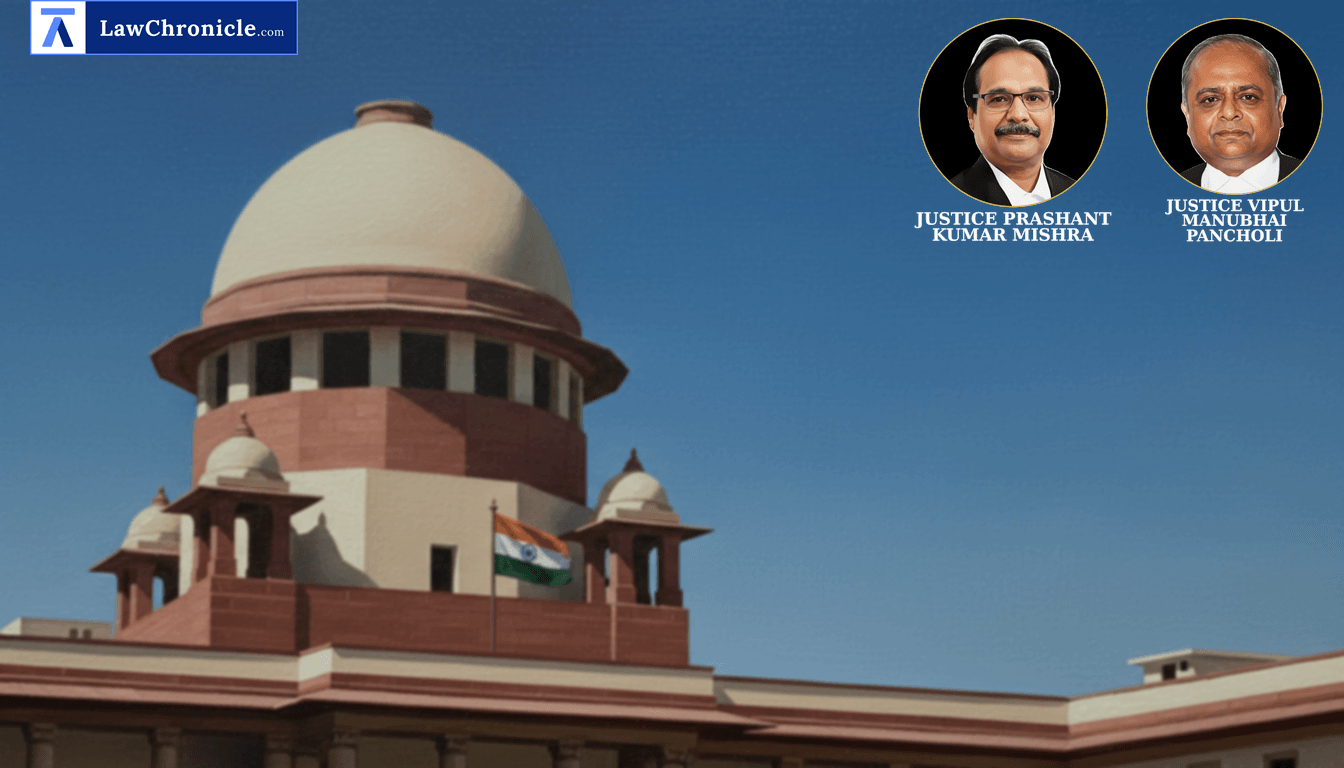
The Supreme Court of India in Sadachari Singh Tomar vs Union Of India & Ors. held that Article 311 applies only to civil servants or individuals holding a “civil post” under the Union or a State. The Court noted that ICAR operates as an autonomous society under the Department of Agricultural Research and Education, Ministry of Agriculture, and that its recruitment and service conditions are regulated by its own rules and bye-laws. Accordingly, Article 311 was found to be inapplicable in the present case.
A bench of Justice Prashant Kumar Mishra and Justice Vipul M. Pancholi heard appeals challenging the premature curtailment of an administrative tenure granted to a senior scientist who had been appointed as Assistant Director General, Agricultural Research Information System (ADG‑ARIS) by the Indian Council of Agricultural Research (ICAR). The appeals arose from concurrent orders of the Central Administrative Tribunal and the High Court of Delhi that had upheld ICAR’s decision to revert the officer to his earlier post and to curtail his five‑year appointment.
The Court summarized its decision by holding that Article 311 of the Constitution of India, 1950 was not attracted because ICAR functioned as an autonomous society governed by its own rules and bye‑laws, and that the appellant had no enforceable right to continue for the full five‑year term. The Court observed that judicial review of such administrative action was confined to assessing whether the exercise of power was arbitrary, irrational, tainted by mala fides or colourable, or resulted in penal or stigmatic consequences without due process, and it relied on Deputy General Manager (Appellate Authority) and Ors. vs. Ajai Kumar Srivastava ( "[2021] 1 SCR 51": 2021 CaseBase(SC) 1228) to explain the narrow scope of review.
The Court, in its reasoning, observed: 25. It is thus settled that the power of judicial review, of the Constitutional Courts, is an evaluation of the decision-making process and not the merits of the decision itself. It is to ensure fairness in treatment and not to ensure fairness of conclusion. The Court/Tribunal may interfere in the proceedings held against the delinquent if it is, in any manner, inconsistent with the rules of natural justice or in violation of the statutory rules prescribing the mode of enquiry or where the conclusion or finding reached by the disciplinary authority if based on no evidence. If the conclusion or finding be such as no reasonable person would have ever reached or where the conclusions upon consideration of the evidence reached by the disciplinary authority is perverse or suffers from patent error on the face of record or based on no evidence at all, a writ of certiorari could be issued. To sum up, the scope of judicial review cannot be extended to the examination of correctness or reasonableness of a decision of authority as a matter of fact.
The Court further explained that it relied on Pavanendra Narayan Verma vs. Sanjay Gandhi P.G.I. of Medical Sciences and Anr. ( "[2001] SUPP. 5 SCR 41 at Pg. 52": 2001 CaseBase(SC) 1342) to determine what language in an administrative order would amount to stigma and on State of U.P. and Ors. vs. Gobardhan Lal to reiterate that allegations of mala fides in transfer or reversion orders must be supported by strong and convincing materials before courts would interfere.
Background
The appellant had been appointed ADG‑ARIS w.e.f. 15.01.1998 “for a period of five years or until further orders, whichever is earlier.” During his tenure he alleged irregularities in procurement and funding and claimed to have acted as a whistleblower. ICAR issued office orders removing him from certain committees and ultimately, by Office Order dated 31.01.2001, curtailed his ADG‑ARIS tenure and reverted him to the post of Senior Scientist. The AARs for 1998‑1999 and 1999‑2000 were recorded as showing performance that was “unsatisfactory and below average,” and the order relied on those AARs. The appellant challenged the curtailment before the CAT (OA No.1276/2001), then the High Court by way of writ petition, and later sought review, all of which were dismissed.
The record showed that an inquiry on specific misconduct charges was conducted and an Inquiry Report dated 21.05.2001 exonerated the appellant, describing the charges as “baseless and motivated.” Nevertheless, the Court found that the inquiry concerned discrete charges and did not preclude ICAR from curtailing tenure on the basis of administrative assessment of performance. The Courts below had found that the ARS Rules did not confer on the appellant an absolute right to complete the five‑year tenure and that the post offered upon reversion constituted a matching position in research work, a conclusion the Supreme Court did not disturb. The Court held that the AARs were not drawn from a remote past, that the appellant was given opportunity to represent, and that the reliance on those AARs did not, on the material before the Court, cross the threshold of perversity, arbitrariness or stigma as defined in Pavanendra Narayan Verma vs. Sanjay Gandhi P.G.I. of Medical Sciences and Anr. ( "[2001] SUPP. 5 SCR 41 at Pg. 52": 2001 CaseBase(SC) 1342).
The appeals were dismissed. The Court noted subsequent developments on record, including a later modification of posting and a promotion with retrospective effect, and observed that retiral benefits had been released. No interim directions survived.
Case Details:
Case No.: CIVIL APPEAL NOS.9330-9331 OF 2013
NeutralCitation: 2026 INSC 427
Case Title: SADACHARI SINGH TOMAR VERSUS UNION OF INDIA & ORS.
Source: 2026 CaseBase(SC) 371
Similar Articles

 Breaking News


