


SC Directs Appointment of Merit-Holders Despite Closure of ReT Scheme
 Copy Link
 Share
 Save
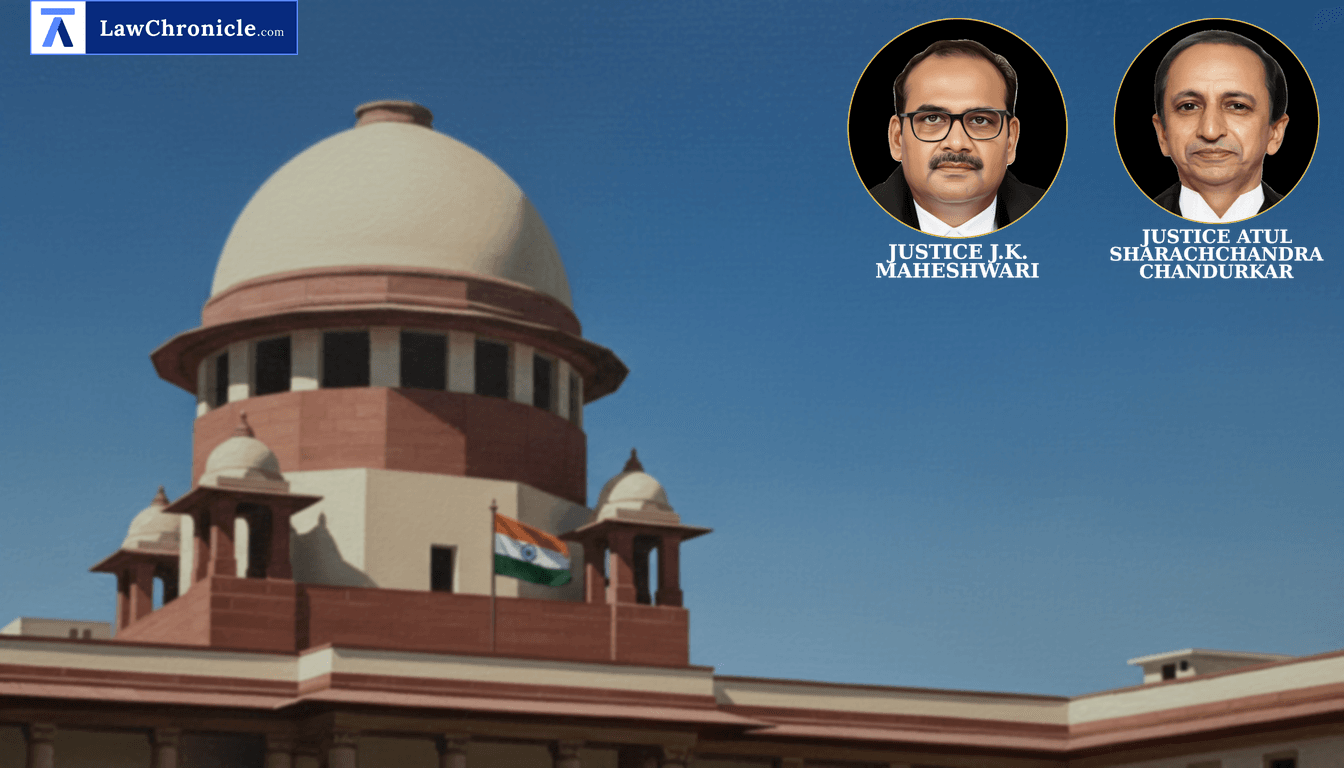
In a significant move to balance the rights of meritorious candidates with the statutory mandates for quality education, the Supreme Court has ruled that the formal closure of the Rehbar-e-Taleem (ReT) scheme cannot retrospectively impair the rights of those already placed in select panels. A bench comprising Justice J.K. Maheshwari and Justice Atul S. Chandurkar addressed a batch of appeals filed by the Union Territory of Jammu and Kashmir and private candidates concerning the validity of Government Order No. 919-Edu of 2018, which had sought to cancel all pending recruitment processes under the scheme.
The Court emphasized that the mere pendency of litigation is an 'extraneous circumstance' and cannot justify a classification that denies appointment to candidates while others in the same select panels were engaged. However, the Court also harmonized this with the mandatory requirements under the Right of Children to Free and Compulsory Education Act, 2009 and NCTE Regulations and Notifications regulations, ensuring that all teachers meet national standards.
The Court has the following directions:
"(a) The Closure Order of ReT Scheme dated 16.11.2018 for cancellation/withdrawal shall not retrospectively impair the right of the candidates found placed in the select panel. In view of the discussion made hereinabove, the candidates placed in respective select panels shall be issued engagement/appointment orders as per their position in the select panel having regard to the available vacancies.
(b) The State shall issue the formal engagement orders to the candidates of select panel within a period of eight weeks in terms of the direction (a) above.
(c) Candidates appointed as per directions (a) and (b) from the select panel under the ReT Scheme are directed to acquire minimum qualification prescribed under NCTE Regulations and Notifications, including to qualify the TET, within 3 years and 3 attempts from date of their engagement/ appointment. In this regard, the State is directed to organize the TET annually. After successfully acquiring the minimum qualification and passing TET within prescribed time limit, the services of such appointees shall be, accordingly, regularized on completion of two years of service thereafter.
(d) The direction (c) above shall be applicable to the other similarly situated candidates who have already been appointed from the select panels under the ReT Scheme after 23.08.2010 i.e., the date of NCTE notification prescribing minimum qualifications and prior to the issuance of Closure Order, and do not possess minimum qualification including TET as per the notification of NCTE. However, those appointees shall acquire prescribed qualification within the time as specified in direction (c).
(e) It is obligatory upon this Court to direct that once the candidates/appointees under the ReT Scheme have acquired the prescribed qualifications and qualified the TET as indicated above, the seniority of all such candidates/ appointees shall be redrawn and determined by the competent authority of the State, maintaining their respective positions in the select panels uninfluenced by the date of appointment, joining or regularization. The inter se seniority shall also be determined accordingly.
(f) It is further directed that if the candidates/appointees including those already appointed and regularized who do not acquire/possess the requisite qualifications in terms of the NCTE notifications and fail to qualify the TET within the period prescribed hereinabove, the State is at liberty to dispense with their services as the mandate of Article 21-A of the Constitution of India cannot be left at altar even while rendering complete justice invoking Article 142 of the Constitution of India. It is further clarified that those candidates/appointees would not have any claim with respect to seniority or regularization as directed hereinabove.
(g) The directions issued hereinabove are in rem and shall apply mutatis mutandis to the candidates already appointed pursuant to 74 advertisements that are subject matter of present proceedings, though they are not party to the present appeals. In view thereof, this judgment shall be widely publicized, and all the candidates/appointees shall be duly informed of these directions so that they can take recourse for acquiring the minimum qualification as per NCTE Regulations and Notifications, if they have not already acquired the same.
(h) The directions contained in clauses (a) to (g) hereinabove shall apply to all the candidates who are litigating in any Court and such cases have been filed prior to the date of this judgement. It is further clarified that candidates who have not already filed cases in any Court shall neither acquire any fresh cause of action by virtue of these directions nor be entitled to seek any further directions from any Court in that regard.
(i) At the cost of repetition, it is clarified that this judgment shall not be construed as reviving the ReT Scheme for any purpose whatsoever, nor shall it be interpreted so as to create or confer any right upon candidates who were not part of a prepared select panel or who failed to approach the Court timely. Moreover, these directions are being issued in the peculiar facts and circumstances of this case invoking the power under Article 142 of the Constitution of India and it shall not be treated as precedent in any manner whatsoever.
(j) In view of the observations made in para 24 above, we believe that the State Government shall apply their mind to the facts and circumstances of the case and the situation prevalent in the State and to take an appropriate decision with respect to the revision of the honorarium of such teachers as they deem fit."
Invalidity of Classification Based on Pending Litigation
The Court, in its reasoning, observed: "This classification, prima facie, fails when tested on the anvil of Article 14 of the Constitution of India. It is a well-settled proposition of law, endorsed repeatedly by this Court, that any classification made by the State must satisfy the twin-test - first, that the classification must be founded on an intelligible differentia which distinguishes persons or things that are grouped together from others left out of the group; second, that such differentia must have a rational nexus with the object sought to be achieved by the legislation or executive action in question. Mere pendency of litigation concerning a candidate is an extraneous circumstance and cannot, by any stretch of imagination, be made a basis for such classification."
NCTE Qualifications Mandatory for All Teachers
Invoking its plenary powers under Article 142 of the Constitution of India, 1950, the Court held that while the merit-holders must be accommodated, they cannot bypass the mandatory qualifications prescribed under Section 23 of the Right of Children to Free and Compulsory Education Act, 2009. Relying on the precedent set in Anjuman Ishaat-E-Taleem Trust v. The State of Maharashtra & Ors. ( "2025 INSC 1063": 2025 CaseBase(SC) 1000), the Court reiterated that passing the Teachers’ Eligibility Test (TET) is a constitutional necessity flowing from the right to quality education. The bench directed that even in-service teachers who haven't cleared the TET must do so within a prescribed time-frame or face termination.
Background:
The dispute arose after the Jammu and Kashmir government issued a 'Closure Order' in November 2018, formally ending the Rehbar-e-Taleem (ReT) scheme. The order canceled all advertisement notices and select panels where engagement orders had not yet been issued. Many candidates challenged this, arguing that their placement in select panels created a vested right that was being unfairly nullified by the closure, particularly when their appointments were delayed only due to pending litigation or administrative delays. The High Court had partially protected these candidates, prompting cross-appeals from both the State and the private parties. The Supreme Court eventually modified the High Court's judgment, allowing the appointments subject to the candidates clearing national eligibility standards within a specific window.
Case Details:
Case No.: Civil Appeal No. of 2026 (Arising out of SLP (Civil) No. 12210 OF 2023)
2026 INSC 439
Case Title: Union Territory of Jammu and Kashmir and Ors. v. Saba Wani
Appearances:
For the Petitioner(s): Mr. K.M. Natraj, learned ASG
Source: 2026 CaseBase(SC) 547
Similar Articles


 Breaking News


