


SC Dissolves Marriage Under Article 142; Quashes All Multi-State Litigations
 Copy Link
 Share
 Save
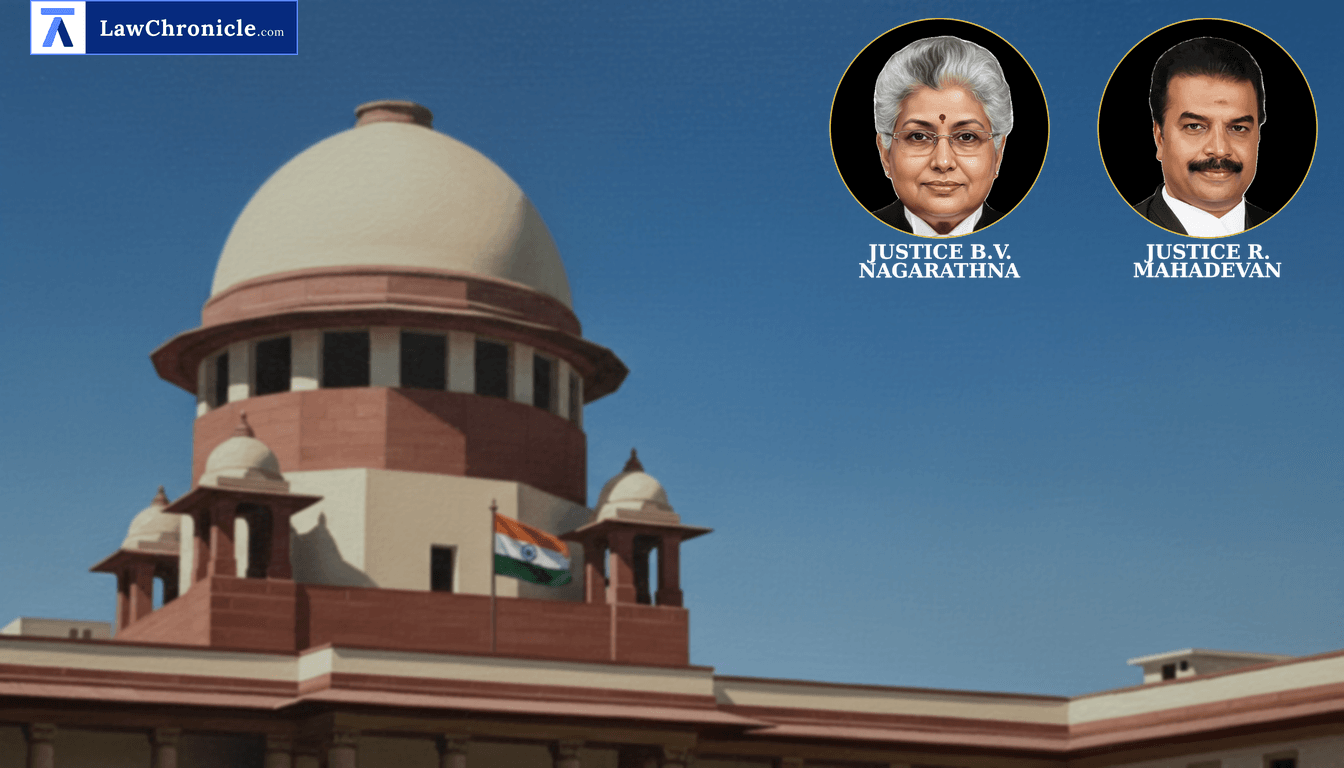
Exercising its extraordinary powers to bring complete closure to prolonged marital discord, the Supreme Court dissolved a dead marriage and quashed eighteen pending civil and criminal proceedings spread across multiple states.
A bench comprising Justice B.V. Nagarathna and Justice R. Mahadevan was considering transfer petitions filed by the wife seeking transfer of criminal and domestic violence proceedings pending in Cuttack, Odisha, to Mumbai, Maharashtra. During the pendency of these petitions, the husband filed an interlocutory application under Article 142 of the Constitution of India seeking a decree of divorce on the ground of irretrievable breakdown of marriage and closure of all ongoing litigation.
Key Takeaways
• Dissolution via Article 142: The Supreme Court can directly grant a divorce decree by mutual consent to do complete justice, bypassing trial court proceedings.
• Blanket Quashing of Disputes: All inter se civil, criminal, and statutory complaints between parties and their families stand quashed upon full settlement.
• Preclusion of Future Litigation: Parties are strictly restrained from initiating any fresh proceedings against each other arising out of the matrimonial dispute.
• Finality in Permanent Alimony: Payment of mutually agreed permanent alimony in full and final settlement provides complete quietus to all financial and medical claims.
Irretrievable Breakdown of Marriage
The Supreme Court noted that the parties had been living separately since 2022 and were entangled in a long list of cross-litigations. Referring to established precedent in Shilpa Sailesh vs. Varun Sreenivasan ( "(2023) 14 SCC 231": 2023 CaseBase(SC) 872) and Rinku Baheti vs. Sandesh Sharda ( "(2025) 3 SCC 686": 2024 CaseBase(SC) 779), the Bench reiterated that Article 142(1) enables it to grant divorce and terminate pending proceedings to prevent hardship and endless litigation.
While justifying its powers for grant of divorce under Article 142 of Constitution, the Apex Court stated that “...grant of divorce on the ground of irretrievable breakdown of marriage is on the basis of exercise of discretion by this Court for doing complete justice between the parties... It is only when this Court is satisfied and convinced that there is a deadlock in the marriage which cannot be saved and the only solution for the parties is to move on independently by putting an end to their marital ties that the decree for divorce on the ground of irretrievable breakdown of marriage can be granted.” The Bench quashed all the pending cases and also directed parties not to file any further matrimonial cases against each other.
Ratio
Where a marriage has irretrievably broken down with no possibility of reconciliation, the Supreme Court can exercise its powers under Article 142 of the Constitution of India to grant a decree of divorce and quash all inter se civil and criminal proceedings to do complete justice between the parties.
Background
The dispute stemmed from a marriage solemnized on December 4, 2016. Due to irreconcilable differences, the spouses separated in 2022, giving rise to 18 multiple legal actions. These included proceedings under Section 498A and Sections 294, 323, 341, 506 of the IPC, maintenance under the Protection of Women from Domestic Violence Act, 2005, divorce petitions under Section 13(1)(i-a) of the Hindu Marriage Act, 1955, RTI challenges, applications under Section 340 of the Cr.P.C., and complaints under the Senior Citizen Act.
After failed mediation sessions, the husband invoked Article 142 of the Constitution of India. The wife agreed to a divorce by mutual consent subject to permanent alimony. Following the Court's intervention, the husband enhanced the permanent alimony to Rs. 35,00,000/-, which was accepted and paid in full. Aligning with principles in Amit Kumar v. Suman Beniwal ( "(2023) 17 SCC 648": 2021 CaseBase(SC) 643) and Amardeep Singh v. Harveen Kaur ( "(2017) 8 SCC 746": 2017 CaseBase(SC) 792), the Supreme Court allowed the application, granted divorce, quashed all listed proceedings, and disposed of the transfer petitions.
Case Details:
Case No.: Transfer Petition (Criminal) No.493 of 2025 with Transfer Petition (Civil) No.2564 of 2025
Neutral Citation: 2026 INSC 1060
Case Title: Shikha w/o Varun Surekha @ Shikha d/o Sharadkumar Raniwala v. State of Odisha & Others
Source: 2026 CaseBase(SC) 8088
Similar Articles
 Breaking News


