


SC Enhances Compensation for Disabled Teen in Motor Accident Case
 Copy Link
 Share
 Save
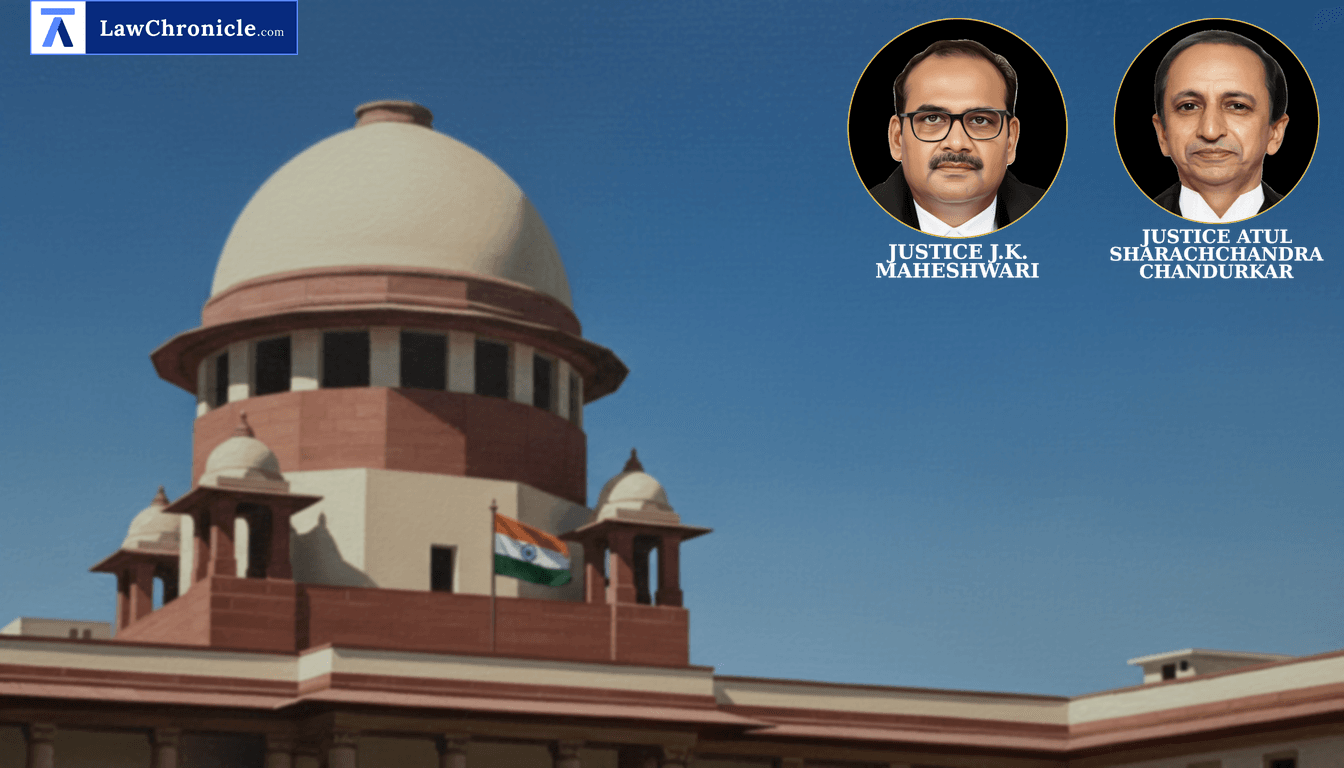
The Supreme Court of India enhanced the compensation awarded to a Rajasthan teenager who sustained 100% permanent disability in a road accident at the age of 14. The Court observed that the sum awarded by the High Court was wholly inadequate and failed to account for the severe and lifelong repercussions of the injuries suffered by the victim.
A Bench of Justice J.K. Maheshwari and Justice Atul S. Chandurkar heard an appeal by a claimant seeking higher compensation arising from a road accident involving a fourteen‑year‑old pillion rider and considered challenges to the partial enhancement granted by the High Court.
The Court summarized its decision by holding that the High Court's enhancement was insufficient and ordered a substantial increase in compensation, while providing directions for immediate release and investment of a portion of attendant charges. The Court, in its reasoning, observed: "Having heard the learned counsel for the parties and after perusing the documentary material on record, we are of the considered view that the amount of compensation as awarded by the High Court deserves enhancement. The appellant was aged fourteen years when the accident took place and as a result of the same has suffered 100% permanent disability. The High Court has considered the notional annual income as ₹30,000/-. This amount is on a lower side. The notional income would have to be determined on the basis of the minimum wages admissible for a skilled workman in the State of Rajasthan in 2016. Such minimum wages were ₹5,746/- per month. Taking the monthly notional income at ₹5,800/-, the annual income would be ₹69,600/-. Future prospects at 40% would make the annual income as ₹97,440/-. On the basis of the age of the appellant, multiplier of 18 has been rightly applied. On that basis, the loss of income would come to ₹17,53,920/-."
Background
The dispute arose from a collision on 08.11.2016 when the first respondent allegedly drove a motorcycle negligently and the then‑fourteen‑year‑old appellant, who was a pillion rider, suffered grievous injuries and 100% permanent disability. The claimant had filed a petition under Section 166 of the Motor Vehicles Act, 1988 before the Motor Accident Claims Tribunal claiming ₹22,45,000. The Claims Tribunal awarded ₹7,76,543, leading to an appeal under Section 173 of the Motor Vehicles Act, 1988 before the High Court which enhanced compensation to produce a net increase of ₹4,41,000. The appellant challenged the partial enhancement before the Supreme Court.
On submissions, the appellant relied on Kumari Laxmisree Vs. The Managing Director, KSRCTC Depot, Bengaluru to argue for a higher notional income (originally urging a notional monthly income of ₹10,000) and pressed for larger attendant charges, lifelong assistance and greater sums for pain, loss of amenities and future medical care. The Insurance Company supported the High Court's approach and relied on Baby Sakshi Greola v. Manzoor Ahmad Simon and another ( "2024 INSC 963": 2024 CaseBase(SC) 897) and Hitesh Nagjibhai Patel Vs. Bababhai Nagjibhai Rabari and another to contend that minimum wages of a skilled workman in 2016 were the appropriate benchmark and that the High Court's figures were reasonable. The Court relied on the principle applied in Kajal Vs. Jagdish Chand and others ( "2020 INSC 135": 2020 CaseBase(SC) 1600) in relation to attendant charges and minimum wages and assessed notional income on the basis of the State minimum wage in 2016, adopting a monthly notional income of ₹5,800 and applying a multiplier of 18 with 40% future prospects.
The Court accepted that the appellant required continuous attendant care and concluded that attendant charges should be calculated on the basis of minimum wages for a semi‑skilled worker, assumed at ₹5,000 per attendant per month, with provision for two attendants and appropriate investment of a portion of that head to meet future needs. The Court awarded enhanced amounts for mental pain and suffering, future medical expenses, loss of marriage prospects, special diet and transportation and directed that interest at 6% per annum would run from the date of filing of the claim petition until actual payment. The Court ordered that 25% of the attendant charges award be released immediately and the balance be invested in a fixed deposit with annual releases to meet attendant expenses.
The appeal was allowed in part and the High Court judgment dated 09.04.2024 in S.B. Civil Miscellaneous Appeal No.1334 of 2022 was modified, with the appellant held entitled to total compensation of ₹56,83,663 along with interest, subject to adjustment of amounts already paid and implementation of the release and investment scheme for attendant charges.
Case Details:
Case No.: @ SLP (C) NO.13122 OF 2024
NeutralCitation: 2026 INSC 454
Case Title: HANSRAJ VERSUS MUKESH NATH AND OTHERS
Source: 2026 CaseBase(SC) 387
Similar Articles

 Breaking News


