


SC: High Court Supervisory Jurisdiction Cannot Derail Arbitral Proceedings
 Copy Link
 Share
 Save
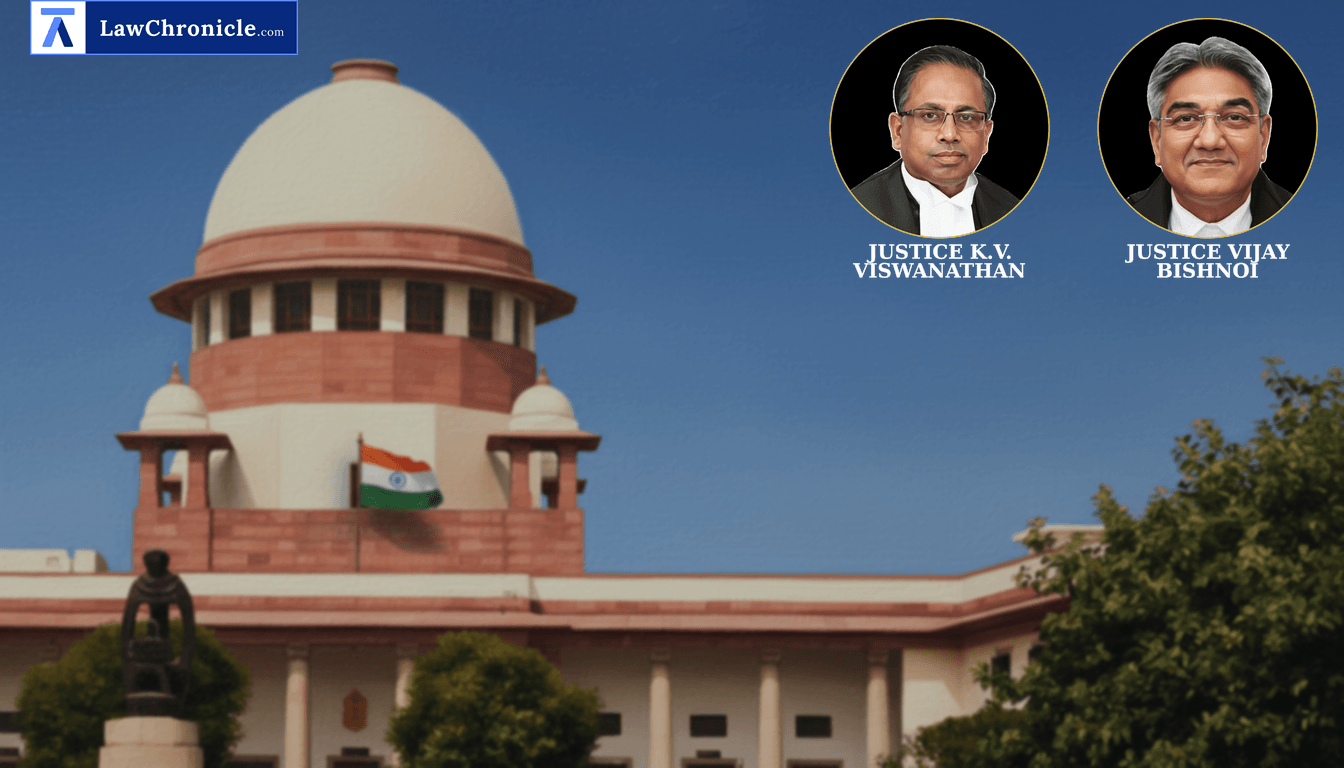
The Supreme Court has decisively throttled judicial overreach in arbitration, ruling that High Courts cannot use their supervisory powers to bypass the statutory mechanism for challenging jurisdictional orders. This landmark judgment reinforces the 'kompetenz-kompetenz' principle, mandating that grievances against an Arbitral Tribunal's refusal to implead non-signatories must wait until the final award rather than stalling proceedings through writ petitions.
A bench of Justice K.V. Viswanathan and Justice Vijay Bishnoi delivered the verdict while setting aside orders of the High Court of Gauhati that had stayed arbitration notices against alleged non-signatory entities. The Court emphasized that the Arbitration And Conciliation Act, 1996 is a self-contained code designed to minimize judicial interference and ensure the expeditious resolution of commercial disputes.
Minimal Judicial Interference and Article 227
The dispute arose when certain companies sought deletion from an arbitral proceeding, claiming they were non-signatories to a partnership deed. When the Arbitral Tribunal rejected their application, they successfully moved the High Court under Article 227 of the Constitution of India, 1950. The Supreme Court, however, noted that the High Court failed to establish any 'patent lack of inherent jurisdiction' before staying the proceedings.
The Court, in its reasoning, observed: "The object of minimising judicial intervention while the matter is in the process of being arbitrated upon, will certainly be defeated if the High Court could be approached under Article 227 or under Article 226 of the Constitution against every order made by the Arbitral Tribunal. Therefore, it is necessary to indicate that once the arbitration has commenced in the Arbitral Tribunal, parties have to wait until the award is pronounced unless, of course, a right of appeal is available to them under Section 37 of the Act even at an earlier stage."
Defining 'Patent Lack of Inherent Jurisdiction'
Referring to Punjab State Power Corporation Limited v. Emta Coal Limited and Another and Deep Industries Ltd. v. Oil and Natural Gas Corporation Ltd. and Another, the Court clarified that supervisory jurisdiction is restricted to cases of extreme perversity. The Bench noted that the Tribunal had the absolute competence under Section 16 of the Arbitration And Conciliation Act, 1996 to determine if non-signatories were 'veritable parties' based on the 'Group of Companies' doctrine established in Cox and Kings Ltd. v. SAP India Pvt. Ltd. and Another ( "2024 (4) SCC 1": 2023 CaseBase(SC) 947).
The Court has following directions:
"In view of the detailed analysis above, we hold that the High Court was not justified in entertaining the challenge under Article 227 of the Constitution and staying the arbitral proceedings. The remedy against the rejection of a Section 16 of the Act application strictly lies under Section 34 of the Act after the pronouncement of the final award. Hence, we deem it appropriate to set aside both the impugned orders of the High Court and dismiss the revision petition before the High Court. However, since the Tribunal had already framed relevant issues with respect to the jurisdictional objections raised by Respondent Nos. 1 to 3 regarding their non-signatory status, we deem it appropriate to direct the Tribunal to decide the status of Respondent Nos. 1 to 3 with respect to the arbitration proceedings independently uninfluenced by the decision of this Court and complete the arbitration proceedings expeditiously in accordance with law."
Key Takeaways:
Statutory Primacy Over Writ Remedies
High Courts must exercise extreme circumspection; a Section 16 rejection is ordinarily challengeable only under Section 34 of the Arbitration Act after the final award.
Threshold for Perversity
To invoke Article 227, the jurisdictional defect must 'stare one in the face' without requiring complex arguments, as established in Punjab State Power Corporation Limited v. Emta Coal Limited and Another.
Non-Signatories and Kompetenz-Kompetenz
Determining whether a non-signatory is bound by an agreement is a factual inquiry for the Tribunal to decide, not for the referral or supervisory court at an interlocutory stage.
Avoidance of Piecemeal Litigation
Parties who do not contest or seek modification of referral orders at the earliest opportunity are estopped from raising jurisdictional hurdles mid-arbitration.
Ratio Decidendi:
The High Court's supervisory jurisdiction under Article 227 of the Constitution of India, 1950 cannot be used to correct interlocutory orders of an Arbitral Tribunal unless there is a patent lack of inherent jurisdiction that is ex-facie perverse. The statutory scheme of the Arbitration And Conciliation Act, 1996, specifically Section 5 and Section 16, mandates that jurisdictional challenges must culminate in a Section 34 application after the award is passed, ensuring minimal judicial intervention during the pendency of proceedings.
Background:
The case originated from Title Suit No. 38 of 2012 regarding the mismanagement of M/s Boloma Tea Company. Despite initial findings by the Trial Court and High Court that certain defendants were non-signatories, the Supreme Court in a prior consent order dated 21.11.2024 (Civil Appeal No. 13188 of 2024) referred the disputes to a Sole Arbitrator. When the non-signatory companies (Respondents 1-3) filed for deletion before the Tribunal, the application was rejected based on the Supreme Court's reference. The Respondents then approached the Gauhati High Court, which stayed the notices and ruled the revision petition maintainable. The Supreme Court, relying on SBP & Co. v. Patel Engineering Ltd. and Another, Deep Industries Ltd. v. Oil and Natural Gas Corporation Ltd. and Another, and M/s Tarini Prasad Mohanty v. M/s Sunflag Iron and Steel Company Limited ( "2026 INSC 566": 2026 CaseBase(SC) 490), set aside the High Court's interference, directing the Tribunal to proceed with the adjudication.
Case Details:
Case No.: CIVIL APPEAL NOS. …………..… OF 2026 (ARISING OUT OF SLP (CIVIL) NOS. 7233-7234 OF 2026)
NeutralCitation: 2026 INSC 701
Case Title: Manash Kamal Bezboruah V. M/S Bokahola Tea Company Private Limited & Ors.
Appearances:
For the Petitioner(s): Mr. Abir Phukan, learned counsel
For the Respondent(s): Mrs. Madhavi Diwan, learned Senior Counsel
Source: 2026 CaseBase(SC) 654
Similar Articles
 Breaking News


