


High Court Cannot Re-interpret Contractual Nature Under Writ Jurisdiction To Overturn Arbitrator's Section 16 Order: SC
 Copy Link
 Share
 Save
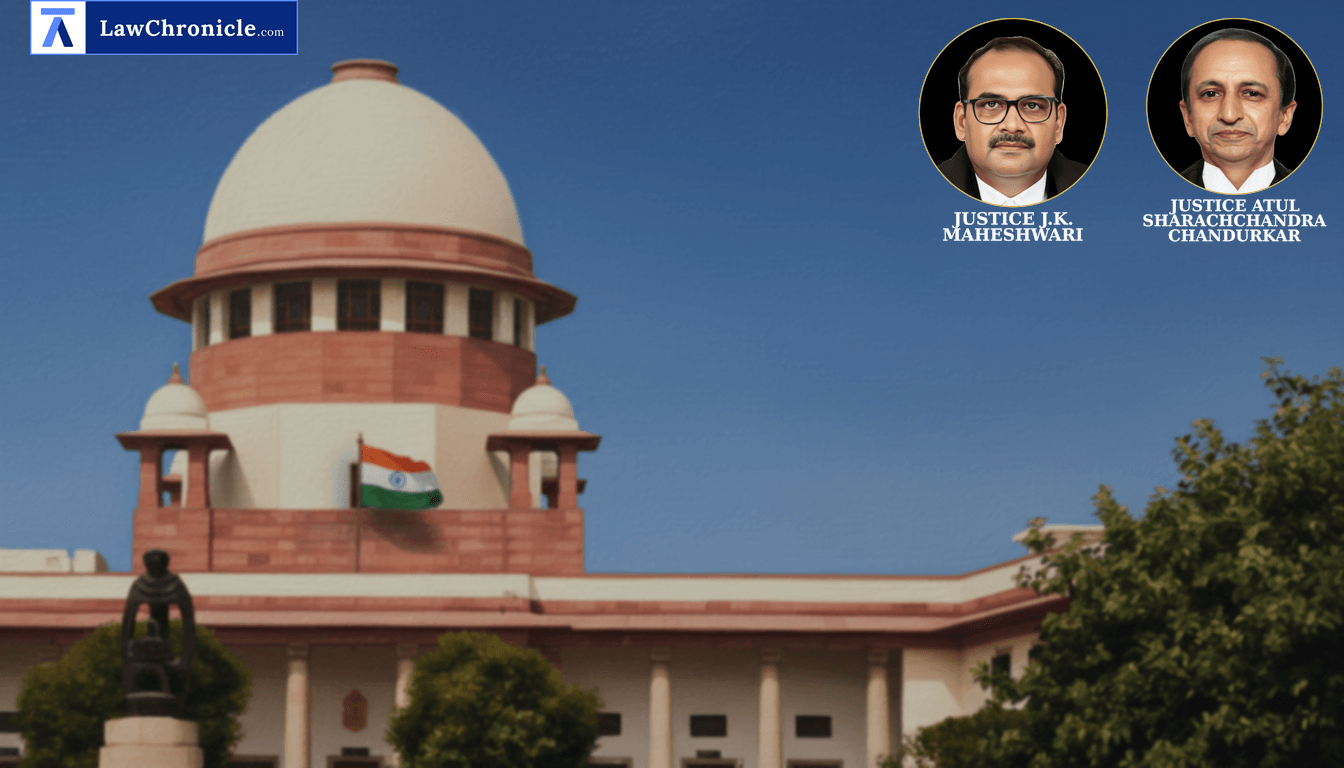
Reinforcing the principle of minimal judicial interference in arbitral proceedings, the Supreme Court held that High Courts cannot invoke writ jurisdiction to examine the merits of contractual interpretation or reassess evidence while considering a challenge to an Arbitrator’s order under Section 16 of the Arbitration and Conciliation Act, 1996.
A bench comprising Justice J.K. Maheshwari and Justice Atul S. Chandurkar heard an appeal where a Single Judge of the High Court had set aside an Arbitrator's decision regarding the sufficiency of stamp duty on agreements. The Court clarified that while writ jurisdiction under Articles 226 and 227 of the Constitution of India is part of the basic structure, its application in pending arbitration proceedings is reserved for cases of 'exceptional rarity' or patent lack of inherent jurisdiction.
The Doctrine of Competence-Competence and Judicial Restraint
The Court emphasized that the Arbitral Tribunal is the primary authority to rule on its own jurisdiction, including objections regarding the validity or stamping of an agreement. The bench observed that any error made by the Arbitrator in such decisions should generally be addressed at the post-award stage under Section 34 of the Arbitration and Conciliation Act, 1996, rather than through mid-arbitration writ petitions.
The Court, in its reasoning, observed: "...it was impermissible for the learned Single Judge to undertake the exercise of entertaining a challenge to the said adjudication by proceeding to interpret the agreements. Assuming that the learned Arbitrator erred in his conclusion that the agreement between the parties was ‘an agreement to sell’, that would not make the case ‘exceptional’ for being set aside in exercise of writ jurisdiction."
Stamping Defects Are Curable and Not Jurisdictional Voids
Addressing the appellant's concern regarding the fiscal implications of insufficient stamping, the Court relied on the Constitution Bench decision in Re: Interplay Between Arbitration Agreements Under the Arbitration And Conciliation Act, 1996 and the Indian Stamp Act, 1899. It reiterated that non-stamping or inadequate stamping is a curable defect and does not render an agreement void ab initio. Therefore, such objections do not constitute a 'patent lack of inherent jurisdiction' that would justify immediate writ intervention.
The Court has the following directions:
"To conclude, we do not find any reason whatsoever to interfere with the order passed by the Division Bench of the High Court. It is clarified that the issue with regard to stamping of the agreement for sale dated 12.02.2004 and the subsequent agreements is kept open for being raised by the aggrieved party under Section 34 of the A and C Act, if the need for the same arises."
Background:
The dispute originated from an iron ore sale agreement dated 12.02.2004. During arbitration, the appellant filed an application under Section 16 of the Arbitration and Conciliation Act, 1996, alleging that the agreements were 'conveyances' and were insufficiently stamped under Article 23 of Schedule I to the Indian Stamp Act, 1899. The Arbitrator rejected this, viewing them as 'agreements to sell' stamped under Article 5(c).
A Single Judge of the High Court, invoking Constitution of India, overturned the Arbitrator's order, directed the impounding of documents, and interpreted the 'true intention' of the parties as being a sale. However, a Division Bench later set aside the Single Judge's order, holding it was in excess of jurisdiction. The Supreme Court upheld the Division Bench's view, noting that Arbitration and Conciliation Act, 1996 is a self-contained code. It relied on Umaji Keshao Meshram and others Vs. Radhikabai w/o Anandrao Banapurkar and another ( "1986 INSC 41": 1986 CaseBase(SC) 368), M/s S.B.P. and Company Vs. M/s Patel Engineering Ltd. and another ( "2005 INSC 526": 2005 CaseBase(SC) 434), and Bhaven Construction through Authorised Signatory Premjibhai K. Shah Vs. Executive Engineer, Sardar Sarovar Narmada Nigam Limited and another ( "2021 INSC 9": 2021 CaseBase(SC) 1744) to highlight that judicial interference must be minimized to ensure the efficiency of the arbitral process. The bench also confirmed that a writ appeal was maintainable since the original writ petition was filed under both Articles 226 and 227, as per the principles in Lokmat Newspapers Pvt. Ltd. Vs. Shankar Prasad ( "1999 INSC 279": 1999 CaseBase(SC) 850) and Sh Jogendrasinhji Vijaysinghji Vs. State of Gujarat and others ( "2015 INSC 485": 2015 CaseBase(SC) 448).
Case Details:
Case No.: Civil Appeal No. of 2026 (@ SLP (C) No. 27534 of 2025)
NeutralCitation: 2026 INSC 566
Case Title: M/S TARINI PRASAD MOHANTY v. M/S SUNFLAG IRON AND STEEL COMPANY LIMITED
Appearances:
For the Petitioner(s): Mr. Shashank Garg, Senior Advocate
For the Respondent(s): Mr. Gopal Subramanium, Mr. N.K. Mody, Ms. Malvika Trivedi, Senior Advocates
Source: 2026 CaseBase(SC) 490
Similar Articles
 Breaking News


