


SC discusses Interplay of Time of Death, Circumstantial Evidence and Last Seen Theory in Murder Case
 Copy Link
 Share
 Save
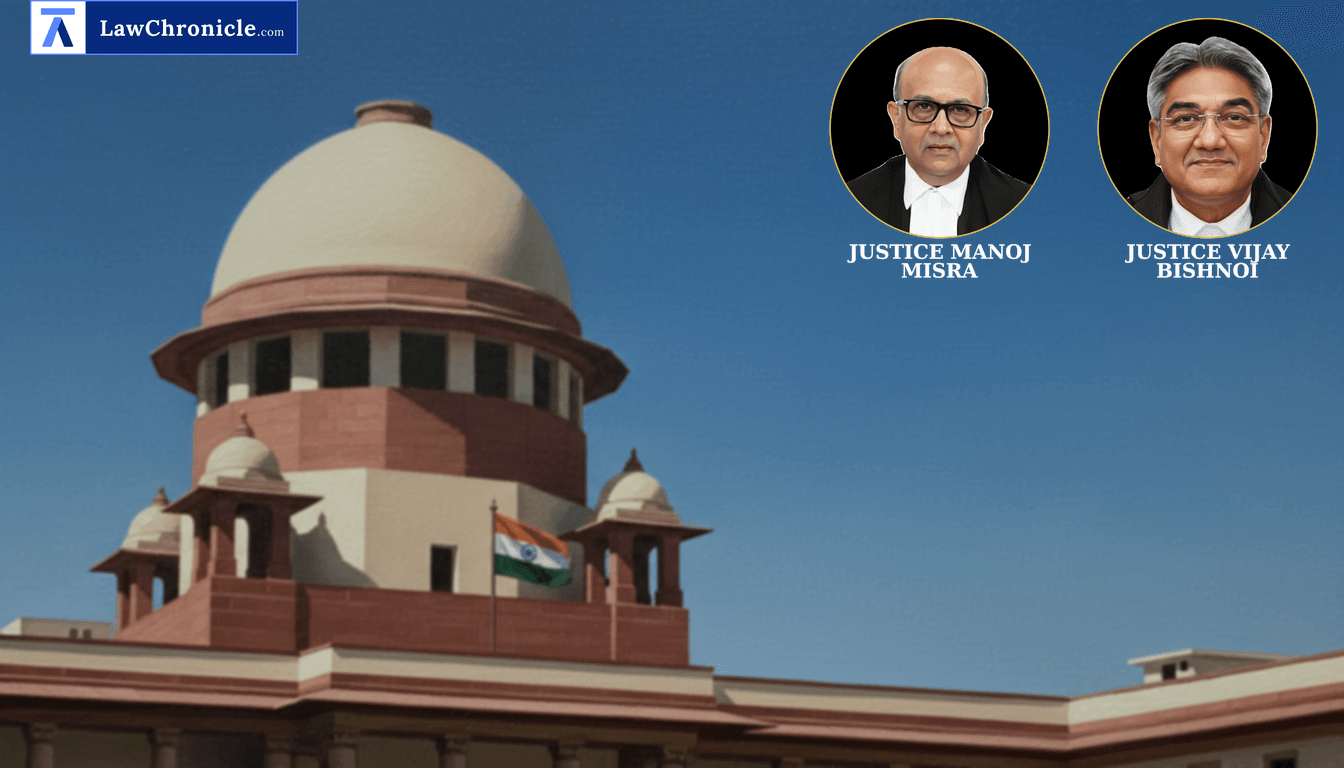
The Supreme Court in Didar Singh vs State of Haryana discussed the crucial role played by time of death in terms of circumstantial evidence and last seen theory. Reaffirming the stringent standard of proof required in cases hinging purely on circumstantial evidence, the Supreme Court overturned the concurrent murder convictions of two men accused of killing their companion.
In an appeal against conviction by Punjab and Haryana High Court, a Division Bench of Justice Manoj Misra and Justice Vijay Bishnoi set aside the convictions under Section 302 read with Section 34 of the Indian Penal Code, 1860.
Key Takeaways
Circumstantial Evidence and Last Seen Theory
Where a substantial time gap exists between the deceased being last seen with the accused and the discovery of the dead body, intervening third-party possibilities cannot be ruled out.
Medical Evidence Must Corroborate Prosecution Timeline
Autopsy findings such as stomach contents, digestive state, and post-mortem injuries serve as crucial indicators to verify or invalidate the prosecution's narrative.
Section 106 Evidence Act Is Not a Substitute for Primary Burden
Section 106 of the Indian Evidence Act, 1872 cannot be invoked to shift the burden onto the accused unless the prosecution first establishes a robust prima facie case.
Inchoate Recoveries Hold No Evidentiary Value
Reconstruction of a crime scene that is already known to the police, without any recovery of weapon or incriminating blood-stained materials, fails to satisfy statutory requirements under disclosure.
Time of Death, Circumstantial Evidence and Last Seen Theory
To lay the foundation of the interplay between the three events, the Apex Court pointed out that the estimated time of death, the time when the body of the deceased was discovered and the time when the FIR was lodged. Questioning circumstantial evidence and last seen theory, the Apex Court in this case “there was huge time-gap between last seen and probable time of death and, therefore, intervening circumstances cannot be ruled out.”
The Supreme Court elaborated that “The circumstance of the deceased being last seen together with the accused is a weak circumstance and on its own is ordinarily not sufficient to record conviction until and unless there is negligible time gap between the two events i.e., the deceased being seen together with the accused and discovery of the dead body of the deceased, which rules out any third party intervention in the crime.”
Gap in Evidence
Evaluating the medical evidence alongside the timeline, the Supreme Court highlighted several fatal gaps in the prosecution's case. The Supreme Court highlighted gaps stating "the prosecution has failed to prove the incriminating circumstances beyond reasonable doubt, and, secondly, those circumstances cumulatively do not indicate that in all human probability it is the accused who had committed the crime and no one else. Besides, the circumstances proven on record do strongly indicate that the deceased died in a motorcycle accident."
Case Laws on Circumstantial Evidence
Addressing the reliance placed on precedents regarding circumstantial evidence, the Court referenced Sharad Birdhichand Sarda v. State of Maharashtra ( "(1984) 4 SCC 116": 1984 CaseBase(SC) 194) to re-emphasize the five golden principles that must be fulfilled before recording a conviction. Furthermore, while considering the 'last seen' doctrine, the Bench observed that the circumstance is inherently weak unless backed by negligible time-gap, as established in Boby v. State of Kerala ( "(2023) 15 SCC 760": 2023 CaseBase(SC) 1018) and Nizam and Another v. State of Rajasthan ( "(2016) 1 SCC 550": 2015 CaseBase(SC) 534).
Repelling the argument on shifting onus, the Bench noted that while Section 106 of the Indian Evidence Act, 1872 applies in appropriate situations as held in State of Rajasthan v. Kashi Ram ( "(2006) 12 SCC 254": 2006 CaseBase(SC) 93) and Satpal v. State of Haryana ( "(2018) 6 SCC 610": 2018 CaseBase(SC) 1223), it does not relieve the prosecution from discharging its foundational burden, echoing the principles laid down in Shivaji Chintappa Patil v. State of Maharashtra ( "(2021) 5 SCC 626": 2021 CaseBase(SC) 1560), State of Punjab v. Kewal Krishan ( "(2023) 13 SCC 695": 2023 CaseBase(SC) 105), and Md. Anowar Hussain v. State of Assam ( "(2022) 19 SCC 264": 2022 CaseBase(SC) 852). On the aspect of evaluating time of death using stomach contents, the Bench kept in mind the cautionary note highlighted in Shivaji Sahabrao Bobade & Anr. v. State of Maharashtra ( "(1973) 2 SCC 793": 1973 CaseBase(SC) 123).
Ratio
In a case resting solely on circumstantial evidence and last seen throry, the failure of the prosecution to establish an unbroken chain of events excluding every reasonable hypothesis of innocence entitles the accused to an acquittal. The last seen circumstance cannot form the sole basis of conviction when the time gap is wide enough to permit intervening factors, and Section 106 of the Indian Evidence Act, 1872 cannot be used to discharge the initial burden of proof resting on the prosecution.
Background
The dispute originated from an incident reported on May 25, 2004, where the complainant alleged that the appellants had taken his son on a motorcycle the previous evening. The son did not return, and his body was subsequently found in an agricultural field the following morning. The prosecution alleged murder due to suspicion that the deceased was acting as an informant against the appellants' illicit trade activities under The Narcotic Drugs and Psychotropic Substances Act, 1985, while one of the appellants also had a prior record under Section 294 of Indian Penal Code, 1860. Following trial under Section 302 and Section 201 read with Section 34 of Indian Penal Code, 1860 and proceedings governed by Code of Criminal Procedure, 1973, the Trial Court convicted the appellants under Sections 302/34 of Indian Penal Code, 1860, which was subsequently affirmed by the High Court.
Upon analyzing the appeal, the Supreme Court found multiple inconsistencies: the failure to prove ownership of the vehicle, uncorroborated motive, lack of drag marks, and medical evidence supporting the alternative hypothesis of a fatal motorcycle accident. Consequently, the Supreme Court allowed the appeals, set aside the judgments of the High Court and Trial Court, and acquitted the appellants of all charges.
Case Details:
Case No.: Criminal Appeal No. 1148 of 2013
Neutral Citation: 2026 INSC 726
Case Title: Didar Singh @ Dari v. The State of Haryana
Source: 2026 CaseBase(SC) 720
Similar Articles

 Breaking News


