


SC: Investor Can Qualify as ‘Member’ Without Formal Registration
 Copy Link
 Share
 Save
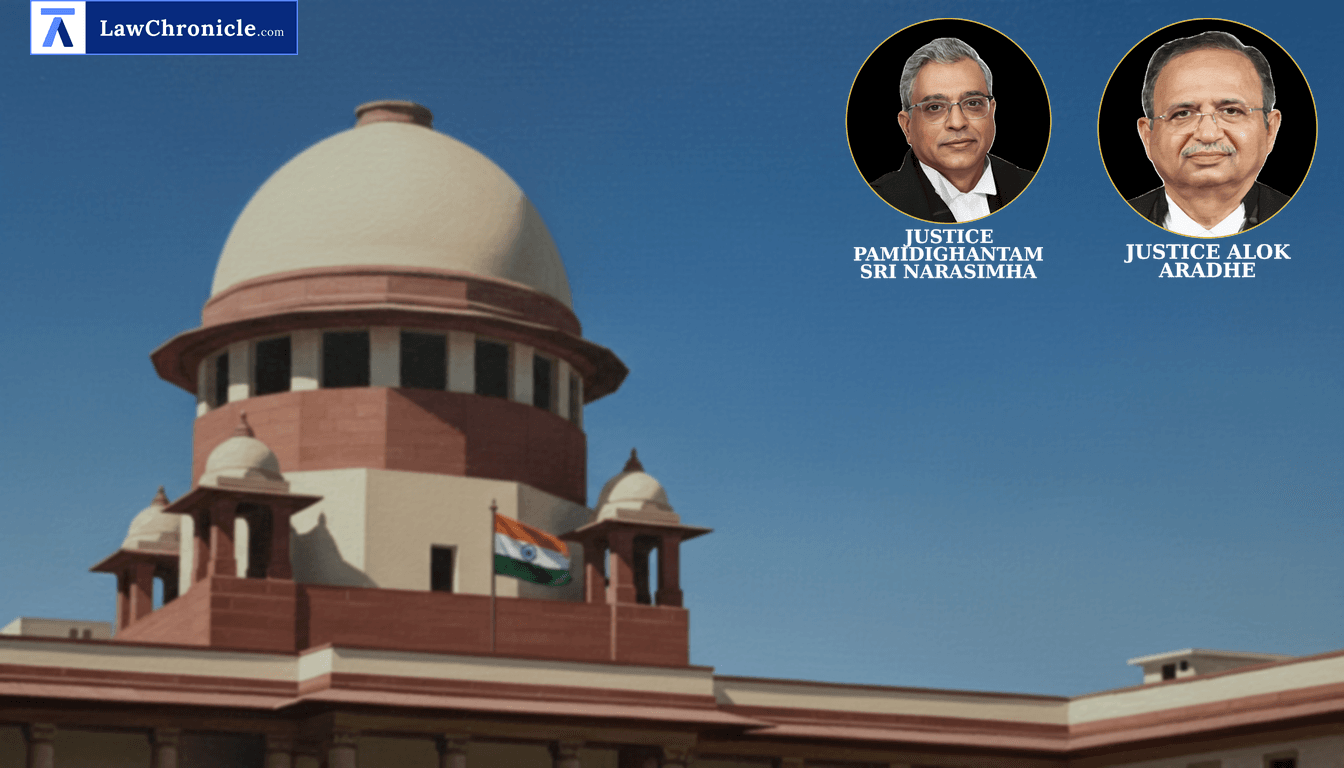
The Supreme Court of India, in Dr. Bais Surgical and Medical Institute Pvt. Ltd. & Ors. v. Dhananjay Pande, held that the requirement of a “written” agreement to become a member, introduced by the 1960 Amendment Act, was intended to ensure reliable proof of consent and to guard against the fraudulent inclusion of names in the register, and not to make entry in the register the sole or exclusive mode of acquiring membership.
A bench of Justices Pamidighantam Sri Narasimha and Alok Aradhe heard appeals that raised the narrow question whether an investor who had not secured formal entry in the register of members could nonetheless be treated as a "member" for the purpose of invoking remedies under Sections 397 and 398 of the Companies Act, 1956.
The Court summarized the main holding and the legal thrust of its decision. It held that the expression "member" appearing in Sections 397, 398 and 399 was not to be construed exclusively by reference to the procedural stipulations of Section 41(2) if the cumulative factual matrix showed that the company had treated the investor as a shareholder and recognised his proprietary interest.
The Court, in its reasoning, observed: "A conjoint reading of Sections 397, 398 and 399 indicates that the expression “member” cannot be construed in isolation or confined to the technical formulation contained in Section 41(2). Rather, the broader definition embodied in Section 2(27) assumes significance in determining whether a person is entitled to invoke the remedies contemplated under the Act. It would be contrary to settled principles of interpretation to attribute to the Legislature an intention to create conflicting meanings of the same expression within the statute. The expression “member”, when employed in the context of remedies under Sections 397 and 398, must therefore be construed with reference to the wider definitional framework provided in Section 2(27) and allied provisions governing the rights of members."
The Court reiterated that equitable considerations underlying the jurisdiction under Sections 397 and 398 required a purposive construction and that formal non-entry in the register did not automatically defeat substantive claims when the corporate conduct consistently recognised the investor's stake. The Court quoted the trial record and contemporaneous communications as evidencing such recognition, and it observed that the High Court and the Company Law Board had correctly proceeded on the basis of the cumulative facts.
Background
The dispute arose from investments made into a hospital-operating company and a subsequent assertion by the investor that large tranches of shares had been allotted to him though formal share certificates and entry in the register had not been completed. The investor was appointed Managing Director, the hospital’s name was altered to reflect his trading identity and substantial funds were accepted and utilised by the company. When disagreements surfaced the investor filed company petitions under Sections 397 and 398 of the Companies Act, 1956 alleging acts of oppression and mismanagement; the appellants challenged maintainability on the ground that, in the absence of entry in the register of members under Section 41, the investor lacked locus to invoke the Company Law Board.
The Company Law Board accepted the investor’s claim and directed allotment or refund; on appeal the High Court dismissed the challenges and expressly relied upon precedent to construe membership for the remedial purposes of Chapter VI. The High Court placed particular reliance on Shri Balaji Textile Mills Pvt. Ltd. and Anr. v. Ashok Kavle and Ors. in concluding that the meaning of "member" for Sections 397 and 398 must be read with reference to the broader definition in Section 2(27) and not be mechanically restricted to Section 41(2). The investor also cited authority in support and this Court noted that both M/s World Wide Agencies Pvt. Ltd. and Anr. v. Margarat T. Desor and Ors. and Umesh Kumar Baveja and Ors. v. IL and FS Transportation Network Ltd. and Ors. had been treated as supportive of the proposition that substantive recognition and acceptance of share application money, reflected in company records and conduct, could establish membership for the purpose of seeking relief against oppression and mismanagement.
The Court reviewed contemporaneous letters, conciliation minutes and financial records and recorded that "These materials, when read alongside the admitted fact that respondent no. 1 was inducted as Managing Director and that the hospital was rebranded as Ekvira Heart Institute, reflecting the identity of the respondent’s trading concern, demonstrate that respondent no. 1 was consistently treated as a stakeholder having interest in the appellant company rather than as a mere investor or creditor." Ultimately the Court found that the cumulative factual circumstances justified treating the investor as a member for the purposes of maintaining proceedings under Sections 397 and 398 of the Companies Act, 1956, dismissed the appeals and directed release of the amount deposited in Court to the investor with accrued interest. The Court recorded there would be no order as to costs and disposed of pending applications.
Case Details:
Case No.: CIVIL APPEAL NO. 8973 OF 2010; CIVIL APPEAL NO. 9456 OF 2010
NeutralCitation: 2026 INSC 447
Case Title: DR. BAIS SURGICAL AND MEDICAL INSTITUTE PVT. LTD. & ORS. v. DHANANJAY PANDE
Appearances:
For the Petitioner(s): Mr. Shyam Mehta, Senior Counsel
For the Respondent(s): Mr. Shailesh Mandiyal, Senior Counsel; Mrs. Haripriya Gopal Shankar, Senior Counsel
Source: 2026 CaseBase(SC) 383
Similar Articles

 Breaking News


