


SC: No Punishment on Unframed Charges Without Fresh Show-Cause Notice
 Copy Link
 Share
 Save
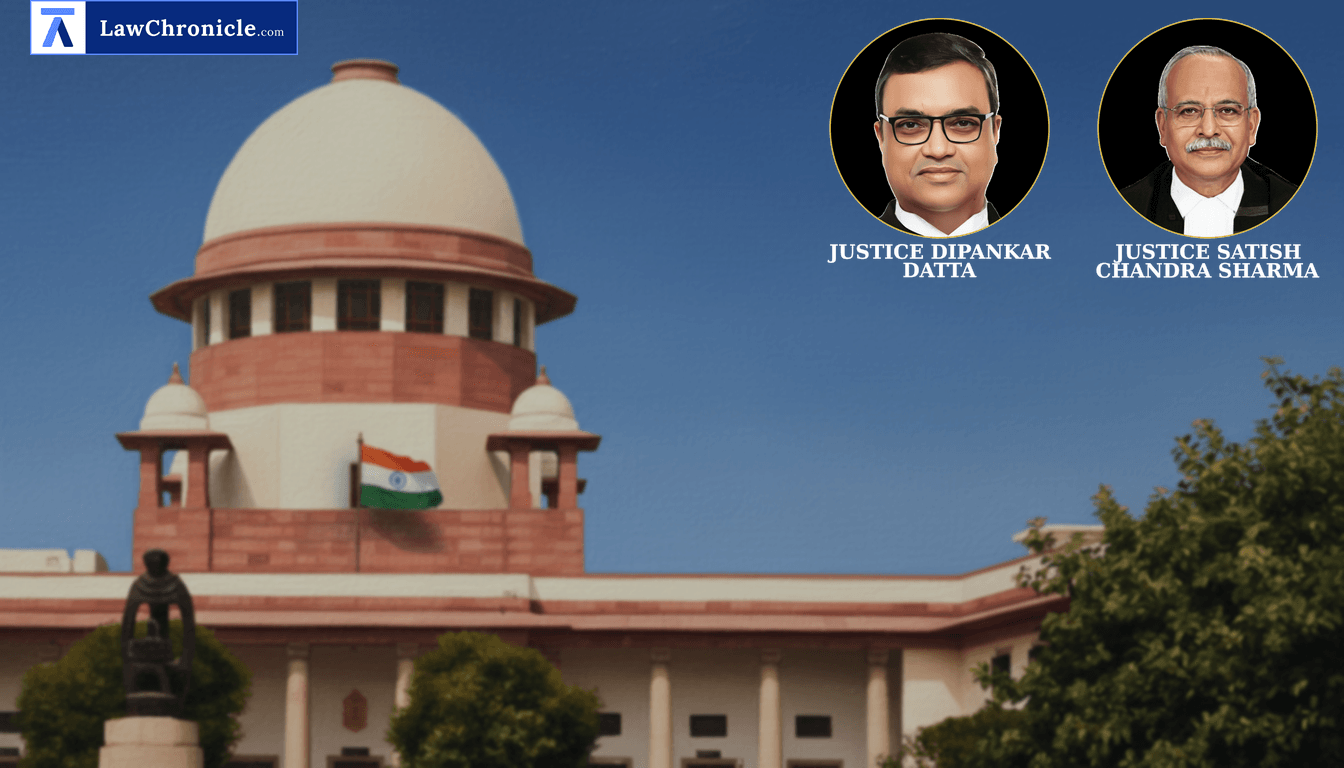
The Supreme Court of India, in Dr. Nigam Prakash Narain v. National Medical Commission & Ors., ruled that once a delinquent employee has successfully defended a charge, the disciplinary authority cannot, in the absence of a fresh show-cause notice, punish the employee on a completely different charge that was never framed against him.
A Bench comprising Justice Dipankar Datta and Justice Satish Chandra Sharma heard an appeal filed by the senior paediatrician challenging the Patna High Court Division Bench’s decision restoring an Ethics Committee order of the Medical Council of India, which had directed the removal of his name from the Indian Medical Register for three months. The dispute concerned whether an allegedly incomplete faculty declaration during surprise inspections warranted the penalty imposed on him.
The Court summarised that while there was evidence of a mis-declaration in the declaration form used for the assessment, there was also a procedural infirmity in the manner in which the disciplinary process was advanced; the appeal was allowed in part and the Court reduced the penalty to issuance of a censure/warning, observing that the disciplinary authority should have afforded an opportunity to answer any fresh charge before imposing punishment.
The Court, in its reasoning, observed: "Once the charge originally framed against Dr. Narain was successfully defended by him, the Ethics Committee (on being prodded by the Executive Committee) proceeded to hold Dr. Narain guilty of an act of omission, which was at variance with the charge. This was without informing him of the same and without calling for his explanation. There has, indeed, been a breach of principles of natural justice. A coordinate bench of this Court in Ravi Oraon v. State of Jharkhand has held that once a delinquent employee had successfully defended a charge, the disciplinary authority, in absence of a fresh show cause notice, cannot punish the delinquent employee on a completely different charge which was not framed. This would be a denial of fair and reasonable opportunity of hearing and in violation of the principles of natural justice. Thus, the Executive Committee could not have imposed the punishment without issuing a fresh show cause notice and/or without granting Dr. Narain a fair and reasonable opportunity to respond to the new/alternative charge under consideration. We quite appreciate that the Executive Committee’s decision, to that extent, does suffer from a serious flaw."
Background
The dispute arose after two surprise inspections by the MCI in the 2014-15 academic year: an inspection at Shridev Suman Subharti Medical College & Hospital, Dehradun on 22 January 2015 and an inspection at Patna Medical College on 5 May 2015. The doctor had accepted a short-term contractual appointment at Patna after resigning and had been out of the country on the date of the Patna inspection. A declaration form produced at the Patna inspection did not disclose the earlier appearance at the Dehradun inspection and signatures on the forms were found to tally. The Ethics Committee initially concluded that the doctor had not appeared at Patna on the date of inspection and found no guilt, but after review the Executive Committee directed that the doctor’s name be removed from the register for three months.
The Single Judge of the High Court set aside that order, finding that the resignation and subsequent contractual engagement showed absence of mens rea and that the disciplinary action was excessive. The Division Bench reversed and upheld the regulatory power to conduct surprise inspections and the significance of accurate faculty declarations, reading Regulation 8.4 and Regulation 8.7 of the Indian Medical Council (Professional Conduct, Etiquette And Ethics) Regulations, 2002 conjunctively to reject the limitation defence. On the procedural point the Supreme Court agreed that once the initially framed charge was successfully defended, the authority could not proceed to punish on a different omission without issuing a fresh show cause notice; the Court relied on the principle laid down in Ravi Oraon v. State of Jharkhand to hold that failure to provide a fresh opportunity amounted to breach of natural justice.
The Court also observed that "While it was true that there had been a lapse on his part by mis-declaration in the Declaration Form one which he now fairly admits in the larger scheme of things, it may not be in the interest of justice to uphold the penalty imposed by the Executive Committee." Having regard to the decade-long pendency of the matter and the age of the doctor, the Court exercised its remedial discretion and directed the disciplinary authority to record a censure/warning in place of the earlier three-month removal. Interim orders granted during the litigation were vacated as the appeal was allowed in the terms recorded.
Case Details:
NeutralCitation: 2026 INSC 453
Case Title: DR. NIGAM PRAKASH NARAIN v. NATIONAL MEDICAL COMMISSION & ORS.
Source: 2026 CaseBase(SC) 384
 Breaking News


