


SC: Police Interrogation Cannot Be Confined To Prison Premises
 Copy Link
 Share
 Save
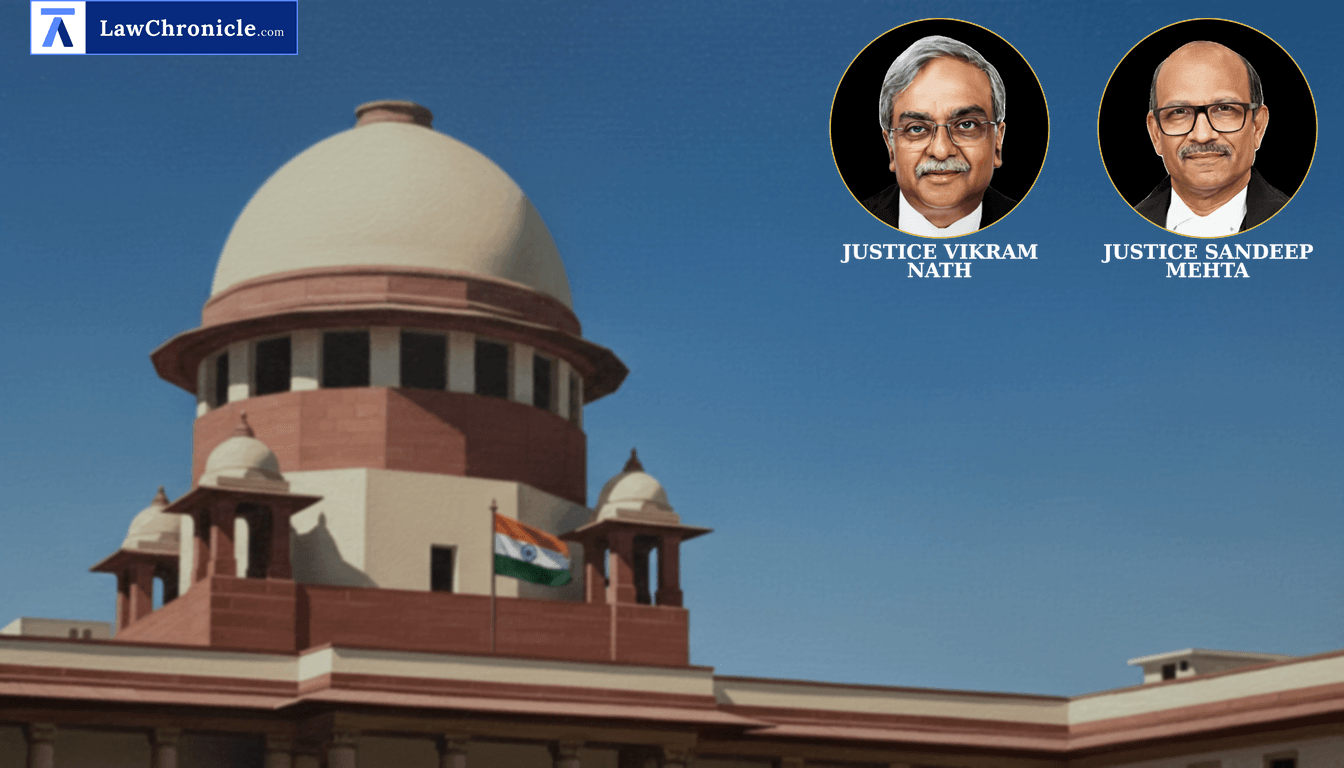
The Supreme Court has dismantled an 'unworkable' custody regime that confined police interrogation within jail premises, ruling that such restrictive conditions render the statutory purpose of custodial remand illusory. Striking a balance between investigative autonomy and prisoner rights, the Court held that while constitutional safeguards are non-negotiable, the police must have the freedom to conduct field investigations and crime scene reconstructions without an 'omnibus' regime of continuous videography and site-specific constraints.
In a criminal appeal filed by the State of Andhra Pradesh, a bench of Justice Vikram Nath and Justice Sandeep Mehta examined the legality of conditions imposed on the police custody of an Inspector of Police accused in a custodial death case. The State challenged the orders of the High Court and the Magistrate which had substantially restricted the SIT’s ability to interrogate the accused outside the Central Prison, Rajamahendravaram.
Invalidity of Restrictive Custody Conditions
The Court found that the conditions imposed by the lower courts, specifically the requirement to conduct all interrogation within the jail and the mandate for continuous videography of transit, were unjustified. It observed that the investigation into the custodial death of one Gade Sai Krishna required the recovery of material evidence and the tracing of the deceased's body, which necessitated taking the accused to specific locations.
The Court, in its reasoning, observed: "In this background, confining the entirety of the custodial interrogation to the Central Prison, Rajamahendravaram is neither justified nor sustainable on the facts of this case. The offence of custodial death in which the respondent-accused is arraigned is alleged to have been committed at, and in the vicinity of, Krishna Lanka Police Station, Vijayawada; the dead body of the deceased-victim remains untraced; the original hard disks of the CCTV system are yet to be recovered; and it is the specific case of the prosecution that discoveries under Section 23 of the Bharatiya Sakshya Adhiniyam, 2023 are imminent if the respondent-accused is properly interrogated."
Clarification on Section 187 of BNSS
Analyzing the new statutory framework, the Bench noted that Section 187 of the Bharatiya Nagarik Suraksha Sanhita, 2023 has expanded the window for seeking police custody compared to the old Code of Criminal Procedure, 1973. The Court held that imposing a non-extendable outer limit on custody periods would run counter to the legislative intent of the Bharatiya Nagarik Suraksha Sanhita, 2023, which allows for custody in parts during the first 40 or 60 days of detention.
Furthermore, the Court clarified the scope of Section 38 of the Bharatiya Nagarik Suraksha Sanhita, 2023 regarding the presence of an advocate. While the right to meet a lawyer is guaranteed, it does not imply a right to the continuous, ongoing physical presence of an advocate throughout every session of interrogation.
Directives for Impartial Investigation
The Court has the following directions:
"(i) The period of police custody shall commence from the date of production of the respondent-accused before the learned Magistrate pursuant to this judgment and shall remain in force for a period of seven (7) days therefrom. Thus, the total period of police remand including that granted by the Courts below would not exceed fifteen (15) days.
(ii) The Investigating Officer shall have unrestricted access to the respondent-accused during the period of police custody for the purposes of interrogation.
(iii) The condition confining custodial interrogation exclusively to the Central Prison, Rajamahendravaram is set aside as unworkable and unjustified. The Investigating Officer shall be at liberty to interrogate the respondent-accused at the designated interrogation centre of the SIT, or any other equivalent facility available with the police authorities at Vijayawada.
(iv) The requirement that the process of custodial interrogation, wherever conducted, shall be conducted under CCTV coverage and/or videographic supervision is retained. It is, however, clarified that this requirement stands satisfied by audio-visual recording of the actual sessions of interrogation and of any proceedings of discovery or recovery undertaken with the accused; it shall not be read as mandating uninterrupted videography of the transit of the accused between locations.
(v) The Investigating Agency shall not subject the respondent-accused to any threat, inducement, coercion, physical assault, mental harassment or third-degree methods during the course of custodial interrogation, whether at the Central Prison or elsewhere.
(vi) The direction given by the learned Magistrate permitting presence of the lawyer is retained with the modification that such lawyer shall only be allowed to remain present within the site of interrogation where he can see the respondent-accused. However, the lawyer shall not be permitted to intervene in the process of investigation at any cost.
(vii) A copy of the CCTV footage and of the videographic recording in its original form without deletion, overwriting, editing or tampering shall be produced, together with a certificate under Section 63 of the Bharatiya Sakshya Adhiniyam, 2023 before the learned Magistrate at Vijayawada upon the completion of the period of police custody.
(viii) The Investigating Officer, the Additional Superintendent of Police, the members of the SIT, and the Jail Superintendent/officer-in-charge of the facility where the accused is lodged during custody, shall be jointly and severally responsible for ensuring the safety, life and physical well-being of the respondent-accused throughout the period of police custody.
(ix) The SIT shall conduct an impartial, fair and scientific investigation strictly in accordance with law, uninfluenced by any observation made in this judgment or in the judgment of the High Court, such observations having been made solely for the disposal of the respective proceedings."
Key Takeaways
Investigative Autonomy Restored
Police custody cannot be rendered ineffective by confining interrogation to prison premises if the investigation requires field visits or crime scene reconstruction.
Interpretation of BNSS Remand
Section 187 of Bharatiya Nagarik Suraksha Sanhita, 2023 allows for flexible custody periods within a larger window, and courts should not prematurely foreclose this statutory right.
Advocate Presence Limitations
Under Section 38 of Bharatiya Nagarik Suraksha Sanhita, 2023, an accused has the right to meet an advocate, but the advocate does not have an unqualified entitlement to be present for every second of the interrogation.
Videography Workability
While custodial interrogation must be recorded for transparency, mandating uninterrupted recording of road transit is unworkable and logically impractical.
Ratio
The statutory power of the police to conduct custodial interrogation under Section 187 of the Bharatiya Nagarik Suraksha Sanhita, 2023 includes the right to conduct investigation at relevant sites outside prison walls. While Article 21 of the Constitution of India mandates safeguards against custodial torture, courts cannot impose conditions that make the interrogation process nugatory or interfere with the statutory right of discovery under Section 23 of the Bharatiya Sakshya Adhiniyam, 2023. Section 38 of the Bharatiya Nagarik Suraksha Sanhita, 2023 guarantees the right to meet an advocate during interrogation but does not contemplate their continuous presence throughout the session.
Background:
The case pertains to the alleged custodial death of Gade Sai Krishna on May 6, 2026. The respondent, a Police Inspector, was accused of illegally detaining and torturing the victim. Following a Habeas Corpus petition and a subsequent complaint by the victim's mother, an FIR was registered under Sections 127(4), 127(6), 103(1), and 238 of the Bharatiya Nyaya Sanhita, 2023. The Magistrate granted police custody for eight days but imposed strict conditions, including conducting the interrogation only within the Central Prison and requiring continuous videography of all movements. The High Court modified some aspects but retained the core restrictions. The State appealed to the Supreme Court, arguing these conditions frustrated the investigation, particularly the need to recover the victim's body and physical evidence. The Supreme Court allowed the appeal, modifying the conditions to allow effective interrogation while maintaining essential human rights safeguards.
Case Details:
Case No.: Criminal Appeal No. of 2026 (Arising out of SLP(Crl.) No. 12344 of 2026)
NeutralCitation: 2026 INSC 744
Case Title: The State of Andhra Pradesh v. Suda Suresh Veera Venkata Naga Raju
Appearances:
For the Petitioner(s): Mr. Sidharth Luthra, Senior Counsel
For the Respondent(s): Mr. L. Narasimha Reddy, Senior Counsel
Source: 2026 CaseBase(SC) 690
Similar Articles
 Breaking News


