


SC Quashes Repeated Termination of CRPF Officer, Slams Executive Apathy
 Copy Link
 Share
 Save
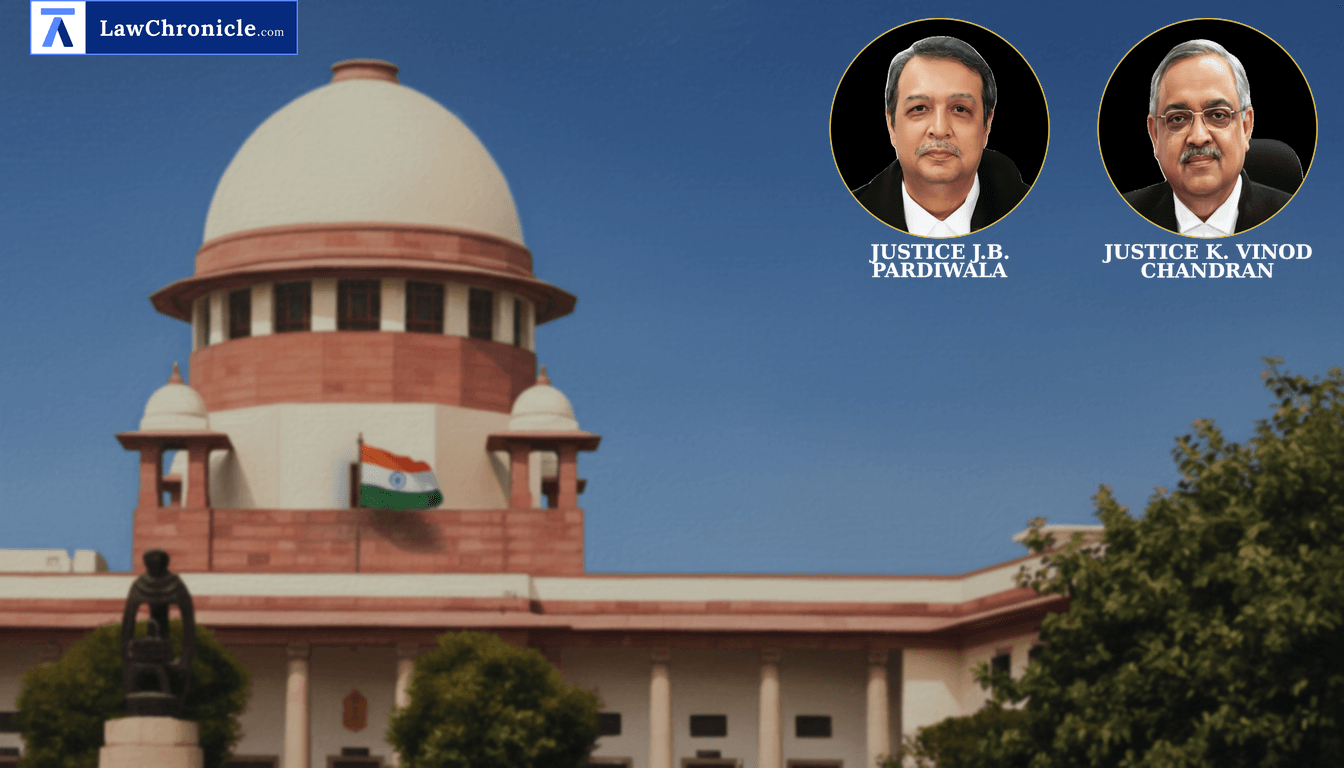
In a scathing indictment of executive apathy and procedural irregularities, the Supreme Court has quashed the repeated termination of a CRPF officer, ruling that departmental indifference cannot be allowed to derail promising careers through a marathon of litigation. The Bench has directed immediate notional promotion and the payment of significant back wages, bringing a conclusion to a twenty-five-year legal battle that the Court characterized as a sacrifice of service at the altar of "brazen pen-pushing."
A Division Bench comprising Justice J.B. Pardiwala and Justice K. Vinod Chandran delivered the judgment while hearing an appeal against a High Court order that had interfered with contempt proceedings. The case involved a CRPF Assistant Commandant whose career was cut short in 1995 following allegations of unauthorized absence, leading to decades of repeated litigation and administrative reversals.
The Procedural Lapse and Executive Overreach
The Court observed that despite previous judicial interventions, the departmental authorities adopted a mechanical and erroneous approach. It specifically highlighted how a recommendation for a minor penalty by the Disciplinary Authority was derailed by an Under Secretary's misplaced interpretation, which eventually led to a second termination order in 2018. The Bench noted that the authorities failed to follow the Government of India (Transaction of Business) Rules, 1961 and internal office memorandums regarding disagreements with the UPSC.
Judicial Restraint vs. Administrative Arbitrariness
While acknowledging the limits of judicial review, the Court emphasized that authorities must not act in mechanical compliance with court directions. The Court, in its reasoning, observed: "It is trite that a judicial review under Constitution of India, 1950, of an order passed in a departmental inquiry holding the delinquent guilty and imposing punishment, is not concerned with the merits of the case and is more on procedure; unless the decision is without authority or vitiated by patent arbitrariness, extraneous considerations or is blatantly perverse... However, the authorities; be it the original authority or the appellate authority, should be cautious to consider the matter and not merely reiterate the earlier findings in mechanical compliance of the directions issued, when a Constitutional Courts directs reconsideration."
Directions Issued to the Authorities
The Court has the following directions:
"The appellant shall hence be promoted from the date on which the other Assistant Commandants were promoted as per the original DPC; of which review DPC was held on 14.03.2023. The appellant shall be paid the entire back wages from the date of entitlement to promotion as a Deputy Commandant, as per the review DPC held on 14.03.2023. If such date of promotion is after 30.11.2012... he shall be entitled to the entire back wages from such date till his retirement as Deputy Commandant. If the promotion date falls prior to 30.11.2012, then necessarily the period prior to 30.11.2012 shall be notional and from 30.11.2012 the back wages shall be paid... the arrears paid of the said benefits including the arrears of pension... We are also inclined to quash the contempt proceedings... on the condition of payment of Rs.10 lakhs to the appellant defraying the costs of the prolonged litigation spanning more than a quarter century."
Key Takeaways
Retroactive Effect of Substituted Penalties
When a major penalty is judicially set aside and replaced by a minor penalty, the 'rigor' of that punishment must relate back to the original date of termination, not the date of the subsequent order.
Prohibition of Mechanical Compliance
Administrative bodies cannot simply 'pen-push' or reiterate old findings when a court orders reconsideration; they must apply an independent mind to mitigating circumstances.
Accountability for Prolonged Litigation
The imposition of Rs. 10 lakhs in costs signifies the Court's intolerance for departmental delays that force employees into decades of avoidable litigation.
Entitlement to Back Wages
Notional promotion alone is insufficient when the delay is entirely attributable to the state's procedural errors; actual back wages must be paid from the date the employee was ready to serve.
Ratio
The court declared that when a Disciplinary Authority identifies mitigating circumstances for a minor penalty, the administrative hierarchy cannot bypass established procedures (like the Committee of Secretaries under Government of India Rules) to impose a harsher penalty based on a misinterpretation of UPSC advice. Furthermore, judicial relief in service matters must ensure that a successful litigant is placed in the position they would have occupied but for the illegal termination, including the benefit of seniority and promotion from the date juniors were promoted.
Background:
The appellant, appointed in 1986, was removed from service in 1995 for an unauthorized absence of 420 days under the Central Civil Services (Classification, Control and Appeal) Rules, 1965. What followed was a complex legal odyssey involving multiple rounds of Writ Petitions and Appeals. In 2019, the Delhi High Court set aside the second termination of 2018, finding that the authorities had wrongly interpreted a UPSC 'independent view' suggestion as a disagreement requiring a major penalty. The Supreme Court previously affirmed this in 2020. However, the department refused to grant actual promotion or full back wages, claiming the appellant lacked the mandatory residency period for the rank of Inspector General. The present appeal arose from the High Court's refusal to enforce the promotion to Inspector General in contempt proceedings, which the Supreme Court has now resolved by granting Deputy Commandant benefits and heavy costs.
Case Details:
Case No.: Civil Appeal No.9224 of 2026
NeutralCitation: 2026 INSC 725
Case Title: Prakash Kumar Dixit v. Ajay Kumar Bhalla and Ors.
Appearances:
For the Petitioner(s): Mr. Sanjoy Ghosh, Senior Counsel
For the Respondent(s): Mrs. Archana Pathak Dave, Additional Solicitor General
Source: 2026 CaseBase(SC) 677
Similar Articles
 Breaking News


