


SC Reduces Natural Life Sentence to 20 Years in Gang Rape Case
 Copy Link
 Share
 Save
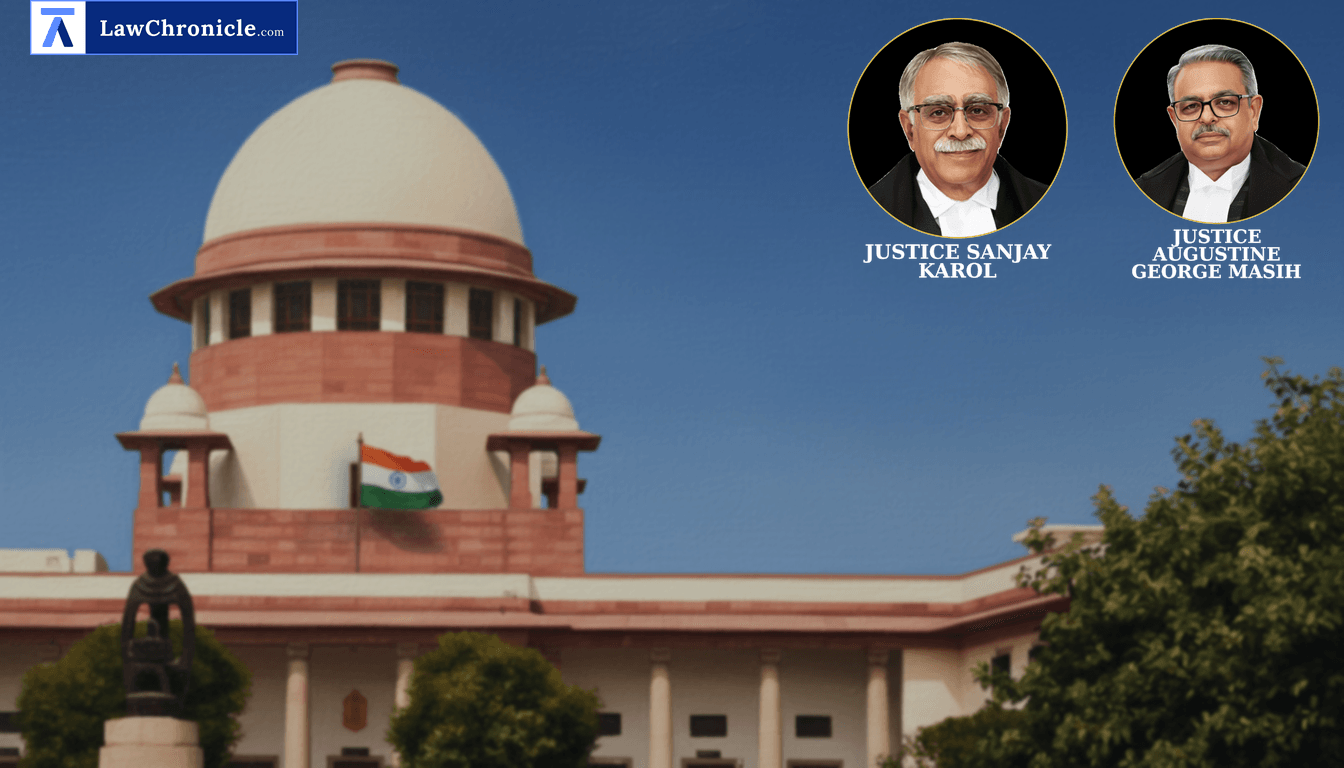
Balancing the scales of retributive justice and rehabilitative potential, the Supreme Court has modified a sentence of life imprisonment for the remainder of natural life to a fixed term of 20 years, ruling that the possibility of reformation must be weighed even in heinous crimes. The verdict underscores that while gang rape warrants stern punishment, judicial discretion must be exercised to ensure sentences remain proportionate to the offender’s age and lack of criminal antecedents.
A bench of Justice Sanjay Karol and Justice Augustine George Masih adjudicated upon the appeal filed by a convict aggrieved by the Delhi High Court's affirmation of his conviction and life sentence for gang rape. While the Court refused to interfere with the finding of guilt, it meticulously examined the doctrine of proportionality regarding the quantum of sentence.
The Doctrine of Proportionality in Sentencing
The Court delved into the constitutional necessity of ensuring that sentences are not arbitrary or irrational. Referring to the dissenting opinion in Bachan Singh v. State of Punjab ( "(1982) 3 SCC 24": 1980 CaseBase(SC) 231), the bench noted that the principle of proportionality is implicit in Articles 14, 19, and 21 of the Constitution. The Court further relied on Surinder Singh v. State (UT of Chandigarh to emphasize that while the gravity of the offence is the primary emphasis, elements of rehabilitative justice and mitigation must be considered within judicial discretion.
Guidelines for Imposing Sentences
Tracing the evolution of sentencing policy through precedents like State of Karnataka v. Krishnappa ( "(2000) 4 SCC 75": 2000 CaseBase(SC) 1543) and Shimbhu v. State of Haryana ( "(2014) 13 SCC 318": 2013 CaseBase(SC) 68), the bench identified key facets for courts to consider, including the nature of the crime, interest of society, deterrent purpose, and the possibility of reformation. The Court, in its reasoning, observed: "When a sentence is imposed on an offender, it is done so with tri-fold purpose i.e. punitive, deterrent and protective. The overall objective is to rid the society of criminal proclivity. The same is done by ensuring that the sentence imposed is proportional to the offence or in other words not overly influenced by the possibility of reformation and instead, striking a judicious balance between the interest of the victim, society and the accused, after following the due process of law."
Analysis of Legislative Mandate Under Section 376D
The Court noted that Section 376-D of the Indian Penal Code, 1860, introduced after the 2013 amendments, prescribes a minimum of twenty years and a maximum of life imprisonment for the remainder of natural life. While acknowledging the legislative intent to provide stringent punishment, the bench observed that the court must abide by the minimum threshold while retaining the discretion to choose between the minimum and the maximum based on the facts of the case.
Court's Directions
The Court has following directions:
"Considering the principles discussed above and applying them to the factors accruing in favour of the appellant - convict noted earlier, we deem it appropriate to modify the sentence to 20 years with benefit of remission, if any. The appeal is partly allowed."
Key Takeaways
Rehabilitative Potential is Crucial
Even in heinous offences like gang rape, the lack of prior criminal history and the young age of the convict must be considered for possible reformation.
State's Burden of Proof
It is the duty of the State to establish that the possibility of reformation for an accused does not exist before the maximum possible sentence is imposed.
Proportionality Over Sole Retribution
Sentencing must strike a judicious balance between the interests of the victim, society, and the accused, avoiding unprincipled or disproportionate punishments.
Ratio
In cases under Section 376D of the Indian Penal Code, 1860, while the court must respect the legislative mandate of a minimum 20-year sentence, the decision to award the maximum punishment of life for the remainder of natural life must be guided by the doctrine of proportionality, taking into account the offender's age, conduct, and lack of criminal antecedents.
Background:
The appellant was convicted for gang rape under Section 376D of the Indian Penal Code, 1860 following an incident in September 2016 where a victim was lured onto a rickshaw and subsequently assaulted by two individuals. The Trial Court, citing State of Punjab v. Saurabh Bakshi ( "(2015) 5 SCC 182": 2015 CaseBase(SC) 266) and Gopal Singh v. State of Uttarakhand ( "(2013) 7 SCC 545": 2013 CaseBase(SC) 3), had awarded rigorous imprisonment for the remainder of the convict's natural life. This was upheld by the Delhi High Court. However, the Supreme Court found that since the appellant was only 25 at the time of the offence, had no criminal record, and maintained good conduct in prison for ten years, the maximum sentence was disproportionate. The Court also reviewed sentencing modifications in Shankar Kisanrao Khade v. State of Maharashtra ( "(2013) 5 SCC 546": 2013 CaseBase(SC) 847), Rajkumar v. State of M.P. ( "(2014) 5 SCC 353": 2014 CaseBase(SC) 176), Selvam v. State, Parsuram v. State of M.P. ( "(2019) 8 SCC 382": 2019 CaseBase(SC) 2620), and Sundar v. State to conclude that a fixed term of 20 years satisfied the ends of justice.
Case Details:
Case No.: Criminal Appeal No. of 2026 (Arising out of SLP(Crl.) No.3407 of 2026)
NeutralCitation: 2026 INSC 720
Case Title: Ehsaan V. State Of National Capital Territory Of Delhi
Source: 2026 CaseBase(SC) 672
Similar Articles

 Breaking News


