


SC: Seat of Arbitration Decides Jurisdiction, Not Venue
 Copy Link
 Share
 Save
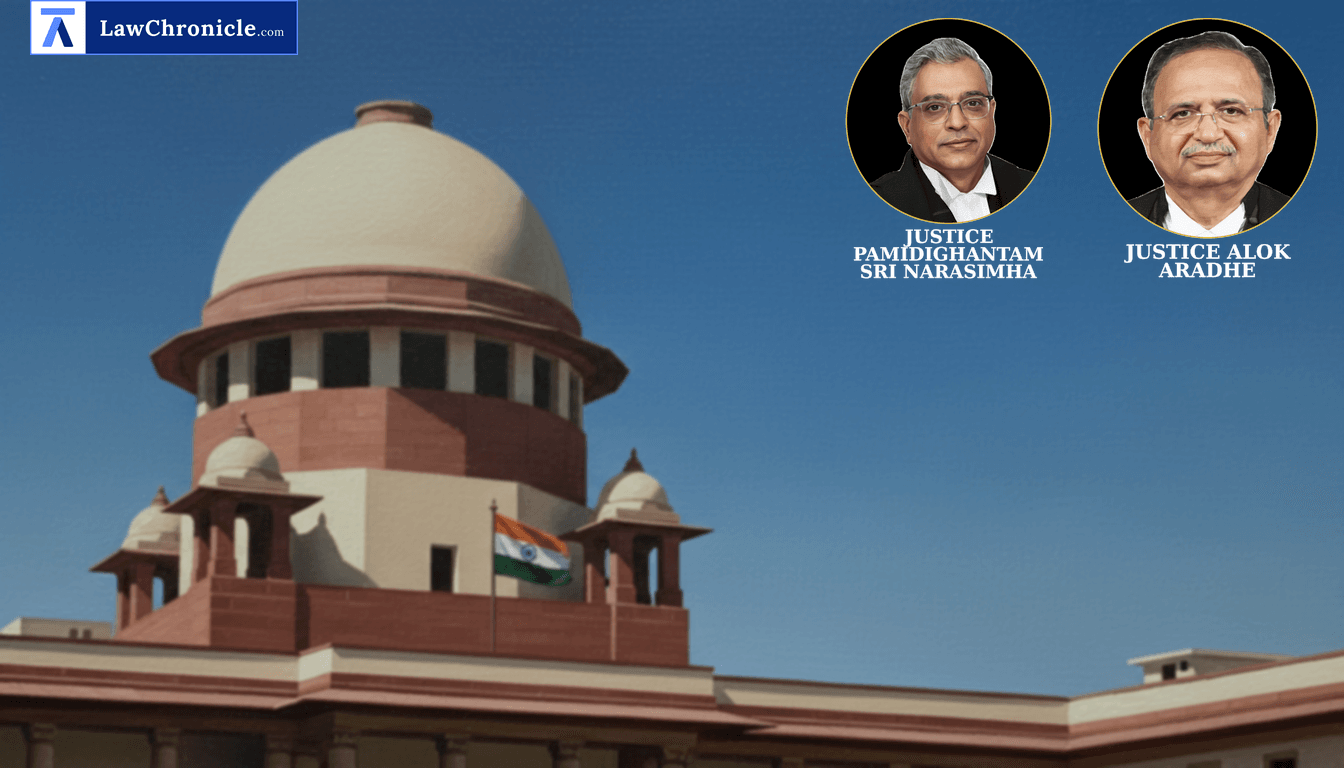
A bench of Justices Pamidighantam Sri Narasimha and Alok Aradhe heard an appeal that questioned whether the juridical seat fixed by parties governed jurisdiction under Section 34 of the Jammu And Kashmir Arbitration And Conciliation Act, 1997 when the arbitral proceedings and award were conducted and rendered at a different venue.
The Court allowed the appeal, held that the seat of arbitration constituted the juridical home of the arbitration and determined supervisory jurisdiction, and quashed the High Court order which had returned the petition on grounds of territorial jurisdiction.
The Court, in its reasoning, observed: Thus, the principles governing the distinction between the seat and venue of the arbitration, and the jurisdictional consequences that follow, may be summarised as under: (i) The seat of arbitration constitutes the juridical home or legal place of arbitration. It determines the curial law governing the arbitral process and identifies the Court having supervisory control over the arbitration. (ii) Once the seat is designated by agreement of the parties, the courts of that place alone have exclusive jurisdiction to entertain all proceedings arising out of the arbitration, including challenges to the award. The designation of the seat operates akin to an exclusive jurisdiction clause, excluding all other courts even those where the cause of action may have arisen. (iii) The venue is merely a geographical location chosen for convenience for holding hearings, examination of witnesses, or meetings of the arbitral tribunal. It does not confer jurisdiction and does not, by itself, alter or determine the seat. The arbitral tribunal is free to conduct proceedings at locations different from the seat without affecting the juridical seat. (iv) The mere fact that arbitral proceedings are conducted or the award is rendered at a particular place does not confer jurisdiction on courts of that place if it is different from the designated seat. The seat remains fixed unless expressly altered by agreement of the parties. (v) Where the seat is not expressly designated, courts determine it by applying: (a) the closest and most intimate connection test, identifying the place most closely connected with the arbitration (based on the Naviera Amazonica principle); and (b) in appropriate cases, construing the venue as the seat where the agreement and surrounding circumstances indicate such intention (as reflected in the Shashoua principle). (vi) The intention of the parties, as discerned from the arbitration agreement and surrounding circumstances, is the paramount factor in determining the seat. Once such intention is expressed either expressly or by necessary implication it must be given full effect by Courts.
The Court further quoted the arbitrator's order fixing seat and venue, noting that in the order dated 16.01.2016 the direction that the seat of arbitration shall be Srinagar and that the venue shall be New Delhi has been inadvertently omitted. Please note that on agreement of the parties' seat of Arbitration shall be at Srinagar and Venue shall be at New Delhi."
Background
The dispute arose from four infrastructure road contracts executed on 31.03.2008 between the appellant society and the respondent contractor for works in Jammu and Kashmir. The respondent issued an arbitration notice on 18.04.2014 and filed four applications on 12.06.2014 under Section 11 of the Jammu And Kashmir Arbitration And Conciliation Act, 1997 before the High Court at Srinagar for appointment of a sole arbitrator; the High Court appointed an arbitrator on 30.07.2015, and this Court, by an order dated 07.12.2015, modified that appointment and appointed a different sole arbitrator. By an order dated 26.03.2016, with the parties' consent the arbitral tribunal fixed Srinagar as the seat of arbitration and New Delhi as the venue. Proceedings continued, a successor arbitrator was appointed by the High Court under Sections 14 and 15 of the Jammu And Kashmir Arbitration And Conciliation Act, 1997, and an award was rendered on 15.01.2024 at New Delhi. The appellant's applications under Section 33 of the Jammu And Kashmir Arbitration And Conciliation Act, 1997 were decided on 12.03.2024.
The appellant filed a petition under Section 34 of the Jammu And Kashmir Arbitration And Conciliation Act, 1997 before the High Court seeking to set aside the award in relation to the Shahdra Project; the respondent raised a territorial jurisdiction objection and the High Court returned the petition on 08.07.2024 holding that courts at New Delhi alone had jurisdiction. The Supreme Court analysed settled principles, including the party autonomy reflected in Section 20 of the Arbitration And Conciliation Act, 1996 and the relevance of Section 2(1)(e) of the Arbitration And Conciliation Act, 1996, and held that the express designation of Srinagar as the seat, supported by surrounding circumstances and the closest and most intimate connection analysis, fixed supervisory jurisdiction in Srinagar. The Court observed that the mere conduct of hearings or rendering of an award at a convenient venue did not alter the designated seat absent an express agreement to change it, and that treating the place of award as determinative would undermine legal certainty and party autonomy.
The Court expressly relied on precedent to frame and apply these principles: it referred to Bharat Aluminium Co. v. Kaiser Aluminium Technical Services Inc. (2012 CaseBase(SC) 339) for the proposition that arbitration is anchored to the seat and governed by the law of that seat; it applied the reasoning of Enercon (India) Ltd. & Ors. v. Enercon GMBH & Anr. (2014 CaseBase(SC) 166) and the English "closest and most intimate connection" principle in Naviera Amazonica Peruana S.A. v. Compania Internacional de Seguros del Peru to identify the juridical seat where ambiguity is present; it accepted the treatment in Indus Mobile Distribution Pvt. Ltd. v. Datawind Innovations Pvt. Ltd. & Ors., BGS SGS Soma JV v. NHPC Ltd. ( 2019 CaseBase(SC) 2108) and Hindustan Construction Co. Ltd. v. NHPC Ltd. & Anr. that a designated seat operates akin to an exclusive jurisdiction clause; and it noted subsequent reaffirmations in Mankastu Impex Pvt. Ltd. v. Airvisual Ltd., BBR (India) Pvt. Ltd. v. S.P. Singla Constructions Pvt. Ltd. and Arif Azam Co. Ltd. v. Micromax Informatics FZE and the guidance in Shashoua v. Sharma on construing venue and surrounding circumstances. The Court therefore allowed the appeal, quashed the impugned High Court order dated 08.07.2024, restored the Section 34 proceeding before the High Court at Srinagar and directed that the High Court decide the petition on merits with due expedition; the appellant was granted liberty to withdraw petitions filed before the High Court of Delhi.
Case Details:
NeutralCitation: 2026 INSC 368
Case Title: J&K Economic Reconstruction Agency v. Rash Builders India Private Limited
Source: 2026 CaseBase(SC) 325
Similar Articles
 Breaking News


