


SC: Section 302 IPC Qualifies as Heinous Offence Under Juvenile Justice Act
 Copy Link
 Share
 Save
Life imprisonment serves as the non-negotiable minimum threshold for murder under the Indian Penal Code, 1860, effectively categorizing such crimes as 'heinous offences' that permit the trial of minors as adults. The Supreme Court has clarified that the statutory discretion to choose between death and life imprisonment does not create a sentencing gap that would downgrade murder to a 'serious offence' for juvenile offenders.
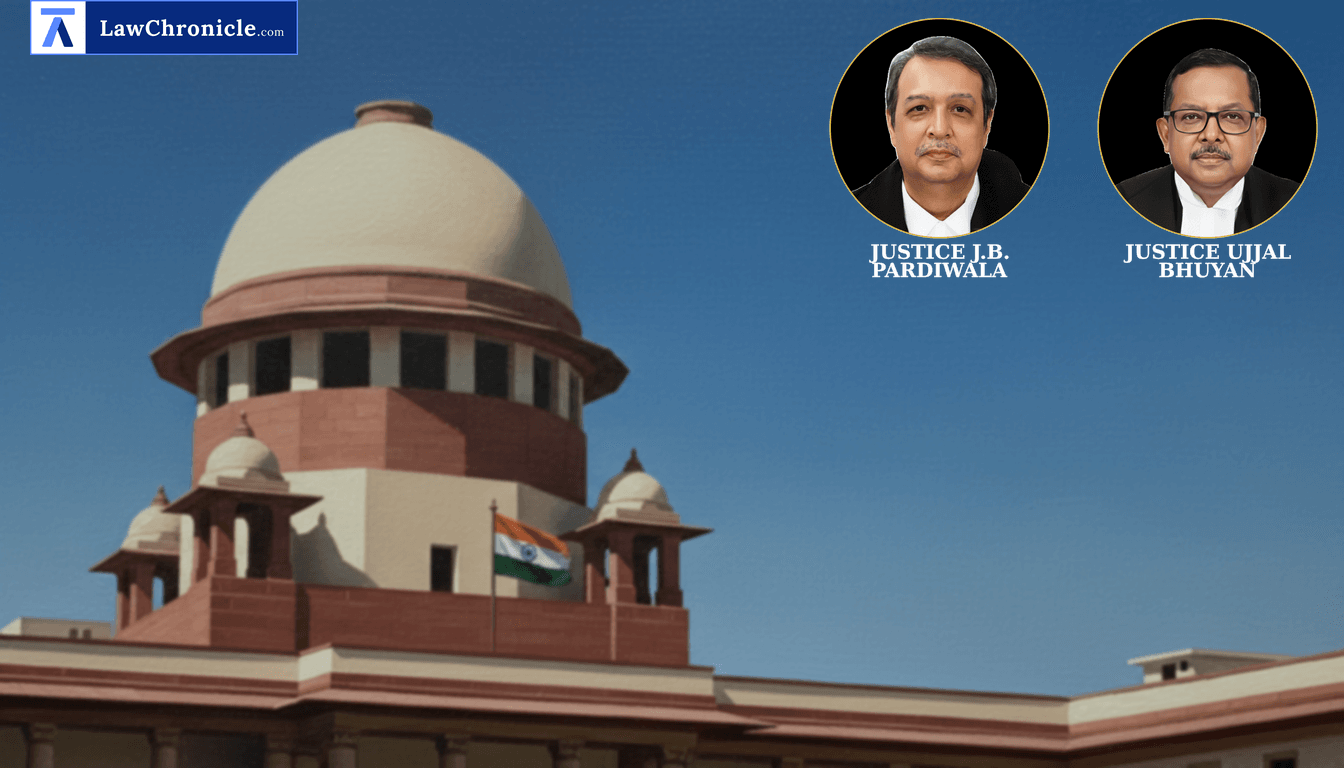
A bench of Justice J.B. Pardiwala and Justice Ujjal Bhuyan delivered this landmark ruling while considering a challenge to a High Court order that affirmed a juvenile’s transfer to a Children’s Court. The case centered on the classification of offences for preliminary assessments under Section 15 of the Juvenile Justice (Care and Protection of Children) Act, 2015 and whether appellate courts are mandatorily required to seek expert assistance during appeals.
Murder as a 'Heinous Offence' under JJ Act
The appellant contended that since Section 302 of the Indian Penal Code, 1860 does not explicitly mention a "minimum" term and offers a choice of punishments, it should be treated as a 'serious offence' rather than 'heinous.' The Court rejected this, observing that Code of Criminal Procedure, 1973, 1973 (and its successor) ensures that a court cannot impose a sentence lesser than life imprisonment for murder. The Court, in its reasoning, observed: "life imprisonment is, by implication, the minimum punishment prescribed under Section 302 of the IPC... The word 'or' merely confers upon the court the discretion to choose between the two punishments having regard to the gravity of the offence. It does not open any avenue for the imprisonment to be lesser than imprisonment for life."
The Court also clarified the application of Shilpa Mittal v. State (NCT) of Delhi, noting it identified a lacuna for offences with no minimum but high maximum sentences, a gap subsequently filled by the Juvenile Justice (Care and Protection of Children) Amendment Act, 2021. However, murder already fits squarely within the definition of 'heinous offences' under Section 2(33) of the Juvenile Justice (Care and Protection of Children) Act, 2015.
Appellate Court's Discretion on Expert Assistance
Addressing whether the Sessions Court must seek expert psychologists' help under Section 101(2) of the Juvenile Justice (Care and Protection of Children) Act, 2015, the Bench held that the word 'may' in the provision is directory, not mandatory. While Barun Chandra Thakur v. Bholu ( "(2023) 12 SCC 401": 2022 CaseBase(SC) 721) made expert assistance mandatory for the Juvenile Justice Board in certain scenarios under Section 15, the same cannot be mechanically applied to the appellate stage. The Court noted that an appellate court is already equipped to evaluate existing reports and only needs fresh expert input if the facts of the case demand it.
Court’s Directions
The Court has the following directions:
"The appeal stands dismissed. Parties shall bear their own cost. Pending applications, if any shall stand disposed of. The Registry shall forward one copy each of this judgment to all the High Courts."
Refining Preliminary Assessment Procedures
The Court emphasized that the Juvenile Justice Board must conduct a calibrated scrutiny of the child's mental and physical capacity, the ability to understand consequences, and the circumstances of the offence. The Court, in its reasoning, observed: "The report by an expert in accordance with the proviso to Section 15(1) is one significant input among several considerations. In other words, it could not be the sole consideration in the Board’s decision. The expert opinion must be read and assessed along with its interaction with the child, the SBR, the SIR, the statement of witness, and other material placed before the Board."
Key Takeaways
Redefining Minimum Sentence
By implication, life imprisonment is established as the minimum sentence for Section 302 IPC, ensuring juveniles accused of murder face the 'heinous' classification process.
Appellate Autonomy
Sessions Courts possess the discretion to decide whether additional expert psychological evidence is necessary for JJ appeals, rather than following a blanket mandatory rule.
Holistic Board Assessments
Juvenile Justice Boards are prohibited from blindly following expert reports; they must independently weigh Social Investigation Reports (SIR) and Social Background Reports (SBR).
No Automatic Sentencing Reductions
Section 21 of the Juvenile Justice (Care and Protection of Children) Act, 2015 modulates how a sentence is served but does not change the classification of the offence for trial forum purposes.
Ratio
An offence punishable by "death or imprisonment for life" carries life imprisonment as its inherent minimum punishment, thus falling within the definition of a "heinous offence" under Section 2(33) of the Juvenile Justice (Care and Protection of Children) Act, 2015. Furthermore, the power of an appellate court to seek expert assistance under Section 101(2) of the Act is discretionary (directory) and must be exercised based on the totality of facts in each case.
Background:
The case arose from the murder of a boy on May 1, 2022. The appellant, aged 16 years and 4 months at the time, was accused of slitting the victim's throat. While the Juvenile Justice Board initially decided to try him as a juvenile, the Appellate Court (Sessions Court) reversed this, ordering him to be tried as an adult. The High Court at Patna upheld this reversal. The Supreme Court dismissed the appeal, affirming that the procedure followed was legally sound and that the nature of the crime warranted the adult trial assessment. The Court relied on precedents like Babasaheb Maruti Kamble v. State of Maharashtra ( "(2019) 13 SCC 631": 2018 CaseBase(SC) 730) and The State of Madhya Pradesh v. Nandu @Nandua ( "Crl. Appeal No. 1356/2022": 2022 CaseBase(SC) 505) to define sentencing standards and State of U.P. v. Babu Ram Upadhya for interpreting 'may' versus 'shall'.
Case Details:
Case No.: CRIMINAL APPEAL NO. 3299 OF 2026
NeutralCitation: 2026 INSC 728
Case Title: X v. STATE OF BIHAR & ANR.
Appearances:
For the Petitioner(s): Mr. Kailas Bajirao Autade, Advocate
For the Respondent(s): Mr. Samir Ali Khan, Advocate for State of Bihar; Mr. Prashant Bhardwaj, Advocate for Complainant
Source: 2026 CaseBase(SC) 675
Similar Articles
 Breaking News


