


SC Quashes Juvenile’s Conviction for Non-Compliance with Section 19(1)
 Copy Link
 Share
 Save
Trial courts lack the jurisdiction to prosecute a child in conflict with law as an adult without first recording a reasoned determination under Section 19(1) of the Juvenile Justice (Care and Protection of Children) Act, 2015, a failure that vitiates the entire criminal proceeding.
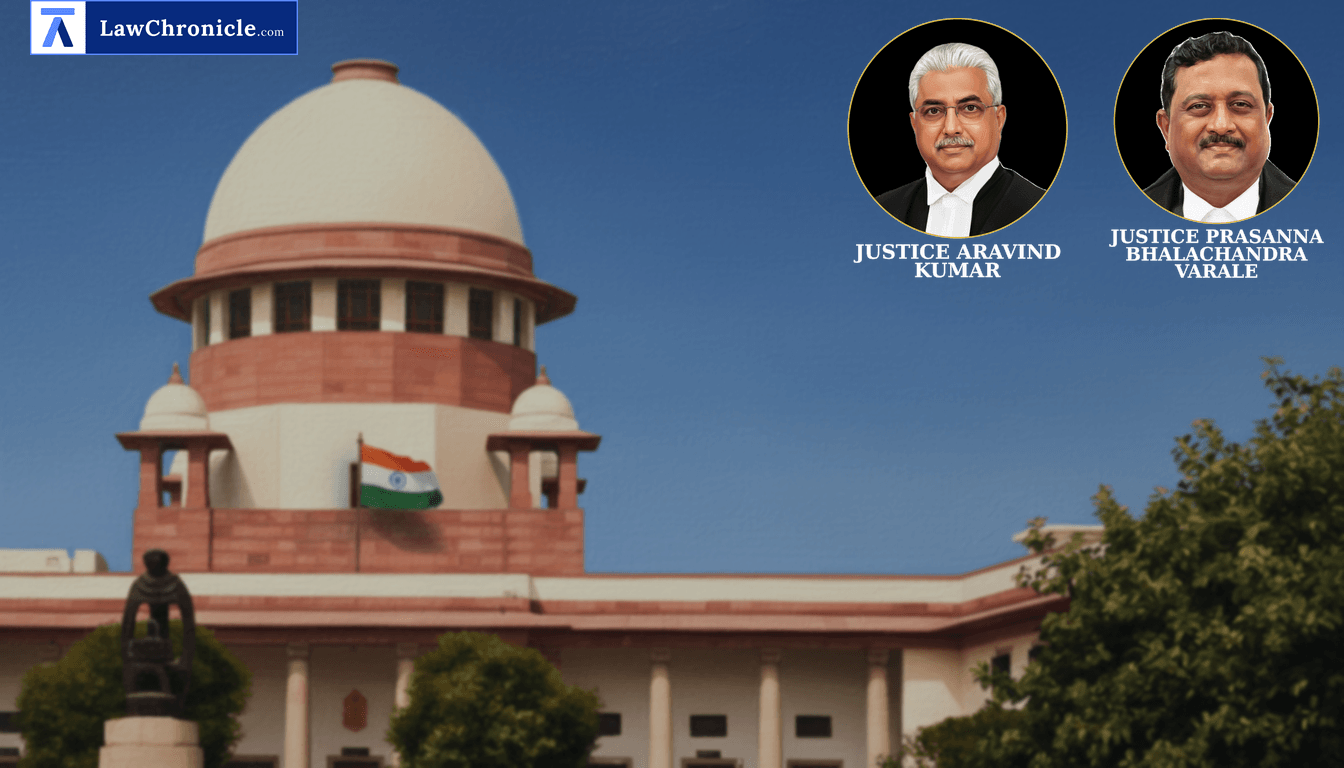
In a decisive intervention, a bench comprising Justice Aravind Kumar and Justice Prasanna B. Varale set aside the murder conviction of a young man who had been tried and sentenced to 14 years of rigorous imprisonment as an adult without the Children’s Court following the mandatory statutory roadmap. The Court emphasized that the protective framework of juvenile justice cannot be bypassed by judicial oversight.
The Mandatory Nature of Section 19(1) Evaluation
The Supreme Court clarified that upon receiving a preliminary assessment from the Juvenile Justice Board under Section 15 of the Juvenile Justice (Care and Protection of Children) Act, 2015, the Children's Court is legally bound to decide whether the child requires trial as an adult. The bench observed that although the statute uses the word 'may', it must be read as 'shall' because the procedural and punitive consequences differ significantly depending on this determination.
The Court, in its reasoning, observed: "The expression 'may' occurring in Sub-section 19(1) and Section 19(1)(ii) will have to be necessarily read as 'shall', since consequences flowing therefrom namely, the trial of a child in conflict with law as an adult and trial as a juvenile would be different. Unless the Children’s Court arrives at a decision as to whether the child in conflict with law is to be tried as an adult or not, it cannot proceed further with the matter."
Vitiation of Trial and Procedural Safeguards
Referring to precedents such as Sarla Goel and Others Vs. Kishan Chand ( "(2009) 7 SCC 658": 2009 CaseBase(SC) 19) and Barun Chandra Thakur v. Master Bholu and Another ( "(2023) 12 SCC 401": 2022 CaseBase(SC) 721), the Court noted that a child tried as an adult faces up to life imprisonment and the loss of disqualification removals under Section 24, whereas a child tried as a juvenile faces a maximum of three years in a special home. Relying on the principles in Thirumoorthy v. State represented by the Inspector of Police ( "(2024) 12 SCC 307": 2024 CaseBase(SC) 615), the bench held that non-compliance with these safeguards strikes at the root of the trial.
As the appellant is now 24 years old and has already spent over six years in custody, the Court found it unfeasible to remit the matter for a fresh assessment of his mental capacity at the time of the 2018 offence.
Directions Issued to Trial Courts
The Court has the following directions:
"Before parting, we deem it appropriate to issue a word of caution and a direction to Children’s Courts across the country that upon receipt of records pursuant to transfer/committal under Section 18(3) of the Act by the Juvenile Justice Board, the first duty of the Children’s Court, after taking cognizance of the matter, is to pass a reasoned order under Section 19(1) of the Act upon due assessment of the ‘child in conflict with law’ before it proceeds further in the matter."
Key Takeaways:
Statutory Safeguards Are Inviolable
Procedural lapses in determining the trial mode for juveniles are not mere technicalities but substantive errors that nullify the entire trial process.
Redefining 'May' as 'Shall'
Section 19(1) is mandatory; a Children's Court must record reasons whether a child is to be treated as an adult or a child immediately after receiving the preliminary assessment.
Impact on Sentencing and Rehabilitation
Trial courts must ensure juveniles are not inadvertently subjected to sessions trials and harsher punishments meant for adults without a formal jurisdictional shift.
Ratio Decidendi:
The power of a Children’s Court to try a child in conflict with law as an adult is contingent upon a mandatory, reasoned order passed under Section 19(1) of the Juvenile Justice (Care and Protection of Children) Act, 2015. Failure to pass such an order results in a lack of jurisdiction to conduct a sessions trial, thereby vitiating the conviction and sentence.
Background:
The case originated from an incident on October 21, 2018, where the appellant was accused of striking the deceased with an iron pipe during a quarrel. Since the appellant was 16 and a half years old, the Juvenile Justice Board conducted a preliminary assessment under Section 15 and committed the matter to the Children’s Court to be tried as an adult. However, the Children’s Court proceeded straight to trial and convicted the appellant under Section 302 of the Indian Penal Code, 1860 without passing the required order under Section 19(1) of the Juvenile Justice (Care and Protection of Children) Act, 2015. The High Court of Punjab and Haryana had previously dismissed the appeal, leading to the current challenge before the Supreme Court.
Case Details:
Case No.: Criminal Appeal No. of 2026 (Arising out of SLP (Crl.) NO. 8113/2024)
NeutralCitation: 2026 INSC 692
Case Title: SAGAR v. THE STATE OF HARYANA
Source: 2026 CaseBase(SC) 652
Similar Articles

 Breaking News


