


"Investigation and Prosecution exist not merely to bring Conviction": SC Orders ₹6 Lakh Compensation for 6-Yr Detention
 Copy Link
 Share
 Save
Exposing a shocking failure of executive power, the Supreme Court ordered the State of Uttar Pradesh to pay ₹6 lakh in compensation to a man illegally incarcerated for six years due to a slipshod criminal investigation. Deprecating the prosecution's complete reliance on surmises and unproven electronic evidence, the Apex Court underscored that investigative agencies are bound to act as neutral stakeholders in the justice system rather than pursuing convictions at all costs.
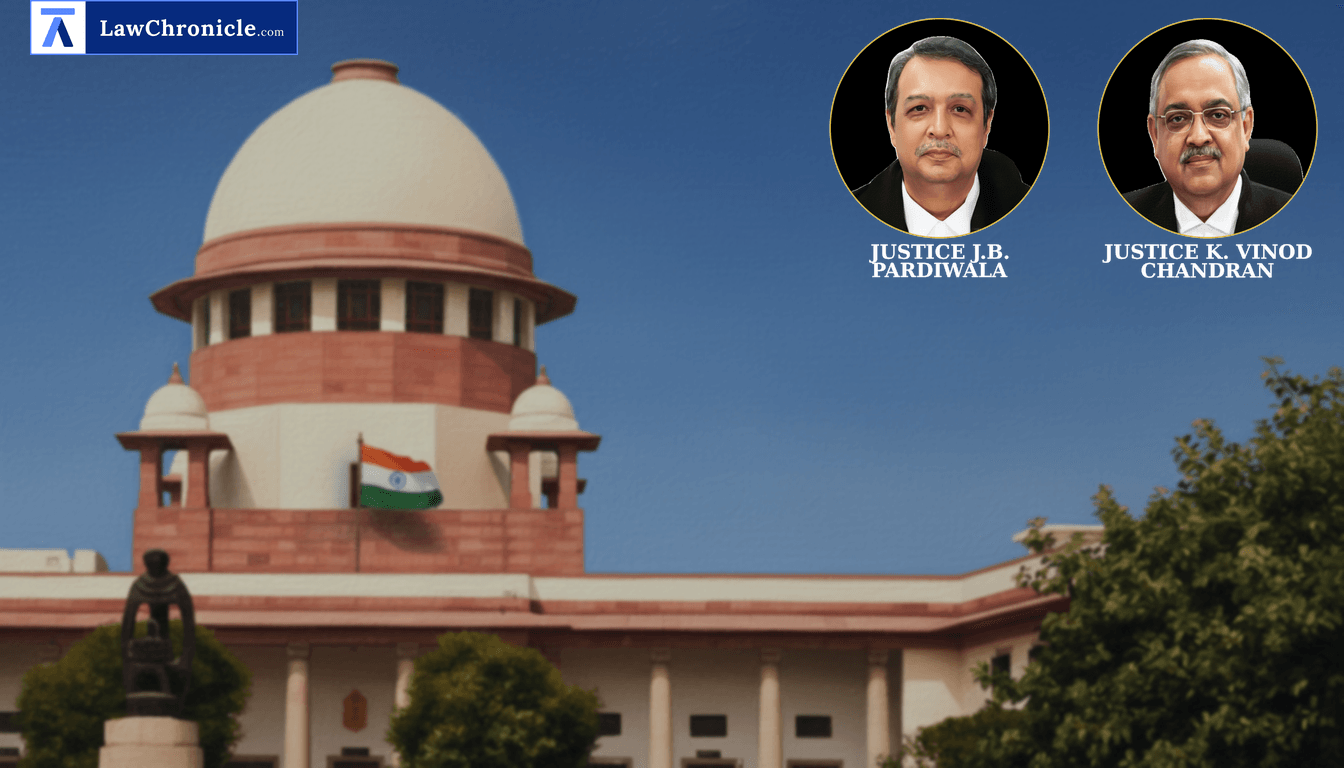
A Bench of Justice J.B. Pardiwala and Justice K. Vinod Chandran delivered the ruling while taking note of the trial court's eventual acquittal of an undertrial accused charged under Section 364 read with Section 302 and Section 201 of the Indian Penal Code, 1860. The Supreme Court Bench scrutinized the underlying record after noting that the petitioner had remained in jail since November 2019 in a case based entirely on circumstantial evidence.
Key Takeaways
Reparation for Systemic Failure
State ordered to pay ₹6 lakh compensation for erasing six years of an innocent person's life through a botched investigation.
Strict Adherence to Section 65B Mandatory
Electronic materials such as CCTV footage and Call Detail Records hold no evidentiary value without compliance under Section 65B of the Evidence Act.
Statutory Duty of Neutrality
Investigating and prosecuting agencies must function as impartial justice delivery stakeholders ensuring rights of both victim and accused.
Requisite Proof for Recovery Rationale
Discoveries under Section 27 of the Evidence Act require explicit recording and proof of the accused's disclosure statement regarding concealment.
Court's Rationale on Investigation Deficiencies
The Bench strongly condemned the haphazard manner in which the investigation was conducted. Examining the record, the Supreme Court observed that the case rested on an unproved CCTV footage, an unverified ransom demand never reported to the police, and joint recoveries made without recording disclosure statements under Section 27 of the Evidence Act. Furthermore, the electronic records lacked the mandatory certification required under Section 65B of the Evidence Act, and the DNA matching of the recovered bones was never completed.
The Apex Court, in its reasoning, observed that “Six years have been erased from the life of a man on the strength of a concocted story built on mere surmises and conjectures. Not even a rudimentary investigation was carried out... The investigation and prosecuting agencies exist not merely to, and by whatever means bring in a conviction. They should recognize themselves to be essential stakeholders in the justice delivery system, ensuring justice, not only to the victim, the de facto complainant and the injured but also to the accused.”
The Apex Court directed the State to pay an amount of Rs.6,00,000/-; though paltry in comparison to the years spent in custody, along with an interest @18% per annum in case of delay.
Ratio
When a citizen suffers prolonged incarceration as an undertrial due to a blatantly malicious, slipshod, and baseless investigation devoid of statutory compliance, the State is under a constitutional duty to provide financial reparation for violating the individual's life and liberty.
Background
The matter originated from FIR No. 367 of 2019 registered at P.S. Achhnera, Agra, involving the kidnapping and murder of a missing person. The petitioner was not named in the initial FIR or in statements recorded under Section 161 of the Code of Criminal Procedure. Instead, police arrayed him as an accused based on unverified CCTV footage and co-accused confessions.
During the trial, the prosecution examined six witnesses, but failed to prove key circumstances, including the identity of the recovered bones, petrol purchases allegedly used to burn the body, or the chain of custody for seized items. After the Supreme Court directed the trial court to expedite the proceeding within three months via an order dated March 23, 2026, the trial court acquitted the petitioner on all counts. Taking note of the blatant injustice suffered by the petitioner during six years of custody, the Supreme Court disposed of the Special Leave Petition with strict directions to the State Government.
Case Details:
Case No.: Special Leave Petition (Crl.) No.4859 of 2026
Neutral Citation: 2026 INSC 1150
Case Title: ARUN @ DEEPAK v. STATE OF U.P.
Source: 2026 CaseBase(SC) 9058
Similar Articles
 Breaking News


