


SC: Suspicion, However Strong, Cannot Replace Proof; Acquittal
 Copy Link
 Share
 Save
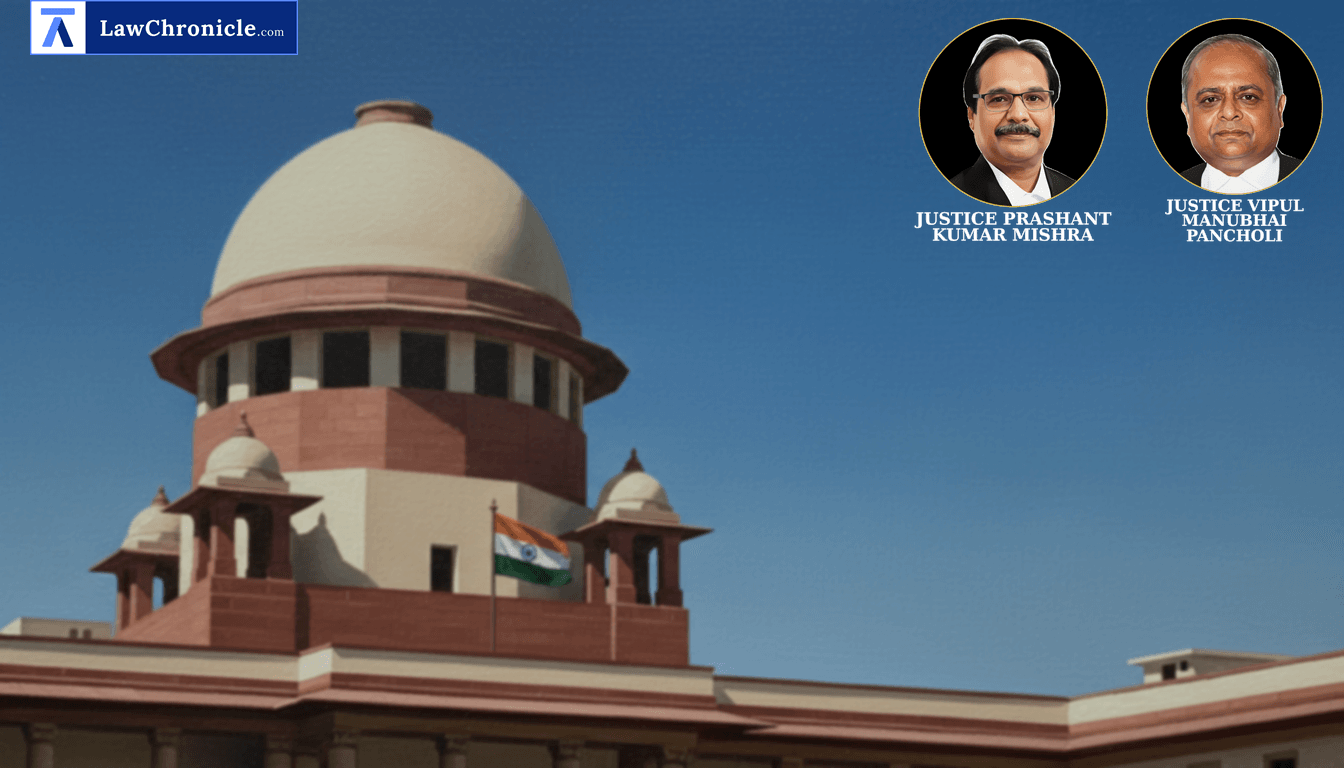
A bench of Justices Prashant Kumar Mishra and Vipul M. Pancholi heard the criminal appeal arising from a challenge to the conviction under Section 302 IPC. The appeal arose from the High Court of Chhattisgarh’s judgment dated 19.07.2017, which had affirmed the Sessions Court’s conviction and life sentence of the appellant for the murder of Dhumman @ Surjeet Bhattacharya.
The Court allowed the appeal and set aside the conviction and sentence imposed on the appellant, Gautam Satnami, observing that the prosecution’s circumstantial case did not discharge the burden of proof beyond a reasonable doubt. The Court noted that the trial court itself had recorded that “the case of prosecution is based on the circumstantial evidence and there is no direct evidence in the case.” It also relied on the constitutional remit under Article 136 to correct manifest injustice and to take note of “striking features in the evidence which demolish the prosecution’s case.”
The Court, in its reasoning, observed: “Here, the prosecution’s case fails at the threshold itself, as each circumstance from which guilt is to be inferred is not firmly and fully established. By way of example, it cannot even be said with certainty that the driving licence was recovered from the spot in the manner alleged, let alone that its presence there was consistent only with the hypothesis of guilt. The evidence on record may raise suspicion, but, suspicion, however strong, cannot take the place of proof. Our considered opinion is that the appellant, like accused No. 2 (Dwarika Jangde), deserves the benefit of doubt.” Consequently, the appellant’s acquittal was directed and his bail bonds, already granted by this Court on 22.04.2025, were ordered to stand discharged.
Background:
The victim, who lived alone in village Dhourabhata and worked selling lentils, was found dead on 15.01.2011 with multiple incised injuries and skull fractures; post-mortem opined death due to shock from excessive haemorrhage occurring the previous evening. The prosecution relied on a prior enmity, an alleged quarrel and threat on 13.01.2011, a “last-seen” account by a witness (Raja Ram) who claimed to have seen the appellant near the deceased’s house at night carrying an axe, and subsequent recoveries said to have been made following disclosure statements under Section 27 of the Evidence Act. Forensic reports confirmed the presence of human blood on seized axes and clothes but did not conclusively link the blood group or hair to the deceased or conclusively establish that those weapons caused the injuries.
At trial, the Sessions Judge convicted the appellant and acquitted the co-accused. On appeal, the High Court affirmed the conviction. Before this Court, counsel for the appellant urged that material contradictions, hostile or non-corroborative testimony of key witnesses, and irregularities in seizure memos and the production of the driving licence undermined the prosecution’s case. The State contended that the chain of circumstantial evidence - enmity, threat, presence at the scene, recoveries, FSL findings and non-explanation under Section 313 Cr.PC established guilt.
The Supreme Court applied established principles governing conviction on circumstantial evidence, including the five guidelines in Sharad Birdhi Chand Sarda, and analyzed each circumstance relied upon by the prosecution. The Court found the last-seen identification unreliable given darkness and inconsistencies about lighting at the scene, noted that witnesses to disclosures and seizures turned hostile or gave contradictory accounts, and emphasised the absence of independent forensic linkage between the weapons and the deceased’s injuries. The Court further observed parity with the acquitted co-accused and held that, cumulatively, the circumstances did not form an unbroken chain excluding reasonable doubt. The appeal was allowed, the conviction set aside, and the appellant acquitted. Pending applications were disposed of.
Case Details:
Case No.: CRIMINAL APPEAL NO. 1782 OF 2026
NeutralCitation: 2026 INSC 325
Case Title: Gautam Satnami v. State of Chhattisgarh
Appearances:
For the Petitioner(s): Mr. A Sirajudeen, Senior Counsel
For the Respondent(s): Mr. Praneet Pranav, Deputy Advocate General, Chhattisgarh
Source: 2026 CaseBase(SC) 292
Similar Articles




 Breaking News


