


Convictions Quashed as Gujarat High Court Finds Circumstantial Chain Incomplete in Murder Trial
 Copy Link
 Share
 Save
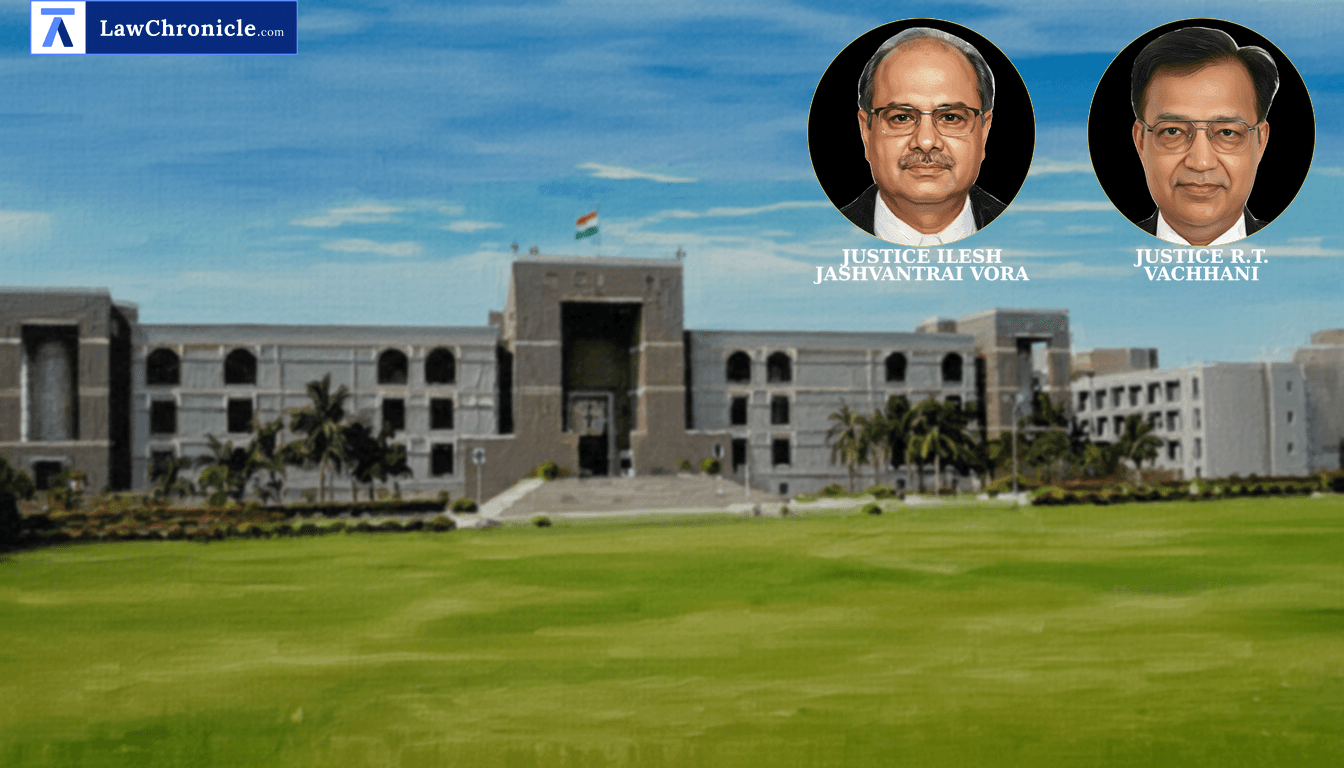
A bench of Justice Ilesh J. Vora and Justice R. T. Vachhani heard appeals by two accused challenging their conviction and life sentence under Sections 302 and 34 IPC arising from Sessions Case No. 52 of 2015, contending that the prosecution relied on incomplete circumstantial evidence and failed to examine key witnesses.
The High Court allowed the appeals, quashed the judgment and order of conviction dated 30.11.2016 and acquitted the appellants. The court held that the prosecution’s case rested solely on circumstantial evidence and that the “chain” required to exclude every hypothesis of innocence was not established. The Court, in its reasoning, observed: “In view of the settled law that one must look for a complete chain of circumstances and not on snapped and scattered links which do not make a complete sequence. The circumstances from which the conclusion of guilt is drawn should be fully proved, and such circumstances must be conclusive in nature. Moreover, all the circumstances should be complete, and there should be no gap left in the chain of evidence; in the present case, the chain is not completed.” The bench also noted that several witnesses gave inconsistent or hearsay evidence and that a prime witness (PW-24) who was alleged to have last seen the deceased with the accused was not examined “for the reasons best known to the prosecution.”
Background The appeals arose from the murder of Ashok, whose dead body was found near his motorcycle on 13 October 2014. The complainant and other factory colleagues alleged that six persons had been with the deceased on the preceding evening and named suspects; an FIR (CR No.119 of 2014) was registered. The police charge-sheeted the accused and the Sessions Court convicted both appellants after hearing prosecution witnesses and applying Section 313 CrPC. The accused argued before the High Court that the prosecution failed to prove motive, last-seen together and recovery of the weapon — the three critical links in circumstantial cases — and that identification and TI parade were not conducted. They also contended that some evidence was based on statements of co-accused and on hearsay.
The High Court examined oral and documentary evidence and found pervasive weaknesses: several witnesses admitted to having only hearsay knowledge, one witness turned hostile, and the prosecution did not examine PW-24 who was cited in the charge-sheet as having last seen the deceased alive. The court applied settled precedents, including Sharad Birdhichand Sarda v. State of Maharashtra and subsequent Supreme Court decisions, and relied on the principle that circumstantial evidence must form a complete and conclusive chain. The bench observed that the prosecution had not proved place of occurrence, call records or any independent material linking the accused to the crime and that arrests and the FIR appeared to be founded on suspicion. In light of these defects, the court found that the prosecution failed to exclude reasonable hypotheses consistent with the appellants’ innocence.
The High Court allowed the appeals, quashed the conviction and sentence, acquitted the appellants, ordered their immediate release if not required in any other case, discharged bail bonds and directed record remittance to the trial court.
Case Details: Case No.: R/CRIMINAL APPEAL (AGAINST CONVICTION) NO. 478 of 2017 with R/CRIMINAL APPEAL NO. 926 of 2017 (R/CR.A/478/2017) Case Title: Ranchhod @ Raso Dayalbhai Kanani Versus State of Gujarat Appearances: For the Petitioner(s): Mr. Pratik Barot with Ms. Alpa J. Dave (for appellant in CR.A.478/2017); Mr. Tatvadeep Jani (for appellant in CR.A.926/2017) For the Respondent(s): Mr. Bhargav Pandya, APP; Harshadkumar D. Panchal; Yuvraj B. Solanki
Date of Judgment: 10/02/2026 Coram: Hon’ble Mr. Justice Ilesh J. Vora and Hon’ble Mr. Justice R. T. Vachhani (per R. T. Vachhani, J.)
Similar Articles

 Breaking News


