


Scope of Referral Court limited to Prima Facie existence of Arbitral Agreement: Supreme Court
 Copy Link
 Share
 Save
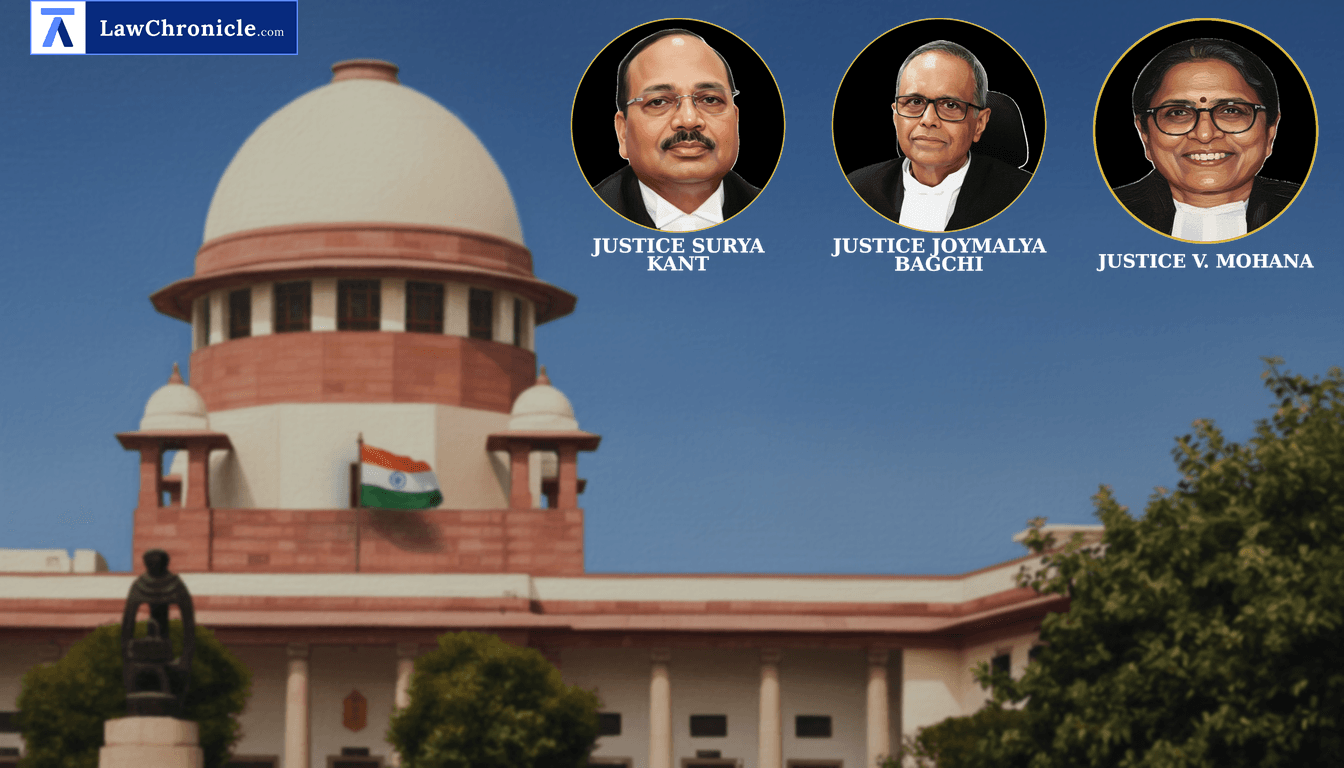
Refusing to let parallel proceedings under a 'mother agreement' stall independent arbitration clauses, the Supreme Court ruled that referral courts must restrict their inquiry strictly to the prima facie existence of an arbitration agreement.
A three-judge bench comprising Chief Justice Surya Kant, Justice Joymalya Bagchi, and Justice V. Mohana heard the petitions filed under Section 11(6-A) of the Arbitration and Conciliation Act, 1996 seeking the appointment of a sole arbitrator.
Key Takeaways
- Strict Scope of Minimal Judicial Intervention: Referral courts are barred from deep-diving into contractual overlaps or arbitrability, leaving complex multi-agreement dynamics to arbitrators.
- Supremacy of Independent Dispute Clauses: Distinct agreements containing explicit integration or merger clauses operate independently of prior mother agreements.
- Joinder of Non-Signatories Left to Arbitrators: Allegations against non-signatory subsidiaries created in breach of non-compete covenants must be adjudicated by the arbitral tribunal.
Minimal Judicial Intervention in Arbitration
The Supreme Court observed that the License Agreement, Joint Venture Agreement (JVA), and Memorandum of Understanding (MoU) prima facie operated in different fields. The Bench noted that the dispute resolution clauses within the JVA and MoU independently governed the claims at hand, as both contracts contained explicit merger clauses overriding prior agreements.
The Apex Court observed that “Section 11(6-A) of the 1996 Act prescribes the principle of minimal judicial intervention by restricting the scope of inquiry to prima facie existence of the arbitration agreement. Once the prima facie existence of an arbitration agreement is adduced before the Referral Court, it ought to appoint an arbitrator and refer the parties to arbitration.” Addressing the respondents' contention that foreign seat arbitration under the License Agreement should override Indian proceedings, the bench clarified that such jurisdiction and overlapping scope arguments fall strictly within the domain of the arbitrator. Similarly, whether a non-signatory entity is bound by the arbitration agreement remains a contentious issue to be relegated to arbitral adjudication.
The Supreme Court accordingly appointed Justice Ramesh Deokinandan Dhanuka, Former Chief Justice of Bombay High Court as the Sole Arbitrator.
Ratio
Under Section 11(6-A) of the Arbitration and Conciliation Act, 1996, the referral court's jurisdiction is strictly confined to examining the prima facie existence of an arbitration agreement. Contentions regarding overlapping claims under prior agreements or the arbitrability of non-signatory subsidiary entities cannot serve as grounds to refuse referral at the threshold and must be relegated to the arbitral tribunal.
Background
The dispute originated from a technical collaboration between Shubham Equipment Private Limited (SEPL) and South Korea-based Rothwell Water Company Limited (RWCL). Following an initial License Agreement in 2019, the parties entered into a Joint Venture Agreement (JVA) in 2021 to set up a joint venture company in India, and subsequently executed an MoU in 2023 for liaison and service operations.
SEPL issued a notice of termination of the JVA and invoked arbitration, alleging that RWCL incorporated a wholly-owned subsidiary, Rothwell Business International Private Limited (RBIPL), to unfairly compete with the JV entity in violation of a non-compete clause. SEPL also claimed outstanding dues under the MoU. RWCL resisted the arbitration petitions filed under Section 11 of the Arbitration and Conciliation Act, 1996, contending that the JVA and MoU were subordinate to the 2019 License Agreement, which mandated foreign arbitration in Seoul under Korean Law, and that the non-signatory entity could not be bound.
After court-monitored mediation failed, the Supreme Court evaluated the matter relying on In re: Interplay Between Arbitration Agreements under the Arbitration and Conciliation Act, 1996 and the Indian Stamp Act, 1899 to reinforce the limited scope of referral courts. Concluding that the JVA and MoU contained valid, independent arbitration agreements providing for a seat in Mumbai, the Supreme Court allowed the petitions and appointed a sole arbitrator.
Case Details:
Case No.: Arbitration Petition (Civil) No.7 of 2025
Neutral Citation: 2026 INSC 1098
Case Title: Shubham Equipment Private Limited & Anr. v. Rothwell Water Company Limited & Ors.
Appearances:
For the Petitioner(s): Mr. C.U. Singh, Senior Advocate
For the Respondent(s): Mr. Sudhanshu Choudhari, Senior Advocate
Source: 2026 CaseBase(SC) 8248
Similar Articles
 Breaking News


